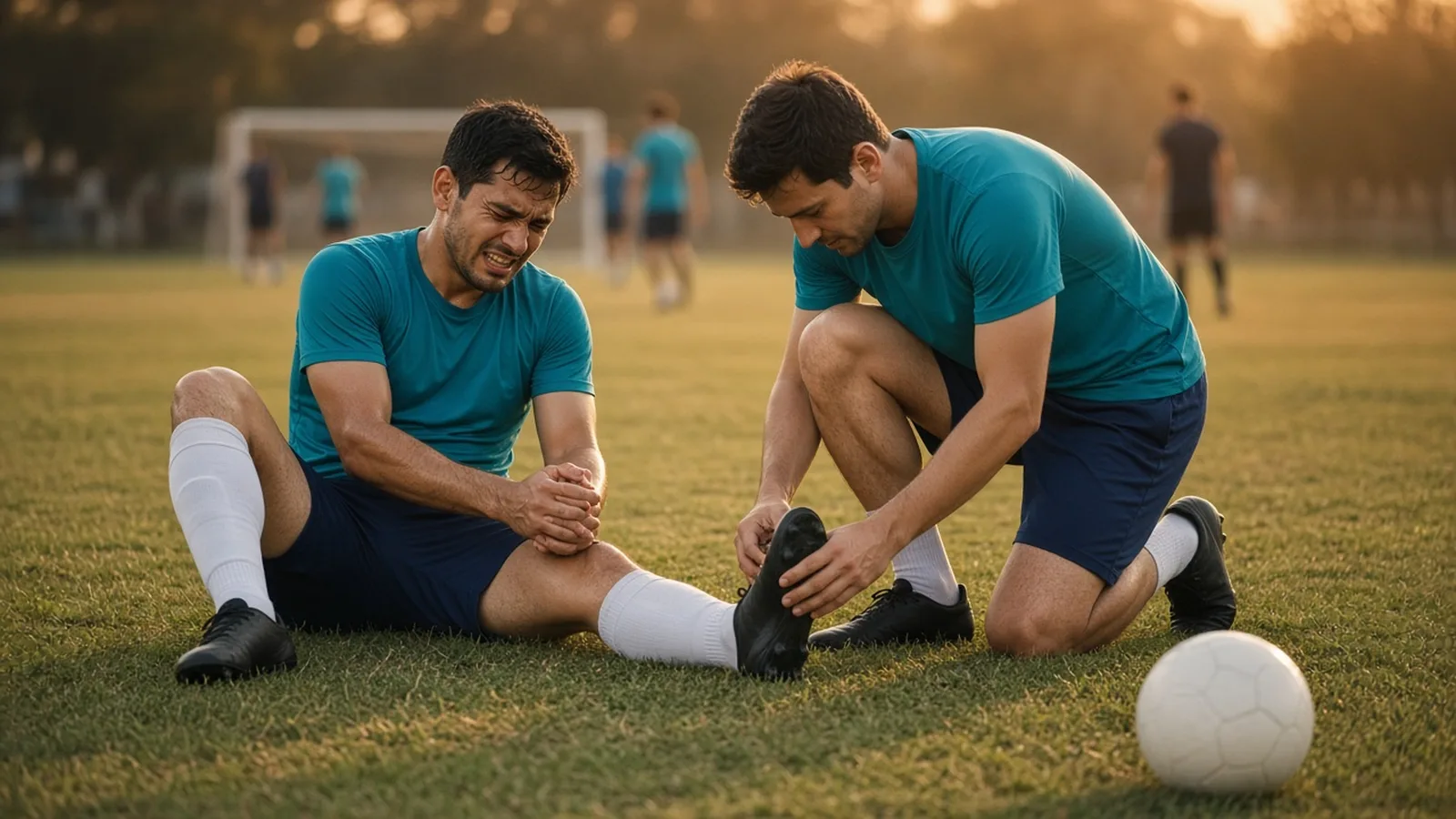
Why do footballers cramp? And why always in the 80th minute, right when the game's on the line?
Short version: cramp is mostly a tired-muscle problem, and water is only part of the story. Below is what the research says, how players stop a cramp, what they actually use (pickle juice included) and how to prevent the next one. (Quick heads-up: we're an independent LactiGo affiliate, so we earn a commission if you buy through our links or use code LactiGoGel. It doesn't cost you anything extra.)
The Short Answer
What a Cramp Actually Is
A cramp is a sudden, painful tightening of a muscle that won't let go, usually the calf, hamstring or quad. Researchers call it an exercise-associated muscle cramp (EAMC), meaning it happens during or right after exercise.
The soreness that builds a day or two after a game is different. That's DOMS. A cramp hits in seconds and usually passes in minutes.
Why Do Footballers Cramp? The Two Main Theories
For most of the last century, the go-to explanation was "you're dehydrated and low on salt." The research has moved on. There are two leading theories, and a 2018 review comparing them concluded the neuromuscular one "may prevail" (Giuriato et al., 2018).
The neuromuscular fatigue theory
This one came out of the University of Cape Town. In 1997, Martin Schwellnus and colleagues proposed that a fatigued muscle's reflexes go out of balance (Schwellnus et al., 1997). The sensors that tell it to contract (muscle spindles) fire more, the ones that tell it to relax (Golgi tendon organs) fire less, and the muscle gets stuck "on."
The field evidence fits:
- In 72 ultra-distance runners, those who cramped weren't more dehydrated or low on electrolytes (Schwellnus et al., 2004).
- In 210 Ironman triathletes, the only independent predictors were racing faster and a history of cramping, not weight loss or blood sodium (Schwellnus et al., 2011).
It also explains why stretching works: it loads the tendon sensors, which tell the muscle to switch off.
The dehydration and electrolyte theory
The older theory says heavy sweating drains fluid and sodium until nerves misfire. It isn't dead. A 2019 review says some cramps do seem linked to water and salt balance, others to fatigue, so there are probably different types of cramp and no single fix (Maughan & Shirreffs, 2019).
A 2022 evidence review agrees: cramps come from a mix of factors, and prevention should fit the player rather than generic "drink more" advice (Miller et al., 2022).
What Makes Cramp More Likely in a Football Match
Football is 90 minutes (sometimes 120) of sprints, jumps and changes of direction, exactly the work that tires muscles out.
| Factor | What the evidence says |
|---|---|
| Fatigue late in the match | Across 85 semi-elite matches in China, all 38 cramps that forced a substitution came in the second half, 42% between 60 and 75 minutes, often on jumping and landing (Wu et al., 2026). |
| Extra time | In a 120-minute match, sprint speed fell 11% in extra time and about 75% of muscle fibers were low on glycogen (Mohr et al., 2023). Cramps weren't counted. |
| Intensity vs fitness | Faster pace predicted cramp (Schwellnus et al., 2011). Think preseason, or a player back from injury playing 90 minutes. |
| Previous cramps | Cramped before? You're more likely to cramp again (same study). |
| Heat and humidity | Cramps are a listed sign of heat exhaustion (NHS), and heat speeds up fatigue. |
| Heavy, salty sweat | Cramp-prone American college football players lost about twice the sweat sodium of teammates (Stofan et al., 2005). Across 350 athletes in 11 sports, sweat only predicted cramping in American football (Miller et al., 2020). |
Click to enlarge
So why do soccer players cramp so much? A long match, lots of explosive efforts, tired legs in the last half hour, and often heat on top.
How to Stop Cramp on the Pitch
The best-supported fix is simple: gently stretch the cramping muscle and hold it until it eases (Miller et al., 2022).
- Stop and signal. Don't try to run it off.
- Stretch the muscle that's cramping, gently (see the table).
- Hold until it lets go, usually seconds to a couple of minutes. Ease off if it hurts more.
- Massage lightly if it helps. Standing on the leg can help too (NHS).
- Sip something: water, a sports drink or pickle juice (more below).
- Get up slowly. Walk and jog before you sprint again.
| Cramping muscle | Gentle stretch |
|---|---|
| Calf | Straighten the knee and have a teammate gently push the toes toward your shin. |
| Hamstring | Lie on your back and have the straight leg lifted slowly. |
| Quad | Bend the knee and bring the heel toward your backside, keeping the knees together. |
| Foot | Pull the toes back toward the shin. |
Click to enlarge
Cramp keeps coming back? Your body is telling you it's done for the day. Coming off is the smart call.
What Do Footballers Use for Cramp?
Walk past any sideline and you'll see a bit of everything. Here's how much evidence is behind each.
| What players use | What the evidence shows |
|---|---|
| Stretching | The standard first-line treatment for an acute cramp (Miller et al., 2022). |
| Pickle juice | In dehydrated men, about 1 mL per kg (roughly 75 mL) cut electrically induced toe-muscle cramps from about 134 to 85 seconds compared with water, before blood electrolytes changed (Miller et al., 2010). Likely a reflex from the mouth and throat. |
| "Cramp shots" (TRP drinks) | Spicy drinks that activate TRP channels in the mouth. In 39 people, one eased lab-induced calf cramps (Craighead et al., 2017). Lab cramps, not match play. |
| Electrolytes and sports drinks | Useful for replacing sweat losses in long, hot matches, where some cramps seem linked to water and salt balance (Maughan & Shirreffs, 2019). More prevention than a mid-cramp fix. |
| Salt (tablets or salty snacks) | Can help replace sodium for salty sweaters in the heat (Stofan et al., 2005). Not everyone needs it. |
| Magnesium | Little evidence for exercise cramps. See magnesium for muscle cramps. |
| Massage and tape | Massage may ease the moment (NHS). We found no good trials showing tape prevents cramp. |
One catch: a shot of pickle juice doesn't rehydrate you. In a follow-up, it didn't change blood sodium or potassium within an hour (Miller, 2014). It's a quick reflex, not a refill. And as the 2019 review puts it, of all the folk remedies, "none are consistently effective" (Maughan & Shirreffs, 2019).
How to Prevent Cramp in Football
Since fatigue is the main driver, the best prevention is being fit enough for the minutes you play.
- Build match fitness gradually. Preseason and comebacks are high-risk, so increase minutes step by step.
- Warm up properly, with some sprints and jumps.
- Arrive hydrated. Drink through the day before kick-off rather than chugging at the whistle.
- Plan for heat. Use every drinks break, and add electrolytes on hot days.
- Know if you're a salty sweater. White marks on your kit are a hint. Ask a sports dietitian about sodium.
- Fuel for 90 minutes. Low glycogen goes with late-game fatigue (Mohr et al., 2023), so eat carbs before the game.
- Know your history. Cramp often? Tell your coach. A planned substitution beats a forced one.
- Recover between games. Sleep and food come first.
Click to enlarge
Heat, Humidity and Winter Pitches
Where you play changes the risk.
- Nigeria and Kenya: afternoon kick-offs in the heat mean bigger sweat losses and faster fatigue. Take it seriously if a cramp comes with dizziness or nausea.
- Singapore: humidity makes it harder for sweat to cool you, so you heat up faster.
- South Africa: summer football in humid Durban is a heat game.
- UK winter: cold doesn't make you cramp-proof. Heavy, muddy pitches make every sprint harder, and tired legs cramp in any weather.
The FIFA World Cup 2026 used three-minute hydration breaks in each half of every match (FIFA). FIFPRO, the players' union, recommends cooling breaks when the heat index (WBGT) passes 26°C (FIFPRO).
When to See a Doctor
Most cramps are harmless and gone in minutes. The NHS says to see a GP (doctor) if:
- a cramp lasts longer than 10 minutes
- you also have numbness or swelling in the leg
- cramps keep disturbing your sleep
Some medicines, like statins and diuretics, can cause cramps too, so mention any new medication.
Where Carnosine Gel Fits (Honestly)
Let's be straight with you: no study has tested carnosine gel for cramps. Not one. So we can't say it prevents or stops them, and be wary of anyone who does.
What has been studied is performance. Small studies in soccer and rugby sevens players reported some sprint benefits (the soccer one had no placebo), and two cycling trials found none (Sharpe & Macias, 2016; Beaven et al., 2025). None measured cramps. Our review of every carnosine gel study grades them all.
So where does it fit? Some athletes simply include a carnosine gel like LactiGo in their pre-match routine, alongside the warm-up, fluids and fueling above. LactiGo's directions say about 30 to 45 minutes before activity (put it on while you're changing). See how to use LactiGo. It contains magnesium too, but that isn't evidence it helps cramps.
See LactiGo Regular, Menthol and Go Packets →
Australian readers: ordering information only. LactiGo is not TGA registered or approved, and we make no product claims for Australian audiences. The store ships to Australia for US$25 flat. UK, Nigeria, Kenya, South Africa and Singapore: direct shipping is coming soon. See where to buy.
The Bottom Line
Footballers cramp mostly because their muscles are tired, which is why it shows up late in games and in players who've cramped before. Heat and salty sweat can add to it.
Stretch it out when it hits. Get fit for the minutes you play, drink and fuel early, and have a plan for hot days. Pickle juice might shorten a cramp, but it won't replace any of that.
Adding a carnosine gel to your pre-match routine? Go in with honest expectations: it's part of how you prepare, not a cramp fix. Add carnosine gel to your pre-match routine →
Curious about carnosine gel?
LactiGo is the topical carnosine gel we write about most on this site. See the ingredients, sizes and current prices on the official LactiGo shop.
Get LactiGoAffiliate disclosure: CarnosineGel.com is an independent LactiGo affiliate and earns a commission if you buy through links on this page, at no extra cost to you.
Frequently Asked Questions
Why do footballers cramp so much?
Ninety minutes of sprints and jumps tires muscles out, and the leading theory is that fatigue upsets the reflexes that control a muscle. Heat, heavy sweating, low fitness and past cramps make it more likely.
How do you stop cramp in football quickly?
Stop and gently stretch the cramping muscle until it eases. For a calf cramp, straighten the knee and pull the toes toward the shin. Walk and jog before you sprint again.
What do footballers use for cramp?
Mostly stretching, plus water, sports drinks, pickle juice or spicy "cramp shots." Some salty sweaters add salt in the heat. None works every time.
Does pickle juice work for cramp?
In one lab study, about 75 mL ended electrically induced cramps around 49 seconds sooner than water, before blood electrolytes changed. It seems to be a reflex, not rehydration, and the cramps were lab-induced, not from match play.
How do you prevent cramp in football?
Build match fitness gradually, warm up, arrive hydrated, fuel with carbs, add electrolytes on hot days and know your cramp history. Experts recommend tailoring prevention to the player.
Does carnosine gel or LactiGo help with cramp?
No study has tested carnosine gel for cramps, so we can't say it does. Some athletes include it in a pre-match routine, about 30 to 45 minutes before activity per LactiGo's directions.
Can I buy LactiGo in Nigeria, Kenya, South Africa, the UK or Singapore?
Not directly yet. The official store ships to the US, Canada and Australia (US$25 flat to Australia). Direct shipping elsewhere is coming soon.
References
1. Schwellnus MP, Derman EW, Noakes TD. Aetiology of skeletal muscle "cramps" during exercise: a novel hypothesis. J Sports Sci. 1997;15(3):277–285. PubMed 9232553
2. Schwellnus MP, Nicol J, Laubscher R, Noakes TD. Serum electrolyte concentrations and hydration status are not associated with exercise associated muscle cramping (EAMC) in distance runners. Br J Sports Med. 2004;38(4):488–492. PubMed 15273192
3. Schwellnus MP, Drew N, Collins M. Increased running speed and previous cramps rather than dehydration or serum sodium changes predict exercise-associated muscle cramping: a prospective cohort study in 210 Ironman triathletes. Br J Sports Med. 2011;45(8):650–656. PubMed 21148567
4. Giuriato G, Pedrinolla A, Schena F, Venturelli M. Muscle cramps: a comparison of the two-leading hypothesis. J Electromyogr Kinesiol. 2018;41:89–95. PubMed 29857264
5. Maughan RJ, Shirreffs SM. Muscle cramping during exercise: causes, solutions, and questions remaining. Sports Med. 2019;49(Suppl 2):115–124. PubMed 31696455
6. Miller KC, McDermott BP, Yeargin SW, Fiol A, Schwellnus MP. An evidence-based review of the pathophysiology, treatment, and prevention of exercise-associated muscle cramps. J Athl Train. 2022;57(1):5–15. PubMed 34185846
7. Wu Q, Zhang J, Hou W, Ding Q, Yu J. Situational characteristics of lower limb muscle cramps in male semi-elite football players: a video-based descriptive case series. BMC Sports Sci Med Rehabil. 2026. doi:10.1186/s13102-026-01938-9
8. Mohr M, Ermidis G, Jamurtas AZ, et al. Extended match time exacerbates fatigue and impacts physiological responses in male soccer players. Med Sci Sports Exerc. 2023;55(1):80–92. doi:10.1249/MSS.0000000000003021
9. Stofan JR, Zachwieja JJ, Horswill CA, et al. Sweat and sodium losses in NCAA football players: a precursor to heat cramps? Int J Sport Nutr Exerc Metab. 2005;15(6):641–652. PubMed 16521848
10. Miller KC, McDermott BP, Yeargin SW. Sweat characteristics of cramp-prone and cramp-resistant athletes. Int J Sport Nutr Exerc Metab. 2020;30(3):218–228. PubMed 32335535
11. Miller KC, Mack GW, Knight KL, et al. Reflex inhibition of electrically induced muscle cramps in hypohydrated humans. Med Sci Sports Exerc. 2010;42(5):953–961. PubMed 19997012
12. Miller KC. Electrolyte and plasma responses after pickle juice, mustard, and deionized water ingestion in dehydrated humans. J Athl Train. 2014;49(3):360–367. PubMed 24955622
13. Craighead DH, Shank SW, Gottschall JS, et al. Ingestion of transient receptor potential channel agonists attenuates exercise-induced muscle cramps. Muscle Nerve. 2017;56(3):379–385. PubMed 28192854
14. NHS. Leg cramps and Heat exhaustion and heatstroke, read October 10, 2026.
15. FIFA. Players to benefit from hydration breaks at FIFA World Cup 2026.
16. FIFPRO. Guidelines and mitigation strategies for hot conditions in professional football.
17. Sharpe TM, Macias CJ. Evaluation of the efficacy of Lactigo topical gel as an ergogenic aid. JEPonline. 2016;19(3):15–23: https://www.asep.org/asep/asep/JEPonlineJUNE2016_Sharpe.pdf
18. Beaven CM, James C, McMaster DT, Brockelbank N. Topical carnosine gel improves intermittent high-intensity exercise performance in world-class rugby sevens players. J Int Soc Sports Nutr. 2025;22(1):2550311. PubMed 40859880
19. LactiGo. Customer help FAQ and directions, read October 10, 2026.