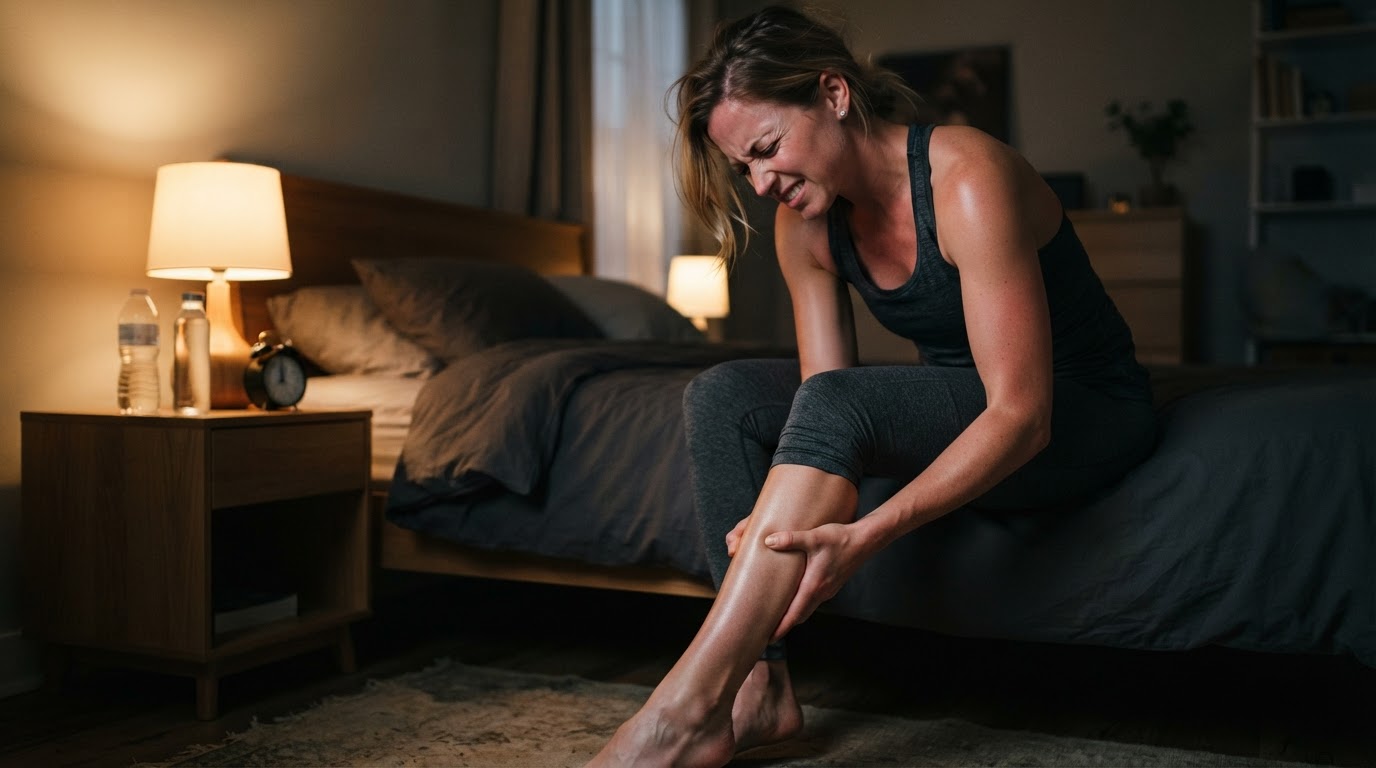
Quick answer: Delayed onset muscle soreness (DOMS) is the aching, tenderness, and stiffness that develops after unfamiliar or demanding exercise. It usually begins 12–24 hours after a workout, feels strongest 24–72 hours afterward, and improves within three to five days. Severe pain, major swelling, profound weakness, or dark urine is not typical DOMS and needs prompt medical attention.
You finish a hard workout feeling tired but capable. The next morning, your legs are stiff. By the second day, stairs feel like a personal challenge. That delayed pattern—not necessarily pain during the workout—is the hallmark of DOMS.
DOMS is common after a new exercise, a sudden increase in training volume, or movements that load a muscle as it lengthens. It is usually temporary and self-limiting. However, not every pain after exercise is DOMS, and soreness is not proof that a workout was productive.
This guide explains the normal DOMS timeline, what is happening in sore muscle, which recovery methods have useful evidence, and when post-workout pain deserves medical evaluation.
Important: This article is educational and is not a diagnosis. Seek urgent medical care for severe or rapidly worsening pain, substantial swelling, marked weakness, or tea- or cola-colored urine after exercise.
Table of Contents
- What is DOMS?
- How long does DOMS last?
- Why is soreness worse on day two?
- What causes DOMS?
- DOMS symptoms
- DOMS vs. muscle strain
- What helps DOMS?
- Can you exercise with DOMS?
- How to reduce future DOMS
- When to seek medical care
- Key takeaways
What Is DOMS?
DOMS stands for delayed onset muscle soreness. It describes muscle discomfort that appears hours after strenuous or unfamiliar physical activity rather than during the activity itself.
DOMS often includes:
- a dull or aching sensation in the muscles you trained;
- tenderness when the muscle is pressed;
- stiffness after sitting or resting;
- discomfort when the muscle contracts or stretches;
- temporarily reduced range of motion; and
- a short-term decrease in strength or athletic performance.
The soreness is especially common after eccentric contractions, which occur when a working muscle produces force while lengthening. Examples include lowering a dumbbell, descending stairs, running downhill, lowering into a squat, or controlling the return phase of a calf raise.

Eccentric actions—such as controlling the lowering phase of a split squat—commonly produce DOMS when the load or movement is unfamiliar.
DOMS can happen to beginners and experienced athletes. Training status helps, but a well-trained person can still become sore after adding an unfamiliar movement, substantially increasing volume, or returning after time away.
DOMS is not a scorecard. A workout can improve strength, endurance, skill, or muscle size without causing significant soreness. Chasing severe DOMS can interfere with training quality instead of improving it.
How Long Does DOMS Last?
For most people, DOMS lasts three to five days. It commonly begins 12–24 hours after exercise and is most noticeable between 24 and 72 hours. Mild residual tenderness can sometimes persist for up to a week after an unusually demanding or unfamiliar session.
The Typical DOMS Recovery Timeline
| Time after exercise | What you may notice | Practical response |
|---|---|---|
| 0–12 hours | Normal fatigue or an immediate "worked" feeling; true DOMS may not be present yet | Cool down, eat normally, rehydrate, and sleep |
| 12–24 hours | Stiffness or tenderness begins | Keep moving gently and assess whether pain is diffuse or sharply localized |
| 24–72 hours | Soreness often peaks; stairs, sitting down, or reaching may feel harder | Reduce load on the affected muscles; use symptom-relief strategies if needed |
| 3–5 days | Symptoms should be clearly improving | Gradually return to normal training as motion and strength normalize |
| 5–7 days | Mild soreness may remain after a very unfamiliar or high-volume session | Persistent, unchanged, or worsening symptoms merit closer evaluation |
Your timeline may vary with the exercise, training volume, prior exposure, age, sleep, overall recovery, and individual sensitivity. The most important pattern is not the exact number of hours—it is progressive improvement.
Can DOMS Last a Week?
It can, particularly after a large jump in eccentric volume or a new activity. But soreness that remains severe, is not improving, or lasts beyond seven days should not automatically be labeled DOMS. A muscle strain, tendon problem, joint injury, illness, medication effect, or another cause may need to be considered by a healthcare professional.
Why Is DOMS Often Worse on the Second Day?
DOMS is delayed because the soreness is not simply leftover discomfort from the workout. Unfamiliar mechanical loading initiates a series of local tissue and nervous-system responses that develop over time. Changes associated with exercise-induced muscle damage, inflammatory signaling, swelling, and increased sensitivity of pain-sensing nerve endings can make the area feel more tender during the next one to three days.
That is why a hard session on Monday may feel manageable on Tuesday morning but much more noticeable on Tuesday evening or Wednesday.
This delayed peak also explains why "I felt fine right after" does not necessarily predict how you will feel 36 hours later.
What Causes DOMS?
DOMS is best understood as a multifactorial response to unfamiliar or strenuous loading, not as one simple event.
Exercise—especially eccentric exercise—can produce microscopic structural disruption within muscle and surrounding connective tissue. That loading is followed by biochemical and inflammatory responses and sensitization of nociceptors, the nerve endings involved in detecting potentially harmful stimuli. Together, those processes contribute to tenderness, stiffness, and pain with movement or pressure.
Researchers continue to refine the exact mechanism. For that reason, saying DOMS is caused only by "tiny muscle tears" is an oversimplification. Microscopic tissue disruption can be part of exercise-induced muscle damage, but soreness intensity does not perfectly track the amount of structural damage.
Is DOMS Caused by Lactic Acid Buildup?
No. Studies have long shown that post-exercise blood lactate does not explain soreness that develops one or two days later. Lactate produced during intense exercise is processed far sooner than the typical DOMS peak.
The burning you feel during a hard set and the aching you feel the next day are therefore different experiences. For a deeper explanation, read how carnosine buffers acidity during high-intensity exercise.
Exercises Most Likely to Cause DOMS
DOMS is common after:
- downhill running or hiking;
- slow lowering phases in resistance training;
- lunges, squats, deadlifts, and step-downs performed at unfamiliar volume;
- sprinting, jumping, and rapid deceleration;
- returning to training after a layoff;
- a new sport or exercise class; and
- a sudden increase in sets, repetitions, load, speed, or duration.
The body often becomes less sore after repeating the same exercise exposure. This protective adaptation is known as the repeated-bout effect. It does not mean the exercise stopped working; it means your tissues adapted to that particular demand.
Common DOMS Symptoms
Typical DOMS is centered in the muscles that did unfamiliar work. Symptoms usually develop gradually and should trend toward improvement after the peak.
Normal Features of DOMS
- Diffuse aching across part or all of a trained muscle group
- Tenderness when you press the muscle
- Stiffness or reduced range of motion
- Temporary weakness or reduced power
- Discomfort when the muscle contracts or lengthens
- Symptoms that ease somewhat after gentle movement or warming up
- Onset many hours after exercise rather than a sudden painful event
Features That Are Less Typical of DOMS
- A pop, snap, or sharp pain during the activity
- Pain centered in a joint rather than a muscle
- One pinpoint area of intense pain
- Significant bruising or visible deformity
- Rapidly increasing swelling
- Numbness, tingling, or loss of function
- Pain that continues to worsen after 72 hours
- Severe symptoms that are out of proportion to the workout
DOMS vs. Muscle Strain: How to Tell the Difference
DOMS and a mild strain can overlap, so timing and symptom pattern matter more than any single sign.
| Feature | DOMS | Possible muscle strain or other injury |
|---|---|---|
| Onset | Usually develops 12–24 hours later | Often begins during the movement or soon afterward |
| Pain quality | Dull, aching, stiff, tender | Sharp, stabbing, pulling, or highly localized |
| Location | Spread through the trained muscle | Often a specific spot or one side |
| Movement | May loosen temporarily with gentle activity | May worsen consistently with a particular motion or load |
| Bruising/swelling | Major bruising is not expected | Can occur, depending on severity |
| Course | Peaks within 24–72 hours, then improves | May remain unchanged or worsen without appropriate care |
| Function | Uncomfortable but basic function is usually possible | Significant loss of strength, stability, or function may occur |
Symmetry can be a clue—for example, both quadriceps may be sore after squats—but it is not a diagnostic rule. DOMS can affect one side more than the other if technique, prior injury, or loading was uneven.
If you are uncertain, reduce or stop the aggravating activity and seek advice from a qualified healthcare professional, such as a sports medicine clinician or physical therapist.
What Helps DOMS? Evidence-Based Recovery Options
There is no instant cure that erases DOMS or repairs tissue overnight. Most strategies aim to reduce soreness, restore comfortable movement, or support normal recovery while time and adaptation do the rest.
Recovery Methods at a Glance
| Method | What the evidence suggests | Important limitation |
|---|---|---|
| Light active recovery | Can temporarily reduce discomfort and stiffness | Relief may be short-lived; hard training is not active recovery |
| Massage | Meta-analyses suggest reduced perceived soreness and fatigue | Effects vary by timing, technique, and study quality |
| Foam rolling | May modestly reduce soreness and improve range of motion | Optimal duration and pressure are not settled |
| Cold-water immersion | May reduce soreness in the first 24–96 hours in some settings | Protocols vary; frequent use after strength work may not suit every adaptation goal |
| Sleep and adequate nutrition | Support normal recovery, tissue remodeling, and training readiness | They do not guarantee DOMS will disappear quickly |
| Static stretching | Useful for flexibility when programmed appropriately | Research does not show a meaningful prevention or treatment effect for DOMS |
| Topical menthol | Can provide temporary relief of minor muscle and joint aches | Symptom relief does not prove faster tissue healing |

Gentle foam rolling may modestly reduce perceived soreness and improve comfortable range of motion.
1. Use light movement, not another hard session
Light movement may temporarily reduce stiffness, provided symptoms do not worsen and mechanics remain normal.
Walking, easy cycling, relaxed swimming, or gentle mobility may reduce the feeling of stiffness and provide temporary relief. Keep the intensity low enough that your movement remains natural and your symptoms do not worsen.
A recovery session is not a test of toughness. If you need to compensate, limp, shorten your range, or brace against pain, choose a different activity or rest the affected area.
2. Consider massage or gentle foam rolling
Massage has some of the more consistent evidence for reducing perceived DOMS, although it does not necessarily mean the muscle has biologically recovered faster. Foam rolling may also modestly reduce soreness and improve range of motion.
Use tolerable pressure. More pain is not more effective. Avoid aggressive work over a suspected tear, major swelling, bruising, or a painful joint.
3. Use cold strategically
Cold-water immersion may reduce post-exercise soreness, particularly when rapid turnaround matters, such as during a tournament or multi-day event. It is optional—not a requirement for routine recovery.
Athletes focused on long-term strength or hypertrophy should use repeated post-lifting cold exposure thoughtfully, because blunting parts of the normal exercise response may not align with every training goal. A coach or sports dietitian can help integrate recovery tools into the broader program.
4. Prioritize sleep, food, and fluids
No recovery gadget replaces basic needs. Aim for adequate sleep, eat enough total energy, and distribute high-quality protein across the day. Replace fluid lost through sweat and include carbohydrate appropriate to the volume and intensity of training.
Hydration supports normal physiological function, but drinking excessive water will not "flush out" DOMS. The soreness is not trapped lactate waiting to be washed away.
5. Use topical products for their intended purpose
Topical menthol products can create a cooling sensation and temporarily relieve minor muscle aches. According to its current DailyMed Drug Facts listing, LactiGo contains menthol 1.25% as the active ingredient; carnosine and magnesium sulfate are listed among the inactive ingredients.
If you use a topical product:
- follow the Drug Facts label;
- apply only to intact skin;
- avoid the eyes and mucous membranes;
- do not combine it with external heat unless the label specifically permits it;
- wash your hands after application; and
- stop use and seek guidance if significant irritation occurs.
Topical comfort may make gentle movement feel easier, but it should not be used to mask sharp pain or force a heavy session. Evidence for a topical gel's temporary pain-relief indication is different from evidence that it shortens the biological duration of DOMS.
6. Do not rely on stretching as a DOMS cure
Gentle stretching may feel pleasant and help you explore comfortable range of motion. However, reviews have not found meaningful evidence that pre- or post-exercise stretching prevents DOMS. Never force a sore muscle into an intense stretch.
Can You Exercise With DOMS?
Yes, you can often exercise with mild DOMS, but the appropriate choice depends on soreness severity, movement quality, and the demands of the planned session.
Use This Practical Decision Guide
Mild Soreness
You have normal movement, no sharp pain, and little or no strength loss.
Usually reasonable: Warm up, reassess, and train at a reduced load if your technique remains normal. Training another muscle group is also an option.
Moderate Soreness
Daily activities are uncomfortable, range of motion is reduced, or the muscle feels clearly weaker.
Better choice: Use light active recovery or train an unaffected area. Delay heavy, explosive, or highly technical work involving the sore muscles.
Severe Soreness
You have altered gait or mechanics, substantial weakness, major swelling, pain at rest, or symptoms out of proportion to the session.
Best response: Stop strenuous training and consider medical evaluation. Do not use pain relief to hide symptoms and push through.
DOMS can change coordination and force production. Even when the soreness itself is benign, poor mechanics during a complex lift, sprint, or change of direction can create avoidable risk.
For a deeper comparison, read active recovery vs. complete rest for muscle soreness.
How to Reduce Severe DOMS in Future Workouts
The most reliable strategy is progressive exposure.
- Introduce a new exercise with fewer sets and conservative loads.
- Increase only one major variable at a time—load, volume, speed, range, or frequency.
- Add eccentric-focused training gradually over one to two weeks.
- Resume training progressively after illness, travel, injury, or a layoff.
- Schedule adequate recovery before repeating demanding work for the same muscles.
- Track performance and movement quality, not soreness, as the main signs of a productive program.
A warm-up is valuable for readiness, movement rehearsal, and performance, but it cannot guarantee that DOMS will not occur. Likewise, a cooldown can help the body transition out of hard exercise but should not be marketed as a proven way to prevent next-day soreness.
When Should You Worry About Muscle Soreness?
Contact a healthcare professional if pain is sharply localized, worsening rather than improving, associated with significant bruising or swelling, or still limiting you after about a week.
Seek Urgent Medical Care for Possible Rhabdomyolysis
Rhabdomyolysis is a serious breakdown of muscle tissue that can injure the kidneys. The CDC advises prompt medical evaluation for signs such as:
- muscle pain, cramps, or aches that are more severe than expected;
- tea- or cola-colored urine; and
- unusual weakness, fatigue, or inability to complete normal tasks.
Not everyone with rhabdomyolysis has all three symptoms, and symptoms can appear hours or days after exertion. A blood test is needed to diagnose it. Do not assume dark urine or extreme pain is "just a really good workout."
Also seek urgent help for severe swelling, inability to use a limb, fainting, confusion, chest pain, trouble breathing, or symptoms of heat illness.
Key Takeaways
- DOMS is delayed muscle aching, tenderness, and stiffness after unfamiliar or demanding exercise.
- It typically begins 12–24 hours after activity, peaks at 24–72 hours, and improves within three to five days.
- Eccentric loading is a common trigger, but DOMS is a multifactorial response—not simply "lactic acid" or a direct measure of muscle growth.
- Light activity, massage, foam rolling, or cold-water immersion may reduce soreness, but no method instantly repairs muscle.
- Topical menthol may temporarily relieve minor aches; symptom relief should not be confused with faster healing.
- Mild DOMS may allow modified exercise. Severe soreness, altered movement, major weakness, or swelling calls for rest and closer evaluation.
- Dark urine, extreme pain, or unusual weakness after exercise requires prompt medical care.
Conclusion
So, what is DOMS and how long does it last? It is a delayed response to unfamiliar or demanding muscle loading that usually feels worst one to three days after exercise and resolves within several days.
The goal is not to eliminate every trace of soreness. It is to recognize the normal pattern, manage symptoms without masking injury, and progress training at a rate your body can adapt to. When soreness follows the expected timeline and steadily improves, patience and sensible movement are usually enough. When it is severe, localized, worsening, or accompanied by systemic warning signs, treat it as something more than routine DOMS.
Support Comfort Without Ignoring the Signal
If minor post-workout aches are making comfortable movement difficult, a label-directed topical menthol gel may provide temporary relief. Learn how LactiGo's ingredients and topical format are designed to be used, and always follow the Drug Facts directions.
Medical disclaimer: This content is for general education and does not replace diagnosis or treatment by a qualified healthcare professional. Stop exercising and seek appropriate care for severe, worsening, or unusual symptoms.
Frequently Asked Questions
What does DOMS stand for?
DOMS stands for delayed onset muscle soreness. It is the aching, stiffness, and tenderness that develops after unfamiliar or strenuous exercise, often beginning the next day rather than during the workout.
How long does DOMS usually last?
DOMS usually improves within three to five days. It commonly starts 12–24 hours after exercise and peaks between 24 and 72 hours. Mild soreness may last up to seven days after an unusually demanding session.
Why am I more sore two days after working out?
DOMS often peaks on the second day because exercise-related tissue and inflammatory responses, along with sensitization of pain-sensing nerve endings, develop over many hours. The delayed soreness is not caused by lactate remaining in the muscles.
Is DOMS caused by lactic acid?
No. Lactate is processed much sooner than the one- to three-day peak of DOMS. Delayed soreness is associated with unfamiliar mechanical loading and a complex combination of tissue, inflammatory, and pain-sensitization responses.
Does DOMS mean the workout was effective?
No. Soreness shows that a training stimulus was unfamiliar or demanding; it does not prove that the workout produced more strength, muscle growth, or fitness. Effective training can occur with little or no DOMS.
Is it safe to exercise with DOMS?
Light exercise is often reasonable with mild DOMS if movement and technique remain normal. Reduce the load or train another area when soreness limits range or strength. Do not push through sharp pain, major weakness, swelling, or altered movement.
What is the fastest way to relieve DOMS?
There is no instant cure. Light movement can provide temporary relief, and massage or foam rolling may reduce perceived soreness. Sleep, adequate food, and appropriate fluid replacement support normal recovery. Most DOMS still improves mainly with time.
Does stretching get rid of DOMS?
Static stretching has not been shown to meaningfully prevent or treat DOMS. Gentle stretching can feel good and maintain comfortable motion, but aggressive stretching of a very sore muscle may increase discomfort.
How can I tell DOMS from an injury?
DOMS usually develops gradually, affects a broader area of a trained muscle, and improves after its 24- to 72-hour peak. An injury is more likely with sudden sharp pain, a pop, one focal spot, bruising, instability, substantial swelling, or symptoms that worsen.
When is muscle soreness an emergency?
Seek prompt medical care for severe pain, rapidly increasing swelling, marked weakness, or tea- or cola-colored urine after exercise. These can be signs of rhabdomyolysis or another serious condition and should not be dismissed as routine DOMS.
External References
- Cleveland Clinic. Delayed Onset Muscle Soreness (DOMS). Medically reviewed, updated December 19, 2025. https://my.clevelandclinic.org/health/diseases/delayed-onset-muscle-soreness
- Cheung K, Hume P, Maxwell L. "Delayed onset muscle soreness: treatment strategies and performance factors." Sports Medicine. 2003;33(2):145–164. https://pubmed.ncbi.nlm.nih.gov/12617692/
- Wilke J, Behringer M. "Is 'Delayed Onset Muscle Soreness' a False Friend? The Potential Implication of the Fascial Connective Tissue in Post-Exercise Discomfort." International Journal of Molecular Sciences. 2021;22(17):9482. https://www.mdpi.com/1422-0067/22/17/9482
- Schwane JA, Johnson SR, Vandenakker CB, Armstrong RB. "Is lactic acid related to delayed-onset muscle soreness?" The Physician and Sportsmedicine. 1983;11(3):124–131. https://pubmed.ncbi.nlm.nih.gov/6829139/
- Dupuy O, Douzi W, Theurot D, Bosquet L, Dugué B. "An evidence-based approach for choosing post-exercise recovery techniques to reduce markers of muscle damage, soreness, fatigue, and inflammation." Frontiers in Physiology. 2018;9:403. https://www.ncbi.nlm.nih.gov/pmc/articles/PMC5956270/
- Guo J, Li L, Gong Y, et al. "Massage alleviates delayed onset muscle soreness after strenuous exercise: a systematic review and meta-analysis." Frontiers in Physiology. 2017;8:747. https://www.ncbi.nlm.nih.gov/pmc/articles/PMC5721254/
- Wiewelhove T, Döweling A, Schneider C, et al. "A meta-analysis of the effects of foam rolling on performance and recovery." Frontiers in Physiology. 2019;10:376. https://www.ncbi.nlm.nih.gov/pmc/articles/PMC6475381/
- Bleakley C, McDonough S, Gardner E, Baxter GD, Hopkins JT, Davison GW. "Cold-water immersion (cryotherapy) for preventing and treating muscle soreness after exercise." Cochrane Database of Systematic Reviews. 2012. https://www.cochranelibrary.com/cdsr/doi/10.1002/14651858.CD001814.pub2/full
- Centers for Disease Control and Prevention, NIOSH. Signs and Symptoms of Rhabdomyolysis. Updated January 14, 2025. https://www.cdc.gov/niosh/rhabdo/signs-symptoms/index.html
- U.S. National Library of Medicine, DailyMed. LactiGo menthol gel Drug Facts. https://dailymed.nlm.nih.gov/dailymed/fda/fdaDrugXsl.cfm?setid=4dda6ac4-d849-69a6-e063-6394a90a3c54&type=display
- Beaven CM, James C, McMaster DT, Brockelbank N. "Topical carnosine gel improves intermittent high-intensity exercise performance in world-class rugby sevens players." Journal of the International Society of Sports Nutrition. 2025;22(1). doi:10.1080/15502783.2025.2550311. https://pubmed.ncbi.nlm.nih.gov/40257500/