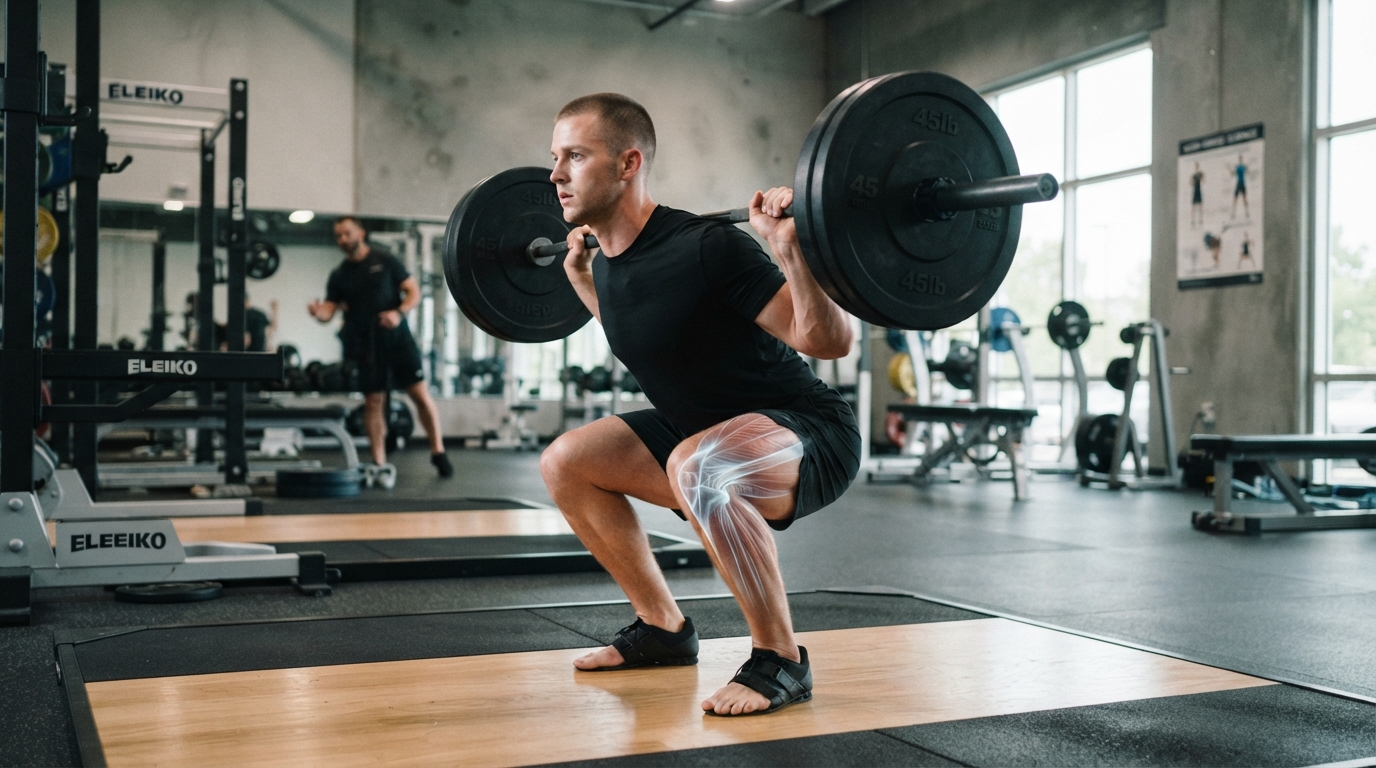
Eccentric exercise occurs when an active muscle produces force while lengthening. Lowering a dumbbell, descending stairs, running downhill, landing from a jump, and controlling the lowering phase of a squat all involve substantial eccentric muscle action.
Eccentric contractions are unusual because muscles can generate relatively high forces during active lengthening while using less metabolic energy than would be required to produce comparable force during shortening contractions. That combination—high mechanical loading with comparatively low energetic cost—helps explain why eccentric work can feel manageable during the workout yet produce substantial soreness and temporary loss of function afterward.
Unaccustomed eccentric exercise is strongly associated with exercise-induced muscle damage, a broad term describing temporary structural and functional disturbances after demanding exercise. Common observations include:
- Reduced strength
- Muscle stiffness
- Swelling
- Delayed-onset muscle soreness
- Changes in range of motion
- Increased blood concentrations of muscle proteins such as creatine kinase
But these measurements are not interchangeable.
A person can be very sore without having the largest strength loss or creatine-kinase response. In a study involving 110 men performing different volumes of maximal eccentric elbow-flexor exercise, delayed-onset soreness did not reliably reflect the magnitude of other muscle-damage indicators.
The soreness also does not come from lactate sitting in the muscle.
DOMS develops after a delay because the pain experience emerges as part of a continuing biological response involving tissue disturbance, inflammatory signaling, swelling, remodeling, and sensitization of pain-sensing nerve endings. Reviews of human exercise-induced muscle damage emphasize that the process develops over hours and days rather than occurring as a simple consequence of the metabolites present when exercise stops.
And the first exposure changes the next one.
After an unfamiliar eccentric bout, a similar workout usually causes substantially less soreness, strength loss, and disturbance the next time. This is the repeated-bout effect, one of the clearest adaptations in exercise physiology. In one human knee-extensor study, the second eccentric bout was associated with 42% less soreness, 62% lower creatine-kinase activity, and 54% less strength loss than the first.
The central lesson is:
Eccentric exercise is not uniquely valuable because it makes you sore. It is valuable because active lengthening allows muscles to handle high force—and the body rapidly adapts to that mechanical demand.
Key Takeaways
- An eccentric contraction occurs when an active muscle lengthens while producing force.
- Examples include lowering a weight, descending stairs, downhill running, landing, and decelerating.
- Eccentric contractions can generate high forces with comparatively low metabolic cost.
- Unaccustomed eccentric loading commonly produces temporary strength loss, stiffness, swelling, and DOMS.
- The mechanism is more complicated than simply creating microscopic "tears."
- Sarcomere mechanics, cytoskeletal structures, excitation-contraction coupling, calcium-related processes, inflammation, and sensory-nerve sensitization may all contribute.
- Titin is increasingly recognized as important to the mechanics of active muscle lengthening.
- DOMS is delayed and is not caused by lactate remaining in the muscle.
- Soreness does not provide a precise measurement of muscle damage.
- Creatine kinase, soreness, swelling, and strength loss can behave differently after the same exercise.
- Longer muscle lengths and unfamiliar loading can increase the challenge imposed by eccentric exercise.
- Downhill running is a classic real-world example because the quadriceps repeatedly lengthen while controlling the body during each stride.
- The same eccentric workout usually produces substantially less disruption after the body has experienced it before—the repeated-bout effect.
- More soreness does not automatically mean a better workout or more muscle growth.
- LactiGo does not create the repeated-bout effect or repair exercise-induced muscle damage. Its current U.S. label supports temporary relief of minor muscle and joint aches through menthol 1.25%.
Table of Contents
- What is an eccentric muscle contraction?
- What are everyday examples of eccentric exercise?
- Why can eccentric exercise create so much force?
- Why can it feel easier while causing more soreness later?
- What actually happens inside the muscle?
- Are "microtears" the whole explanation?
- What role do sarcomeres play?
- What is titin and why does it matter?
- What happens after the initial mechanical stress?
- Why does soreness appear the next day?
- Is inflammation responsible for DOMS?
- Why lactate is not the cause
- Is soreness the same as muscle damage?
- Why strength loss may matter more than soreness
- Why does downhill running make your quads so sore?
- Why do long muscle lengths matter?
- Why is a new exercise often worse?
- Why are you less sore the second time?
- Does more soreness mean more growth?
- How should you introduce eccentric exercise?
- How long does eccentric soreness last?
- When soreness deserves medical attention
- Where LactiGo fits
- Frequently asked questions
What Is an Eccentric Muscle Contraction?
Muscles can produce force in several ways.
Concentric Contraction
The muscle shortens while producing force.
Example:
Curling a dumbbell upward.
Isometric Contraction
The muscle produces force without a meaningful change in overall length.
Example:
Holding the dumbbell stationary halfway through the curl.
Eccentric Contraction
The active muscle lengthens while producing force.
Example:
Slowly lowering the dumbbell back down.
The muscle has not "turned off" during the lowering phase.
Your elbow flexors remain active because gravity is trying to extend the elbow faster than you want it to move.
The muscle produces force to control that lengthening.
That controlled active lengthening is eccentric muscle action.
Eccentric Does Not Mean "Relaxing"
This misconception is important.
When you lower a heavy object, the muscle may be getting longer—but it is still generating force.
If it stopped generating force entirely, the object would simply fall.
Eccentric muscle action therefore functions as a biological braking system.
It helps your body:
- Decelerate
- Absorb mechanical energy
- Control joint motion
- Lower external loads
- Land
- Descend
- Change direction
That is why eccentric contractions occur throughout normal movement.
They are not an unusual gym technique.
Everyday Examples of Eccentric Muscle Action
You perform eccentric contractions constantly.
Walking Down Stairs
Your quadriceps lengthen under load as they control knee flexion and lower your body onto the next step.
Running Downhill
Your quadriceps repeatedly absorb energy as you land and control your body's downward motion.
Lowering a Squat
The quadriceps and gluteal muscles remain active while lengthening as you descend.
Lowering a Dumbbell
The target muscle controls the external weight as gravity pulls it downward.
Landing From a Jump
Lower-body muscles lengthen under substantial load while slowing the body's momentum.
Braking During a Sprint
Muscles generate eccentric force while decelerating the limbs and controlling the body.
Hiking Down a Mountain
The descent can produce substantial eccentric stress even when cardiovascular effort feels easier than climbing uphill.
That last example explains why hikers sometimes feel surprisingly good on the descent—then wake up the next morning with extremely sore quadriceps.
Want a Deeper Look at Exercise-Induced Muscle Damage?
For readers who want to go beyond the simplified "microtear" explanation, this European College of Sport Science session examines what exercise-induced muscle damage actually means, how researchers measure it, and why eccentric contractions are such an important experimental model.
Why Can Eccentric Contractions Produce So Much Force?
Eccentric muscle mechanics are unusual.
During active lengthening, skeletal muscle can resist forces that exceed those produced during equivalent shortening contractions.
At the same time, eccentric contractions can require less metabolic energy for a given amount of force.
Contemporary reviews describe eccentric loading as capable of producing higher force and work with lower oxygen consumption and reduced metabolic cost compared with concentric muscle action.
This creates a situation that can feel counterintuitive:
The muscle can experience substantial mechanical loading without the exercise necessarily feeling as metabolically exhausting.
That is why soreness severity does not always match how "out of breath" you were during the workout.
Mechanical Stress and Metabolic Stress Are Not the Same Thing
Imagine two tasks.
Task A
Cycle uphill hard.
Your heart rate rises.
Breathing becomes difficult.
The muscles are producing substantial metabolic work.
Task B
Walk downhill for an extended period.
Cardiovascular effort may feel modest.
But your quadriceps repeatedly absorb your body's mechanical energy through eccentric contractions.
Task B can sometimes produce more next-day muscle soreness even though Task A felt harder during the activity.
That does not mean the downhill walk was physiologically more demanding in every sense.
It means:
cardiovascular demand and eccentric mechanical loading are different dimensions of exercise stress.
Why Does Eccentric Exercise Cause More Soreness Than Many Other Movements?
There is no single mechanism.
One of the most durable findings in exercise physiology is that unaccustomed eccentric exercise is particularly likely to cause exercise-induced muscle damage and DOMS.
The proposed sequence broadly involves:
1. High Mechanical Loading During Active Lengthening
Some contractile units experience substantial strain.
2. Structural and Functional Disturbance
Sarcomeres, cytoskeletal components, membranes, and excitation-contraction processes may be affected.
3. Calcium-Related and Proteolytic Processes
Disturbed calcium handling may contribute to continued cellular changes after exercise.
4. Immune and Inflammatory Responses
The tissue initiates cleanup, signaling, remodeling, and repair processes.
5. Sensory-Nerve Sensitization
Chemical and mechanical changes in the tissue can make movement and pressure painful.
This is far more accurate than saying:
"Eccentric exercise creates tiny tears and the tears hurt."
Are "Microtears" Real?
The word microtear is useful only if it is understood as shorthand.
Exercise researchers have observed structural changes after demanding eccentric exercise.
These can involve:
- Sarcomere organization
- Z-line structure
- Cytoskeletal proteins
- Membrane integrity
- Excitation-contraction coupling
- Connective tissue
But the muscle is not simply a rope that develops a collection of tiny cuts.
The biological response occurs across multiple structural levels.
And the visible or biochemical signs of disruption do not perfectly correspond with how sore the person feels.
A modern explanation is therefore:
Unaccustomed eccentric exercise can create temporary structural and functional disruption that initiates a complex recovery and adaptation response.
That captures the evidence more accurately than the popular phrase "your muscles tear and grow back stronger."
What Is a Sarcomere?
A sarcomere is one of the repeating contractile units inside skeletal-muscle fibers.
Inside each sarcomere, proteins including actin and myosin interact to generate force.
Thousands of these units operate in series and parallel throughout a muscle fiber.
The classic explanation for eccentric exercise-induced muscle damage proposes that during active lengthening, not every sarcomere experiences exactly the same strain.
Some may lengthen more than others.
Under unfamiliar high-force conditions, portions of the contractile structure may become mechanically disrupted.
Proske and colleagues have argued for many years that a mechanical event is an important early stage of eccentric exercise-induced muscle damage.
But muscle science has evolved beyond a simple actin-and-myosin-only model.
What Is Titin?
Titin is an enormous structural protein that spans a substantial portion of the sarcomere.
It has several roles, including helping:
- Maintain sarcomere organization
- Provide passive tension
- Stabilize muscle structure
- Contribute to mechanical signaling
Modern eccentric-contraction research increasingly considers titin an active participant in how muscle behaves during lengthening.
A 2023 review of eccentric mechanics describes titin as a fundamental part of a proposed three-filament model of muscle force production, supplementing the traditional focus on actin and myosin.
This matters because eccentric contractions display force behavior that classical cross-bridge theory alone does not fully explain.
Does Titin Mean the Old "Sarcomere Damage" Model Is Wrong?
Not exactly.
Muscle physiology is not replacing one cartoon explanation with another.
The older mechanical-strain framework remains influential.
What has changed is the recognition that eccentric muscle behavior involves more structures and more complex force regulation than a simple picture of actin and myosin being pulled apart.
Current models may involve interactions among:
- Cross-bridges
- Titin
- Sarcomere length
- Passive elastic structures
- Calcium
- Cytoskeletal proteins
So it is reasonable to say:
Mechanical stress is central.
It is less reasonable to say:
Scientists have identified one single molecular event that completely explains every case of eccentric muscle soreness.
They have not.
What Happens Immediately After the Eccentric Exercise?
One of the earliest measurable consequences can be a reduction in the muscle's ability to produce force.
This is important.
The most meaningful sign of exercise-induced muscle damage is often not how painful the muscle feels.
It is how much normal function has been temporarily disturbed.
Researchers commonly assess:
- Maximal voluntary strength
- Range of motion
- Muscle stiffness
- Swelling
- Blood creatine kinase
- Subjective soreness
These measures develop on different timelines.
A muscle can show an immediate strength deficit while soreness is still minimal.
That alone tells us DOMS cannot be the original event.
Why Can Strength Fall Before Soreness Peaks?
Because the mechanisms are not identical.
Immediately after demanding eccentric exercise, force production can be impaired by factors including:
- Contractile disruption
- Altered excitation-contraction coupling
- Neuromuscular changes
- Mechanical changes inside the muscle
Pain sensitivity develops later.
This separation is one reason researchers increasingly resist using soreness as a simple synonym for muscle damage.
The athlete's question:
"How bad does it hurt?"
and the physiologist's question:
"How much force can the muscle currently produce?"
can produce very different answers.
What Is Excitation-Contraction Coupling?
A muscle fiber does not contract simply because a nerve tells it to.
The electrical signal has to be translated into calcium release and interaction among contractile proteins.
That process is called excitation-contraction coupling.
After demanding eccentric contractions, disturbances in excitation-contraction coupling can contribute to reduced force production.
Calcium handling is also implicated in secondary events after eccentric loading.
Reviews of eccentric muscle damage describe an early mechanical insult followed by downstream biochemical events that can continue after exercise ends.
This helps explain why recovery is a process rather than a single moment.
Primary and Secondary Muscle Changes
A useful model divides exercise-induced muscle damage conceptually into two phases.
Primary Mechanical Events
Occur during the eccentric loading itself.
Potential contributors include:
- High strain
- Nonuniform sarcomere lengthening
- Cytoskeletal stress
- Membrane disturbance
- Excitation-contraction disruption
Secondary Biological Responses
Develop after exercise.
Potential contributors include:
- Altered calcium homeostasis
- Proteolytic activity
- Immune-cell activity
- Inflammatory signaling
- Oxidative processes
- Tissue remodeling
The word secondary does not mean unnecessary.
Many of the same biological processes involved in cleaning up disrupted tissue also participate in adaptation and regeneration.
Is Inflammation Bad?
Not inherently.
Inflammation is often described in consumer wellness content as something that should always be "shut down."
Exercise physiology is more complicated.
After unaccustomed eccentric exercise, immune and inflammatory processes participate in:
- Signaling
- Removal of damaged material
- Cellular communication
- Tissue remodeling
- Recovery
A major 2017 review emphasized that inflammatory events and muscle remodeling are linked and that the response cannot simply be reduced to "inflammation causes soreness."
The relationship is also imperfect.
Some human studies have observed substantial DOMS even when markers of skeletal-muscle inflammation did not parallel the soreness pattern closely.
Then Why Does the Muscle Hurt?
DOMS is ultimately a pain experience.
Pain requires sensory nerves.
Following demanding eccentric exercise, the changing tissue environment can sensitise nociceptive nerve endings to:
- Mechanical pressure
- Stretch
- Movement
- Chemical signals
That is why a muscle that felt normal immediately after exercise may become tender when:
- You press on it
- You stretch it
- You contract it
- You stand up
- You walk downstairs
hours later.
The delayed pain reflects the evolving biological environment around those sensory structures—not lactate being trapped inside the muscle.
Why Is DOMS Delayed?
DOMS usually does not peak while you are doing the eccentric exercise.
It develops after a delay.
Classic and contemporary literature commonly describes soreness appearing during the hours after unfamiliar exercise and becoming more noticeable during the following one to several days.
That delay itself disproves one of the oldest explanations for soreness.
Lactate rises during intense exercise.
DOMS appears later.
Those timelines do not match.
Lactic Acid Is Not Sitting in Your Muscles the Next Morning
The old explanation was:
Hard exercise produces lactic acid → lactic acid remains in muscle → next-day soreness occurs.
That model is not supported.
One of the classic experiments compared level and downhill running.
Downhill running emphasizes eccentric muscle action and became strongly associated with delayed soreness even though the pattern could not be explained by lactate accumulation.
Modern physiology now recognizes lactate as a valuable metabolic intermediate that can be transported and reused.
DOMS instead emerges from the delayed consequences of unfamiliar mechanical loading and the biological response that follows.
Soreness and Muscle Damage Are Not the Same Thing
This is one of the most important takeaways in the article.
Researchers often use several indirect markers when studying exercise-induced muscle damage:
- Soreness
- Strength loss
- Creatine kinase
- Swelling
- Range-of-motion change
- Muscle stiffness
If all of these measured one identical phenomenon, they would move together tightly.
They do not.
In a human study involving 110 participants performing different volumes of maximal eccentric elbow-flexor exercise, Nosaka and colleagues found that DOMS did not reflect the magnitude of other damage indicators closely enough to serve as a direct proxy for muscle damage.
Therefore:
More soreness does not necessarily mean more structural disruption.
And:
Less soreness does not necessarily mean nothing happened inside the muscle.
What About Creatine Kinase?
Creatine kinase, usually abbreviated CK, is an enzyme found inside tissues including skeletal muscle.
When muscle-cell integrity is disturbed, CK can appear in the bloodstream at elevated concentrations.
That makes blood CK useful in research.
But CK responses to exercise vary dramatically among individuals.
Two people can complete the same workout and show very different blood CK responses.
CK also does not perfectly mirror:
- Soreness
- Strength loss
- Swelling
This is another reason one biomarker should not be treated as a universal "muscle damage score."
Strength Loss May Be More Functionally Important Than Soreness
Imagine two athletes.
Athlete A
Very sore but nearly normal strength.
Athlete B
Moderately sore but substantial strength loss.
Which athlete is more recovered?
If the next day's training requires maximal force or power, Athlete B may have the larger performance limitation even though Athlete A reports more pain.
This is why recovery should not be judged by soreness alone.
A useful recovery assessment may consider:
- Strength
- Power
- Movement quality
- Range of motion
- Training performance
- Perceived fatigue
- Soreness
rather than one symptom in isolation.
Why Does Downhill Running Make Your Quads So Sore?
Downhill running is one of the classic research models for eccentric exercise.
Each time your foot contacts the ground, your quadriceps help control knee flexion and absorb mechanical energy.
The muscle is active while being lengthened.
Repeat that thousands of times during a descent and you accumulate a large eccentric workload.
This is why:
running downhill
can produce a different soreness response from:
running the same duration on level ground
even when the downhill session feels cardiovascularly easier.
Human downhill-running studies have documented DOMS, strength changes, and altered running mechanics after the eccentric-biased exercise.
This Is Why Hiking Descents Can Surprise People
The hardest cardiovascular part of a hike may be climbing.
The most soreness-producing part may be descending.
On the climb:
- Muscles perform substantial concentric work.
- Heart rate may be high.
- Breathing may be difficult.
On the descent:
- Cardiovascular demand may fall.
- Quadriceps repeatedly perform eccentric braking.
- The legs absorb substantial mechanical energy.
The next morning, your quadriceps remember the descent.
Your lungs may not.
Why Can Longer Muscle Lengths Matter?
The mechanical challenge of an eccentric contraction depends partly on where in the muscle's range of motion the loading occurs.
Research has long suggested that eccentric loading at longer muscle lengths can increase susceptibility to exercise-induced muscle damage.
The reason is not simply that a "stretch is bad."
Rather, active muscle fibers exposed to substantial force while lengthened may experience greater sarcomere-level strain.
Reviews of eccentric damage identify muscle length and strain as relevant mechanical variables.
This concept is one reason a new exercise emphasizing loaded stretch can create unexpected soreness even in a well-trained person.
Why Does a New Exercise Make You So Sore?
Because novelty changes the stress.
You can be extremely fit and still become sore from:
- A new exercise
- A new range of motion
- More eccentric emphasis
- A new running terrain
- More downhill work
- A new lifting tempo
- Greater volume
- Greater load at long muscle lengths
Fitness is specific.
A marathon runner may become sore from strength training.
A bodybuilder may become sore after downhill running.
A cyclist may become sore after hiking.
The body adapts strongly to the stresses it encounters repeatedly.
A new stress removes some of that protection.
Why Is the First Exposure Often the Worst?
Because skeletal muscle adapts rapidly.
After an initial unfamiliar eccentric bout, repeating a similar bout usually produces:
- Less soreness
- Less strength loss
- Smaller changes in CK
- Less disruption in performance
This is called the repeated-bout effect.
A 2023 systematic review and meta-analysis of multi-joint exercise found consistently greater DOMS and CK responses after the first bout than the second and greater initial impairment in measures including strength and vertical-jump performance.
The repeated-bout effect is one of the strongest pieces of evidence against the idea that soreness is required for an effective workout.
How Large Can the Repeated-Bout Effect Be?
The exact magnitude depends on the protocol.
But human studies demonstrate substantial protection.
In one knee-extensor experiment, participants performed an eccentric protocol and later trained the other leg.
Compared with the first eccentric exposure, the later bout produced:
- 42% less muscle soreness
- 62% lower CK activity
- 54% less strength loss
The study also provided evidence of contralateral protection, supporting the idea that the adaptation is not purely local structural hardening.
Neural and system-level changes may contribute too.
Does the Repeated-Bout Effect Mean the Second Workout Stopped Working?
No.
This is a common mistake.
If the second workout creates less soreness, some people conclude:
"I need to change the exercise because my body got used to it."
But adaptation is the point of training.
A muscle becoming more resistant to unnecessary disruption does not mean:
- The muscle cannot produce force
- The exercise has no training stimulus
- Growth is impossible
- Strength adaptation has stopped
It means the body became better prepared for that physical demand.
Does More Soreness Mean More Muscle Growth?
No reliable rule supports that conclusion.
Resistance exercise can stimulate muscle adaptation without severe DOMS.
And an unfamiliar eccentric workout can cause intense soreness without necessarily being a superior hypertrophy program.
Soreness tells you that your pain-sensitive system is responding to the exercise and recovery environment.
It does not directly quantify muscle-protein synthesis or future hypertrophy.
So:
Productive training does not require maximized soreness.
Is Muscle Damage Required for Growth?
Muscle remodeling and hypertrophy are complex processes.
Mechanical tension is a major training stimulus.
Exercise-induced disruption may occur alongside effective hypertrophy training.
But intentionally maximizing damage is not required to maximize adaptation.
Severe damage can temporarily reduce:
- Strength
- Training quality
- Movement tolerance
- Ability to perform subsequent sessions
The useful training question is therefore not:
"How much damage can I create?"
It is:
"How much useful training stimulus can I recover from consistently?"
Can Concentric Exercise Cause Soreness Too?
Yes.
Eccentric exercise is particularly effective at producing DOMS when unfamiliar, but eccentric muscle action does not possess an exclusive monopoly on soreness.
Demanding or novel exercise can produce soreness through multiple pathways.
The magnitude of the response depends on:
- Exercise novelty
- Force
- Volume
- Range of motion
- Muscle length
- Training history
- Recovery
- Individual susceptibility
The correct statement is:
Unaccustomed eccentric loading is especially associated with exercise-induced muscle damage and DOMS.
Not:
Only eccentric exercise can make muscles sore.
Why Some People Get Much Sorer Than Others
People can complete the same exercise and experience very different responses.
Potential contributors include:
- Previous exposure to the exercise
- Training history
- Exercise volume
- Relative intensity
- Muscle architecture
- Fiber-type characteristics
- Genetics
- Age
- Sex
- Recovery status
- Individual inflammatory and CK responses
This variability is another reason soreness should not be used as a universal workout score.
A person who experiences relatively little DOMS is not necessarily training poorly.
How Should You Introduce Eccentric Exercise?
The most evidence-supported strategy is not avoiding eccentric exercise.
It is progressing exposure.
A 2019 review on eccentric muscle contractions concluded that the most useful preventive strategy against the adverse effects of unfamiliar eccentric loading is repeated submaximal eccentric exposure with progressively increasing intensity.
In practical terms:
Start With Manageable Volume
Do not introduce an unfamiliar exercise with an enormous number of sets.
Use Appropriate Load
The first exposure does not need to be maximal.
Build Range of Motion Gradually
Especially when loading the muscle at long lengths.
Repeat the Movement
Familiar exposure builds the repeated-bout effect.
Increase One Variable at a Time
For example:
- Load
- Sets
- Repetitions
- Range
- Descent volume
- Tempo
rather than dramatically changing all of them simultaneously.
You Do Not Need a Brutal First Workout to Become Protected
A particularly useful finding from repeated-bout research is that an initial exposure does not always need to be extremely damaging to create protection.
Human eccentric-exercise experiments have demonstrated repeated-bout effects after reduced-volume or reduced-intensity initial exposures.
That means the strategy:
"Destroy yourself once so you won't be sore later"
is unnecessary.
A more intelligent strategy is:
Introduce the mechanical demand progressively and allow adaptation to accumulate.
Can You Train While Sore?
Sometimes.
But the answer depends on more than pain.
Mild DOMS with otherwise normal movement and function is different from:
- Large strength deficits
- Severe movement restriction
- Sharp pain
- Significant swelling
- Altered gait
- Suspected injury
Because soreness and functional recovery do not perfectly match, readiness should be based on the demands of the planned session.
A light aerobic session and a maximal eccentric leg workout require very different levels of recovery.
Should You Stretch Sore Muscles?
Stretching may temporarily feel good.
But it should not be presented as a proven way to reverse exercise-induced muscle damage.
The muscle is sore because of an evolving physiological response, not because one simple stretch will "flush out" something trapped in the tissue.
Gentle comfortable mobility is reasonable if it feels helpful.
Aggressive stretching of a very painful muscle is not required for recovery.
Should You Massage Sore Muscles?
Massage may reduce perceived soreness in some circumstances.
That does not mean massage repairs sarcomeres instantly or eliminates muscle damage.
This distinction matters throughout recovery science:
Symptom relief
and
structural recovery
are not the same outcome.
A person can feel better before full force production or tissue recovery has returned.
This principle also applies to topical analgesics.
Does Feeling Better Mean the Muscle Is Fully Recovered?
No.
Pain relief can change how you feel.
It does not automatically restore:
- Maximal strength
- Power
- Range of motion
- Neuromuscular function
That distinction is important for athletes deciding whether to perform another demanding workout.
Symptom management can be useful.
But it should not be confused with proof that all physiological recovery is complete.
How Long Does Eccentric Exercise Soreness Last?
There is no universal clock.
DOMS typically develops after exercise rather than during it, becomes prominent over the following one to several days, and gradually resolves.
Classic literature describes the sensation across approximately 1–5 days after unaccustomed exercise, although the time course varies substantially with the exercise and individual.
More severe exercise-induced muscle damage can produce functional effects that outlast the peak soreness.
That means:
"My soreness is gone"
does not always mean:
"Every physiological marker has returned to baseline."
A Simple Eccentric-Soreness Timeline
During Exercise
- Active muscle lengthening
- High mechanical force
- Initial contractile and structural stress
Immediately After
- Strength may already be reduced
- Soreness may still be minimal
- Range of motion may begin changing
Hours Later
- Secondary biological responses develop
- Sensory tissues become increasingly sensitive
24–72 Hours
- DOMS is often most noticeable
- Stiffness and tenderness may be prominent
- Strength may still be reduced
Following Days
- Symptoms generally improve
- Remodeling continues
- The muscle develops protection against a similar future bout
The timing is approximate, not a diagnostic schedule.
When Muscle Soreness Is Not Normal DOMS
Most ordinary DOMS improves with time.
But not every painful muscle after exercise should be dismissed as soreness.
Seek medical evaluation when symptoms are unexpectedly severe or concerning.
Warning Signs Include
- Pain far more severe than expected
- Major swelling
- Marked weakness
- Inability to perform ordinary tasks
- Dark, tea-colored, or cola-colored urine
- Decreased urine output
- Symptoms that are worsening rather than improving
Severe exertion can, in uncommon cases, contribute to rhabdomyolysis, a serious breakdown of muscle tissue that requires medical evaluation.
CDC guidance identifies unusually severe muscle pain, weakness or fatigue, and dark urine as important warning signs and advises immediate medical attention when rhabdomyolysis is suspected.
Do not attempt to cover these symptoms with a topical pain reliever and continue training.
DOMS vs. Injury
DOMS commonly:
- Appears after a delay
- Affects muscles that were heavily trained
- Feels diffuse or tender
- Often affects both sides when both sides performed the exercise
- Gradually improves
An acute muscle or tendon injury may be more likely to involve:
- Sudden pain during activity
- A specific painful event
- Sharp or focal pain
- Bruising
- Significant loss of function
- Pain linked to one specific movement or structure
These are not diagnostic rules.
If you are uncertain whether pain represents ordinary soreness or an injury, professional evaluation is appropriate.
What Does Recovery Actually Require?
For ordinary eccentric exercise soreness, the body does most of the important biological work itself.
Useful priorities include:
Time
Recovery and remodeling require time.
Appropriate Movement
Comfortable movement can maintain mobility without imposing another major damaging stimulus.
Sleep
Sleep supports general recovery and training readiness.
Nutrition
Adequate energy and protein support normal muscle remodeling.
Hydration
Normal hydration supports overall physiology, although water does not "flush out lactic acid" to cure DOMS.
Training Management
Avoid repeatedly imposing maximal unfamiliar eccentric stress simply because soreness is fading.
Recovery Is Not the Same as Eliminating Every Inflammatory Signal
This deserves emphasis.
Some inflammatory and oxidative processes participate in normal adaptation.
The goal should not automatically be to suppress every post-exercise biological signal as aggressively as possible.
A review of exercise-induced muscle damage and nutrition has specifically highlighted the tradeoff between short-term symptom reduction and biological processes involved in adaptation.
That does not mean pain should be celebrated.
It means:
Recovery biology is more nuanced than "inflammation bad, no inflammation good."
Where Does Carnosine Fit Into Eccentric Muscle Soreness?
Carnosine has established relevance to skeletal-muscle physiology.
Its best-established exercise role concerns intracellular buffering during high-intensity exercise.
That does not mean carnosine has been established as:
- Preventing exercise-induced muscle damage
- Preventing DOMS
- Repairing sarcomeres
- Suppressing post-exercise inflammation
- Creating the repeated-bout effect
Those are separate research questions.
This distinction is particularly important for topical carnosine.
Evidence from high-intensity performance studies should not automatically be repurposed into a claim about structural recovery after eccentric exercise.
Where LactiGo Fits
LactiGo has an appropriate role in this article, but that role should be defined by the evidence and current product label.
The current U.S. DailyMed label identifies:
- Menthol 1.25% as the active ingredient
- Topical analgesic as the purpose
- Temporary relief of minor aches and pains of muscles and joints as the labeled use
- L-carnosine and magnesium sulfate among the inactive ingredients.
The label also directs adults and children age 2 and older to apply the product to the affected area no more than three to four times daily and states:
- For external use only
- Avoid eyes and mucous membranes
- Do not apply to wounds or damaged skin
- Do not bandage tightly
- Consult a doctor if symptoms persist or recur as described on the label.
The evidence-based positioning is:
Training exposure creates the repeated-bout effect.
Time and normal biology drive structural recovery.
Progressive programming reduces unnecessary disruption.
A topical analgesic may provide temporary relief of appropriate minor aches.
Those roles should not be confused.
LactiGo Does Not Create the Repeated-Bout Effect
This statement should be explicit.
LactiGo does not create the repeated-bout effect. Your training exposure does.
The repeated-bout effect is a physiological adaptation that develops after the body experiences eccentric loading.
A topical product does not replace that adaptation.
This protects the article from turning an interesting recovery discussion into an unsupported product mechanism.
Pain Relief Is Not Proof of Muscle Repair
If a topical analgesic makes a sore muscle feel more comfortable, that can be useful.
But it does not prove:
- Sarcomere structure has normalized
- Strength is fully restored
- CK has returned to baseline
- Inflammation is gone
- The muscle is ready for another maximal eccentric session
This is exactly why athletes should distinguish:
"I feel better."
from:
"I am fully recovered."
Both are useful observations.
They are not equivalent.
A Practical Strategy for Your Next Eccentric Workout
If a new eccentric-heavy session left you extremely sore, the solution does not have to be abandoning the exercise.
Instead:
1. Reduce the Next Exposure
Lower the volume or intensity if needed.
2. Keep the Movement Familiar
Allow the repeated-bout effect to develop instead of constantly replacing exercises.
3. Increase Load Gradually
Especially with long-muscle-length movements.
4. Track Function, Not Just Soreness
Ask whether strength, range of motion, and movement quality have returned.
5. Avoid Chasing DOMS
Your training program does not become more productive simply because walking downstairs hurts.
6. Use Symptom Relief Appropriately
If minor muscle aches are bothersome and a labeled topical analgesic is appropriate for you, symptom relief can be part of recovery without pretending it accelerates muscle rebuilding.
The Bottom Line
Eccentric exercise causes so much soreness because active muscle lengthening creates a distinctive mechanical challenge.
Muscles can generate high force during eccentric contractions at comparatively low metabolic cost. That is why:
- Lowering a weight
- Running downhill
- Descending stairs
- Landing
- Decelerating
can produce substantial next-day soreness even when the activity did not feel metabolically extreme.
But the mechanism is not simply:
"The muscle tears."
Eccentric loading can disturb contractile structures, cytoskeletal components, excitation-contraction processes, calcium handling, and muscle function.
Secondary immune, inflammatory, and remodeling responses develop afterward.
Pain-sensitive nerves become sensitized as that biological environment evolves.
That is why DOMS is delayed.
And it is why lactate is not the explanation.
Just as importantly:
soreness is not a precise muscle-damage meter.
Human research shows that soreness, CK, strength loss, swelling, and other damage indicators do not move in perfect lockstep.
And severe soreness is not required for adaptation.
The strongest proof is what happens the next time.
After an initial eccentric exposure, a similar workout generally creates much less disruption.
That protective adaptation—the repeated-bout effect—can dramatically reduce soreness, strength loss, and biochemical markers after later exercise.
So the goal of eccentric training should not be:
Make the muscle hurt as much as possible.
It should be:
Use eccentric force intelligently, progress the exposure, recover, adapt, and become better prepared for the next bout.
Soreness may accompany that process.
It is not the objective.
Frequently Asked Questions
What is eccentric exercise?
Eccentric exercise involves muscle contractions in which an active muscle produces force while lengthening. Examples include lowering a weight, descending stairs, downhill running, landing from a jump, and controlling the downward phase of a squat.
Why does eccentric exercise cause more soreness?
Unaccustomed eccentric exercise can expose active muscle fibers to high mechanical forces and substantial strain. This can produce temporary structural and functional disturbances followed by biological responses that contribute to delayed soreness.
Why can eccentric exercise feel easier?
Eccentric contractions can produce relatively high force with lower metabolic and oxygen cost than comparable concentric contractions. That means cardiovascular effort does not always reflect the amount of mechanical loading the muscle is experiencing.
Is eccentric muscle soreness caused by microtears?
"Microtears" is an oversimplification. Eccentric exercise can produce structural disturbances, but the response may involve sarcomeres, cytoskeletal proteins, membranes, excitation-contraction coupling, calcium-related pathways, inflammatory signaling, and sensory-nerve sensitization.
What is DOMS?
DOMS stands for delayed-onset muscle soreness. It is the pain and tenderness that develops after unfamiliar or demanding exercise, particularly eccentric exercise, rather than necessarily occurring during the workout itself.
Is DOMS caused by lactic acid?
No. Lactate does not remain trapped in muscles for days and is not considered the cause of delayed-onset muscle soreness. The timing and biology of DOMS are inconsistent with the old lactic-acid explanation.
Does more soreness mean more muscle damage?
Not necessarily. Research shows that soreness does not closely track all other markers of exercise-induced muscle damage, including strength loss and creatine kinase.
Does more soreness mean more muscle growth?
No. Soreness is not a direct measurement of hypertrophy. Effective resistance training can stimulate adaptation without severe soreness.
Why does downhill running cause so much soreness?
The quadriceps repeatedly perform eccentric muscle actions while absorbing energy and controlling knee flexion during downhill running. This large volume of active lengthening can produce substantial DOMS when the activity is unfamiliar.
Why am I less sore the second time I do the same exercise?
Your body develops a protective adaptation known as the repeated-bout effect. A similar second workout generally causes less soreness, less strength loss, and smaller changes in other muscle-damage markers.
How quickly can the repeated-bout effect develop?
Protective adaptation can begin after a single exposure, and research shows that even relatively early repeat exposures can produce reduced disruption. The magnitude and duration depend on the exercise and individual.
Should I change exercises whenever I stop getting sore?
No. Reduced soreness can mean you have adapted to the movement. It does not mean the exercise has stopped providing a training stimulus.
How long does DOMS usually last?
Soreness typically develops after exercise and can remain noticeable for several days. Classic literature describes DOMS across approximately one to five days, although the exact time course varies.
Can severe muscle soreness be dangerous?
Very severe muscle pain, major swelling, unusual weakness, or dark tea- or cola-colored urine can be warning signs of rhabdomyolysis or another medical problem and deserve prompt medical attention.
Can LactiGo prevent DOMS?
Current evidence does not establish LactiGo as preventing DOMS or exercise-induced muscle damage.
What is LactiGo labeled for?
The current U.S. DailyMed label identifies LactiGo as a menthol 1.25% topical analgesic for temporary relief of minor aches and pains of muscles and joints. L-carnosine and magnesium sulfate are listed among the inactive ingredients.
Does using a topical analgesic mean the muscle is fully recovered?
No. Temporary pain relief does not demonstrate that strength, power, tissue structure, or other physiological measures have fully recovered.
References
- Tomalka A. Eccentric muscle contractions: from single muscle fibre to whole muscle mechanics. Pflügers Archiv. 2023;475(4):421–435. PMID: 36790515. DOI: 10.1007/s00424-023-02794-z. PubMed
- Qian Z, et al. Re-examining the mechanism of eccentric exercise-induced skeletal muscle damage. 2023. PMID: 38124762. PubMed
- Proske U, Morgan DL. Muscle damage from eccentric exercise: mechanism, mechanical signs, adaptation and clinical applications. Journal of Physiology. 2001;537(Pt 2):333–345. PMID: 11731568. PubMed
- Proske U, Allen TJ. Damage to skeletal muscle from eccentric exercise. Exercise and Sport Sciences Reviews. 2005. PMID: 15821431. PubMed
- McHugh MP, Connolly DAJ, Eston RG, Gleim GW. Exercise-induced muscle damage and potential mechanisms for the repeated bout effect. Sports Medicine. 1999;27(3):157–170. PMID: 10222539. DOI: 10.2165/00007256-199927030-00002. PubMed
- Peake JM, Neubauer O, Della Gatta PA, Nosaka K. Muscle damage and inflammation during recovery from exercise. Journal of Applied Physiology. 2017. PMID: 28035017. DOI: 10.1152/japplphysiol.00971.2016. PubMed
- Hody S, Croisier JL, Bury T, Rogister B, Leprince P. Eccentric Muscle Contractions: Risks and Benefits. Frontiers in Physiology. 2019. PMID: 31130877. PubMed
- Nosaka K, Newton M, Sacco P. Delayed-onset muscle soreness does not reflect the magnitude of eccentric exercise-induced muscle damage. Scandinavian Journal of Medicine & Science in Sports. 2002. PMID: 12453160. PubMed
- Kanda K, Sugama K, Hayashida H, et al. Eccentric exercise-induced delayed-onset muscle soreness and changes in markers of muscle damage and inflammation. Exercise Immunology Review. 2013;19:72–85. PMID: 23977721. PubMed
- Hody S, Rogister B, Leprince P, Laglaine T, Croisier JL. The susceptibility of the knee extensors to eccentric exercise-induced muscle damage is not affected by leg dominance but by exercise order. Clinical Physiology and Functional Imaging. 2013;33(5):373–380. PMID: 23701247. DOI: 10.1111/cpf.12040. PubMed
- Doma K, Matoso B, Protzen G, Singh U, Boullosa D. The Repeated Bout Effect of Multiarticular Exercises on Muscle Damage Markers and Physical Performances: A Systematic Review and Meta-Analyses. Journal of Strength and Conditioning Research. 2023;37(12):2504–2515. PMID: 38015738. DOI: 10.1519/JSC.0000000000004628. PubMed
- Schwane JA, Johnson SR, Vandenakker CB, Armstrong RB. Delayed-onset muscular soreness and plasma CPK and LDH activities after downhill running. Medicine & Science in Sports & Exercise. 1983. PMID: 6843319. PubMed
- Braun WA, Dutto DJ. The effects of a single bout of downhill running and ensuing delayed onset of muscle soreness on running economy performed 48 h later. European Journal of Applied Physiology. 2003. PMID: 12783232. PubMed
- Owens DJ, Twist C, Cobley JN, Howatson G, Close GL. Exercise-induced muscle damage: What is it, what causes it and what are the nutritional solutions? European Journal of Sport Science. 2019;19(1):71–85. DOI: 10.1080/17461391.2018.1505957. PubMed
- CDC / NIOSH. Signs and Symptoms of Rhabdomyolysis. Current CDC guidance reviewed during preparation of this article. CDC
- DailyMed / U.S. National Library of Medicine. LACTIGO — Menthol Gel. Current DailyMed listing. Active ingredient: menthol 1.25%. Purpose: topical analgesic. L-carnosine and magnesium sulfate listed among inactive ingredients. DailyMed
Get evidence-based performance and recovery guidance
Join CarnosineGel.com for practical articles that separate exercise myths, plausible mechanisms, preliminary findings, and proven outcomes—without hype.