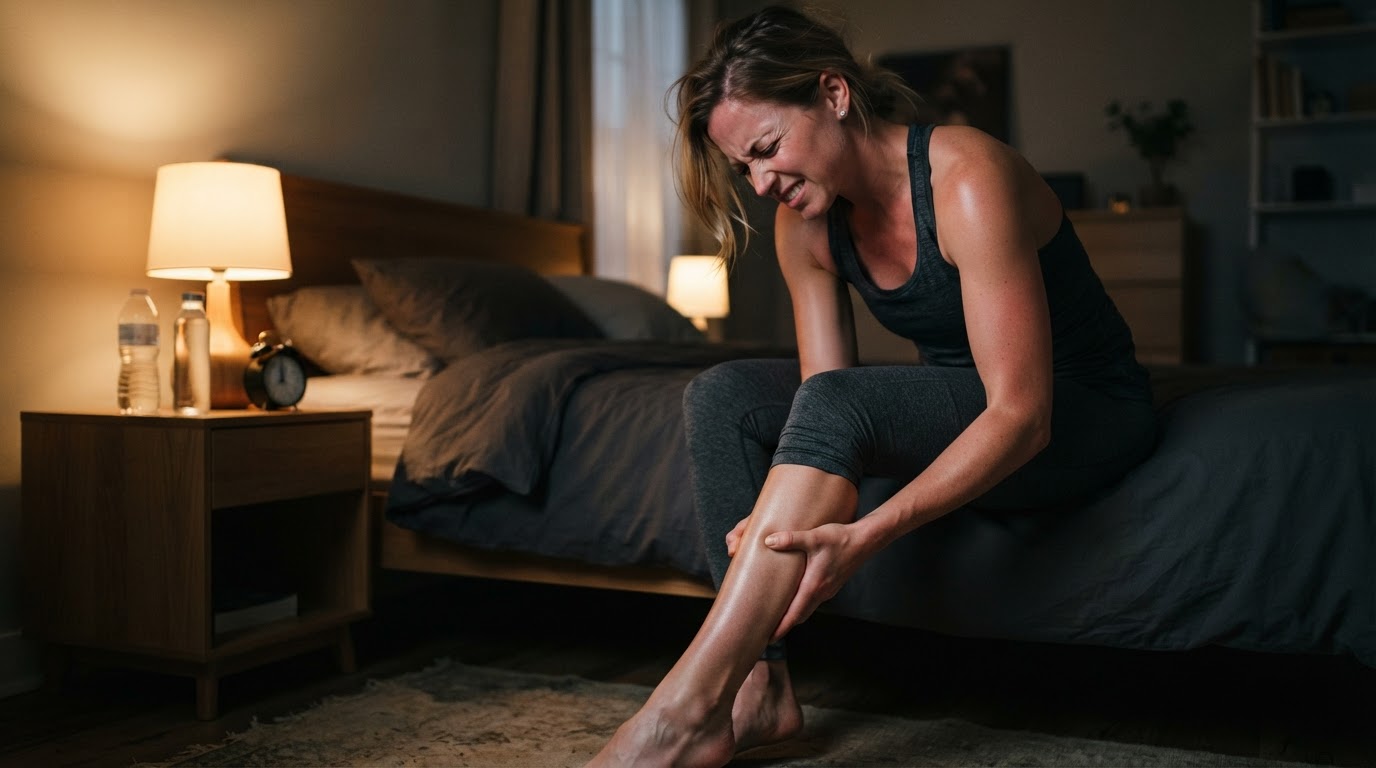
Quick answer: If you feel more sore two days after a workout than you did the morning after, the most likely explanation is delayed-onset muscle soreness, or DOMS. It commonly follows an unfamiliar, unusually hard, or lengthening-focused workout and may feel strongest about 24 to 72 hours later. The delay reflects an evolving response to exercise-related tissue stress and pain sensitization—not lactic acid trapped in the muscles. Mild, symmetrical soreness usually improves over several days. Sharp, one-sided, severely swollen, or worsening pain deserves more caution.[1–8]
Day-two soreness can feel strange because the workout itself is already in the past. You may have finished feeling tired but capable, woken up only mildly stiff, and then found stairs, sitting down, or reaching overhead noticeably harder at the 48-hour mark.
That pattern can be normal. It is not, however, a universal badge of a successful workout, and every pain that appears after exercise should not automatically be labeled DOMS. The timing, location, severity, and effect on normal movement matter.
Bottom line: Soreness that is broad, symmetrical, linked to the muscles you trained, and gradually improving is more consistent with DOMS. Pain that is sharp, focal, one-sided, rapidly worsening, or accompanied by major swelling, weakness, numbness, fever, or dark urine needs a different response.
Table of Contents
- Why soreness can be worse on day two
- What happens during the first 48 hours
- DOMS or injury: how to tell the difference
- Which workouts cause the most day-two soreness
- Does soreness mean you had a good workout?
- What to do when you are sore on day two
- Should you work out while still sore?
- Which recovery tools actually help?
- Where a topical gel can fit
- When soreness needs medical attention
Why Is Workout Soreness Worse on the Second Day?
DOMS is delayed because the pain is not simply the feeling of a muscle running out of fuel during the workout. Unaccustomed loading—especially when a working muscle produces force while lengthening—can create mechanical strain within muscle fibers and surrounding connective structures. That initial stress is followed by a series of local responses involving cell signaling, fluid shifts, inflammatory activity, and sensitization of pain-sensing nerve endings.[1–7]
Those processes do not all peak the moment the final repetition ends. Tenderness and movement-evoked pain can build over the next day or two, which is why lowering yourself onto a chair may feel worse at 48 hours than at 12 hours.
Researchers still debate the relative contribution of muscle fibers, connective tissue, inflammation, and neural sensitization. It is more accurate to describe DOMS as a multi-step response to unfamiliar exercise stress than to reduce it to "tiny muscle tears."[4–7]
It is not trapped lactic acid
Lactate rises during demanding exercise and is transported, reused, and cleared on a much shorter time scale. It does not remain stored in the trained muscles for two days. Classic research has separated the two phenomena: exercise can produce high lactate without later soreness, and lengthening-heavy exercise can produce DOMS without a large lactate response.[1–3]
For the broader explanation, read What Is DOMS and How Long Does It Last?. To understand why the "lactic acid buildup" phrase is misleading, see Lactic Acid Buildup: Causes, Symptoms, and Fast Relief.
Myth check: Day-two soreness is not old lactic acid finally leaving the muscle. Stretching, sweating, massage, and topical products should not be described as "flushing" it out.
What Happens During the First 48 Hours After a Workout?
The exact time course varies by exercise, muscle group, training history, sleep, age, and individual sensitivity. A useful general pattern is:
During the workout
The muscle experiences mechanical and metabolic stress. A hard set may burn or feel fatigued, but that immediate sensation is not DOMS.
From zero to 12 hours
You may feel tired, tight, or mildly tender. The local response to unfamiliar loading is developing, but the full soreness pattern may not yet be obvious.
From 12 to 24 hours
Stiffness and tenderness commonly become more noticeable, particularly when a sore muscle is lengthened, contracted, or pressed.
From 24 to 72 hours
DOMS often reaches its most noticeable period. Many people call this "second-day soreness," although an individual peak can occur earlier or later.[1,3,4]
After 72 hours
Ordinary DOMS should trend toward improvement. Some soreness may last several more days after a very unfamiliar session, but a worsening pattern, major loss of function, or symptoms that fail to improve should not be ignored.
Pain intensity alone does not precisely reveal how much structural muscle damage occurred. Studies find that subjective soreness and other markers of exercise-induced muscle damage can correlate poorly. A person can be very sore without having the largest function loss, or have reduced force without dramatic pain.[5,8]
DOMS or Injury: How Can You Tell the Difference?
No table can diagnose an injury, but the pattern can help you choose a safer next step.
| What you notice | More consistent with ordinary DOMS | More concerning for injury or illness | Sensible next step |
|---|---|---|---|
| Timing | Develops gradually after the workout and is often strongest 24–72 hours later | Sudden pain during a repetition, impact, twist, fall, or sprint; or pain that rapidly worsens | Stop the provoking activity and reassess |
| Location | Broad tenderness in the muscles trained, often on both sides | Sharp, focal, one-sided, joint-centered, or bone pain | Avoid loading the painful area and consider evaluation |
| Movement | Stiff at first but may ease somewhat with gentle movement | Causes limping, altered technique, instability, catching, or inability to use the limb normally | Do not train through altered movement |
| Appearance | Little or modest swelling | Marked swelling, deformity, rapidly spreading bruising, redness, or unusual warmth | Seek prompt medical assessment |
| Neurologic symptoms | None | Numbness, tingling, new weakness, loss of coordination, or pain radiating from the neck or back | Obtain medical advice promptly |
| Whole-body symptoms | Otherwise feel well | Fever, fainting, chest pain, shortness of breath, profound weakness, or dark urine | Seek urgent medical care |
Decision check: If soreness changes how you walk, lift, pedal, or stabilize a joint, choose the safer training option. Pain relief is not proof that the tissue is ready for normal loading.
Which Workouts Cause the Most Day-Two Soreness?
DOMS is driven more by novelty and loading pattern than by whether an exercise is officially "hard." Common triggers include:
- returning to resistance training after time away;
- adding substantially more sets, repetitions, load, or range of motion;
- emphasizing slow lowering phases or negatives;
- downhill running or hiking;
- descending stairs repeatedly;
- lunges, split squats, Romanian deadlifts, and other exercises with a strong lengthening component;
- jumping, sprinting, or change-of-direction work that has not been introduced gradually;
- a new sport, class, manual-labor task, or long day of yard work;
- training a muscle at longer lengths than it is accustomed to.
Lengthening contractions are often called eccentric contractions. Examples include the quadriceps controlling your descent into a squat and the calves controlling the lowering phase of a heel raise. These actions can produce high force and are useful for training, but unfamiliar exposure is a reliable DOMS trigger.[1–7]
Why the same workout may hurt less next time
After one unfamiliar bout, a later similar bout often causes less soreness and disruption. This adaptation is called the repeated-bout effect. Neural, mechanical, cellular, and connective-tissue adaptations may all contribute.[6–9]
That does not mean you must get extremely sore once to earn protection. Progressive exposure—starting with a manageable dose and building over time—can develop tolerance without deliberately chasing severe pain.
Does Soreness Mean You Had a Good Workout?
Soreness tells you that the session was a meaningful or unfamiliar stress to your current system. It does not tell you, by itself, that the session was optimally programmed.
DOMS is not a dependable score for:
- muscle growth;
- calories burned;
- fat loss;
- fitness gained;
- training quality;
- technical execution;
- tissue damage;
- readiness for the next hard session.
Productive training can cause little soreness once you adapt. Conversely, a poorly scaled novelty workout can cause extreme soreness without delivering a better long-term result. Progress is better judged by performance, repeatability, technique, training consistency, recovery, and movement toward the actual goal.[5,8,9]
If every session leaves you unable to move normally for days, the training dose may be interfering with consistency. More soreness is not automatically more progress.
What Should You Do When You Are Sore on Day Two?
There is no proven shortcut that erases DOMS immediately. The best plan protects function, supports normal recovery, and avoids turning soreness into a second damaging workout.
- Check the pattern before treating it
Confirm that the soreness is broad, expected for the muscles trained, and not accompanied by the warning signs in this article. If you are unsure whether the pain is muscular, joint-related, or neurologic, do not use an internet checklist as a diagnosis.
- Use easy movement as a comfort test
Try several minutes of relaxed walking, easy cycling, or pain-free range-of-motion work. Gentle movement may temporarily reduce stiffness and improve how you feel. Keep it easy enough that it does not add meaningful fatigue.[1,10]

Easy movement may temporarily reduce stiffness, but it should remain comfortable and should not add meaningful fatigue.
Stop if movement increases sharp pain, changes your gait, causes instability, or makes symptoms progressively worse.
- Reduce the load on the sore tissue
You do not have to remain completely still, but the sore muscle may not be ready for another high-volume or high-intensity exposure. Train another region, use a technique-focused session, shorten the workout, or take a recovery day.
- Eat enough total energy and protein
Recovery requires adequate food. Include protein across the day and enough carbohydrate to support the training you are doing. Protein supplementation is not a guaranteed DOMS cure, and reduced soreness is not the only or best way to judge whether nutrition is supporting recovery.[16,17]
- Replace fluid losses sensibly
Drink according to thirst, conditions, and sweat loss. Dehydration can make a person feel worse, but drinking excessive water does not wash DOMS away. Include normal meals and sodium replacement when the workout and environment justify it.
- Protect sleep
Sleep supports performance, pain regulation, and recovery. One poor night does not explain every case of DOMS, but repeatedly sacrificing sleep makes it harder to assess readiness and maintain training quality.[18]
- Reassess over the next 24 hours
The direction matters. Ordinary DOMS should begin trending toward improvement. Pain that escalates, localizes sharply, or increasingly limits normal activity deserves reassessment.

Adequate food, sensible hydration, time, and sleep support recovery even though no single behavior instantly erases DOMS.
Should You Work Out While You Are Still Sore?
You can sometimes exercise with mild DOMS, but "can" is not the same as "should train normally." Use function as the main filter.
A light or modified session may be reasonable when:
- soreness is mild to moderate;
- it is broad and symmetrical;
- normal walking and daily activities are intact;
- easy movement improves how you feel;
- range of motion and technique remain normal;
- the planned workout does not heavily reload the sore muscle.
Rest or change the session when:
- soreness is severe enough to alter movement;
- strength or control feels meaningfully reduced;
- you cannot use the normal range of motion;
- the same muscle group is scheduled for another hard session;
- fatigue is systemic rather than local;
- symptoms are worsening rather than improving.
Stop and seek assessment when:
- pain is sharp, focal, or joint-centered;
- there was a pop, tear, impact, or sudden onset;
- swelling, instability, numbness, or new weakness is present;
- normal walking or use of the limb is not possible;
- warning signs of rhabdomyolysis or another urgent condition appear.
An easy session can sometimes make soreness feel temporarily better, but that analgesic effect does not prove full recovery. Avoid using the warm-up to override a clear loss of function.[1,10]
Which Recovery Tools Actually Help Day-Two Soreness?
Recovery studies measure different outcomes: pain ratings, perceived fatigue, range of motion, strength, jump performance, or blood markers. A method that helps one outcome may not accelerate all aspects of recovery.[10–15]
Massage
Massage can reduce perceived soreness for some people and may help relaxation. Evidence is more consistent for comfort than for restoring performance. Use tolerable pressure; aggressive work on a very painful area is not automatically better.[10,13]
Foam rolling
Foam rolling may produce small improvements in soreness perception and range of motion. It should feel controlled, not like a test of pain tolerance. Avoid rolling directly over an acute injury, major bruise, swollen joint, or area with unexplained neurologic symptoms.[11]
Stretching
Post-exercise stretching has little evidence for preventing or meaningfully treating DOMS compared with passive recovery. Gentle stretching can still be useful when it feels comfortable and supports normal mobility. Do not force a painful end range.[12]
Heat or cold
Heat and cold can change pain perception, and cold-water immersion may reduce soreness in some settings. The best option depends on preference, timing, the sport, and the next performance demand. Neither should be described as repairing all exercise-related muscle damage.[14,15]
Compression and recovery devices
Compression garments or pneumatic devices may improve perceived recovery for some athletes, but effect sizes and protocols vary. They are optional tools, not substitutes for appropriately scaled training, food, and sleep.[10]
Pain medication
Do not automatically use medication to make a painful workout possible. Nonprescription medicines have individual risks and interactions. Follow the label and ask a pharmacist or clinician when you have kidney disease, ulcers, cardiovascular disease, take blood thinners, are pregnant, or are unsure what is safe for you.
Evidence boundary: A recovery tool can make you feel more comfortable without proving that muscle structure, force production, or readiness has fully recovered.
Where Can a Topical Muscle Gel Fit?
A topical analgesic can fit as an optional comfort tool when the discomfort is a minor muscle or joint ache and the skin is intact. It does not replace the training decision you made from symptoms and function.
The current LactiGo with Menthol Drug Facts list menthol 1.5% as the active ingredient for temporary relief of minor aches and pains of muscles and joints associated with simple backache, arthritis, strains, bruises, and sprains. L-carnosine and magnesium sulfate are listed as inactive ingredients.[20]
That label supports a limited statement about temporary relief. It does not establish that topical carnosine reaches skeletal muscle, raises intramuscular carnosine, treats the biological cause of DOMS, speeds structural repair, flushes lactate, or improves readiness for the next workout.
Use only as directed. Do not use it on wounds or irritated or damaged skin, with a heating pad, under a tight bandage, in the eyes or mucous membranes, or as a reason to train through a possible injury. Review the complete Drug Facts before use.[20]
Readers who want the separate product overview may visit The Science Behind LactiGo and Carnosine Gel. This is an educational same-tab link, not the purchase CTA.
Product boundary: Temporary pain relief can improve comfort. It cannot tell you whether a sore muscle, tendon, joint, or injured tissue is ready for normal loading.
When Does Post-Workout Soreness Need Medical Attention?
Seek urgent medical care for:
- dark, tea-colored, or cola-colored urine after strenuous activity;
- muscle pain, cramps, or swelling that are much more severe than expected;
- profound weakness or inability to complete ordinary tasks;
- rapidly increasing swelling or a very tight, painful muscle compartment;
- chest pain, fainting, severe shortness of breath, confusion, or heat-illness symptoms;
- new numbness, paralysis, or loss of bowel or bladder control;
- a deformed limb or inability to bear weight after an injury.
Severe exertion, heat, and muscle injury can contribute to rhabdomyolysis, a serious condition in which damaged muscle releases contents into the bloodstream. Symptoms can begin hours or days after the activity. Dark urine is an important warning sign, but its absence does not rule the condition out. A clinician uses blood testing, including creatine kinase, to evaluate suspected rhabdomyolysis.[19]
Contact a clinician soon if pain keeps worsening, remains strongly one-sided, repeatedly returns with the same movement, lasts longer than expected without improvement, or prevents normal daily function.
Medical warning: Do not use a topical product, massage, stretching, or another workout to test severe or unexplained symptoms. When rhabdomyolysis or a significant injury is possible, prompt assessment matters more than a recovery hack.
Final Takeaway
Being especially sore two days after a workout is commonly a DOMS pattern, particularly after a new exercise, more volume, a return from time away, or lengthening-heavy training. The delay comes from an evolving response to exercise stress and pain sensitization—not lactic acid trapped for 48 hours.
Use this practical sequence:
- Check whether the soreness is broad and expected or sharp and concerning.
- Test a few minutes of easy, pain-free movement.
- Protect normal walking, range of motion, and technique.
- Reduce or redirect training if the sore tissue is not functioning normally.
- Eat enough total energy, protein, and carbohydrate for your training.
- Replace fluids according to the workout and environment without forced overdrinking.
- Prioritize sleep.
- Use massage, foam rolling, heat, cold, compression, or a topical analgesic only for reasonable comfort goals.
- Expect ordinary DOMS to trend toward improvement over the next several days.
- Seek prompt medical care for dark urine, profound weakness, severe swelling, neurologic symptoms, or pain far beyond what the workout should explain.
This article provides general education and cannot diagnose DOMS, injury, rhabdomyolysis, or another medical condition. If the pattern is unclear or symptoms are severe, obtain individualized medical advice.
[[AUTHOR_BIO]]
Frequently Asked Questions
Why am I more sore two days after working out?
Soreness that feels worse around 48 hours is often delayed-onset muscle soreness, or DOMS. Unfamiliar or lengthening-focused exercise starts a local response involving tissue stress, inflammation, fluid shifts, and pain sensitization that develops after the workout rather than peaking immediately.
Is it normal to be sore 48 hours after exercise?
Yes, mild to moderate soreness that is broad, linked to the muscles trained, and strongest about 24 to 72 hours later can be a normal DOMS pattern. Sharp, one-sided, severely swollen, rapidly worsening, or function-limiting pain is less typical and deserves more caution.
Is day-two soreness caused by lactic acid?
No. Lactate is transported and reused on a much shorter time scale and does not remain trapped in muscle for two days. Delayed soreness is linked to the body's evolving response to unfamiliar exercise stress, not stored lactic acid.
Does being sore mean I had a good workout?
Not necessarily. Soreness shows that the workout was a meaningful or unfamiliar stress, but it is not a reliable measure of muscle growth, calories burned, tissue damage, or workout quality. Productive training can cause little soreness after you adapt.
How long should second-day workout soreness last?
DOMS often becomes noticeable within a day, may feel strongest between 24 and 72 hours, and then trends toward improvement. Very demanding or unfamiliar exercise can cause symptoms for several more days. Worsening pain or a lack of improvement should be reassessed.
Should I work out if I am still sore after two days?
A light or modified workout may be reasonable when soreness is mild, symmetrical, improving, and does not alter normal movement or technique. Rest, redirect the session, or seek assessment when pain is sharp, one-sided, worsening, swollen, or changes how you move.
Does stretching get rid of DOMS?
Post-exercise stretching has little evidence for preventing or meaningfully treating DOMS compared with passive recovery. Gentle stretching may feel good or support mobility, but it should not be forced into pain and does not flush lactic acid from muscle.
Do massage and foam rolling help day-two soreness?
Massage and foam rolling may reduce perceived soreness or improve range of motion for some people, but the effects are generally modest and do not prove complete tissue recovery. Use tolerable pressure and avoid aggressively treating a possible injury.
Can LactiGo cure DOMS or speed muscle repair?
No. LactiGo is not proven to cure DOMS or speed structural muscle repair. Its current Drug Facts list menthol 1.5% as a topical analgesic for temporary relief of minor muscle and joint aches. Temporary comfort does not establish recovery or readiness to train.
When is post-workout soreness dangerous?
Seek prompt medical care for dark tea- or cola-colored urine, pain or swelling far more severe than expected, profound weakness, rapidly increasing swelling, chest pain, fainting, confusion, neurologic symptoms, or inability to use the limb normally.
References
- Hotfiel T, Freiwald J, Hoppe MW, et al. Advances in Delayed-Onset Muscle Soreness (DOMS): Part I: Pathogenesis and Diagnostics. Sportverletzung Sportschaden. 2018;32(4):243–250. doi:10.1055/a-0753-1884. https://pubmed.ncbi.nlm.nih.gov/30537791/
- Cheung K, Hume P, Maxwell L. Delayed Onset Muscle Soreness: Treatment Strategies and Performance Factors. Sports Medicine. 2003;33(2):145–164. doi:10.2165/00007256-200333020-00005. https://pubmed.ncbi.nlm.nih.gov/12617692/
- MacIntyre DL, Reid WD, McKenzie DC. Delayed Muscle Soreness: The Inflammatory Response to Muscle Injury and Its Clinical Implications. Sports Medicine. 1995;20(1):24–40. https://pubmed.ncbi.nlm.nih.gov/7481277/
- Mizumura K, Taguchi T. Insight from the Study on Delayed-Onset Muscle Soreness. Journal of Physiological Sciences. 2024. https://pmc.ncbi.nlm.nih.gov/articles/PMC10809664/
- Nosaka K, Newton M, Sacco P. Delayed-Onset Muscle Soreness Does Not Reflect the Magnitude of Eccentric Exercise-Induced Muscle Damage. Scandinavian Journal of Medicine & Science in Sports. 2002;12(6):337–346. https://pubmed.ncbi.nlm.nih.gov/12453160/
- Peake JM, Neubauer O, Della Gatta PA, Nosaka K. Muscle Damage and Inflammation During Recovery from Exercise. Journal of Applied Physiology. 2017;122(3):559–570. https://pubmed.ncbi.nlm.nih.gov/28035017/
- Hyldahl RD, Chen TC, Nosaka K. Mechanisms and Mediators of the Skeletal Muscle Repeated Bout Effect. Exercise and Sport Sciences Reviews. 2017;45(1):24–33. https://pubmed.ncbi.nlm.nih.gov/27782911/
- Kanda K, Sugama K, Hayashida H, et al. Eccentric Exercise-Induced Delayed-Onset Muscle Soreness and Changes in Markers of Muscle Damage and Inflammation. Exercise Immunology Review. 2013;19:72–85. https://pubmed.ncbi.nlm.nih.gov/23977721/
- Ebbeling CB, Clarkson PM. Exercise-Induced Muscle Damage and Adaptation. Sports Medicine. 1989;7(4):207–234. https://pubmed.ncbi.nlm.nih.gov/2657962/
- Dupuy O, Douzi W, Theurot D, Bosquet L, Dugué B. An Evidence-Based Approach for Choosing Post-exercise Recovery Techniques to Reduce Markers of Muscle Damage, Soreness, Fatigue, and Inflammation: A Systematic Review With Meta-Analysis. Frontiers in Physiology. 2018;9:403. doi:10.3389/fphys.2018.00403. https://www.frontiersin.org/journals/physiology/articles/10.3389/fphys.2018.00403/full
- Wiewelhove T, Döweling A, Schneider C, et al. A Meta-Analysis of the Effects of Foam Rolling on Performance and Recovery. Frontiers in Physiology. 2019;10:376. doi:10.3389/fphys.2019.00376. https://www.frontiersin.org/journals/physiology/articles/10.3389/fphys.2019.00376/full
- Afonso J, Clemente FM, Nakamura FY, et al. The Effectiveness of Post-exercise Stretching in Short-Term and Delayed Recovery of Strength, Range of Motion and Delayed Onset Muscle Soreness: A Systematic Review and Meta-Analysis of Randomized Controlled Trials. Frontiers in Physiology. 2021;12:677581. doi:10.3389/fphys.2021.677581. https://pmc.ncbi.nlm.nih.gov/articles/PMC8133317/
- Poppendieck W, Wegmann M, Ferrauti A, Kellmann M, Pfeiffer M, Meyer T. Massage and Performance Recovery: A Meta-Analytical Review. Sports Medicine. 2016;46(2):183–204. doi:10.1007/s40279-015-0420-x. https://pubmed.ncbi.nlm.nih.gov/26744335/
- Bleakley C, McDonough S, Gardner E, Baxter GD, Hopkins JT, Davison GW. Cold-Water Immersion (Cryotherapy) for Preventing and Treating Muscle Soreness After Exercise. Cochrane Database of Systematic Reviews. 2012;(2). https://pubmed.ncbi.nlm.nih.gov/22336838/
- Wang Y, Lu H, Li S, Zhang Y, Yan F, Huang Y. Heat and Cold Therapy Reduce Pain in Patients with Delayed Onset Muscle Soreness: A Systematic Review and Meta-Analysis of 32 Randomized Controlled Trials. Physical Therapy in Sport. 2021;48:177–187. https://pubmed.ncbi.nlm.nih.gov/33493991/
- Pasiakos SM, Lieberman HR, McLellan TM. Effects of Protein Supplements on Muscle Damage, Soreness and Recovery of Muscle Function and Physical Performance: A Systematic Review. Sports Medicine. 2014;44(5):655–670. https://pubmed.ncbi.nlm.nih.gov/24435468/
- Jäger R, Kerksick CM, Campbell BI, et al. International Society of Sports Nutrition Position Stand: Protein and Exercise. Journal of the International Society of Sports Nutrition. 2017;14:20. https://pubmed.ncbi.nlm.nih.gov/28642676/
- Dáttilo M, Antunes HKM, Galbes NMN, et al. Effects of Sleep Deprivation on Acute Skeletal Muscle Recovery After Exercise. Medicine & Science in Sports & Exercise. 2020;52(2):507–514. https://pubmed.ncbi.nlm.nih.gov/31469710/
- National Institute for Occupational Safety and Health. Signs and Symptoms of Rhabdomyolysis. Centers for Disease Control and Prevention. https://www.cdc.gov/niosh/rhabdo/signs-symptoms/index.html
- National Library of Medicine. Label: LACTIGO—Menthol Gel. DailyMed. Active ingredient: menthol 1.5%; revised March 2026. https://dailymed.nlm.nih.gov/dailymed/drugInfo.cfm?setid=4dda6ac4-d849-69a6-e063-6394a90a3c54