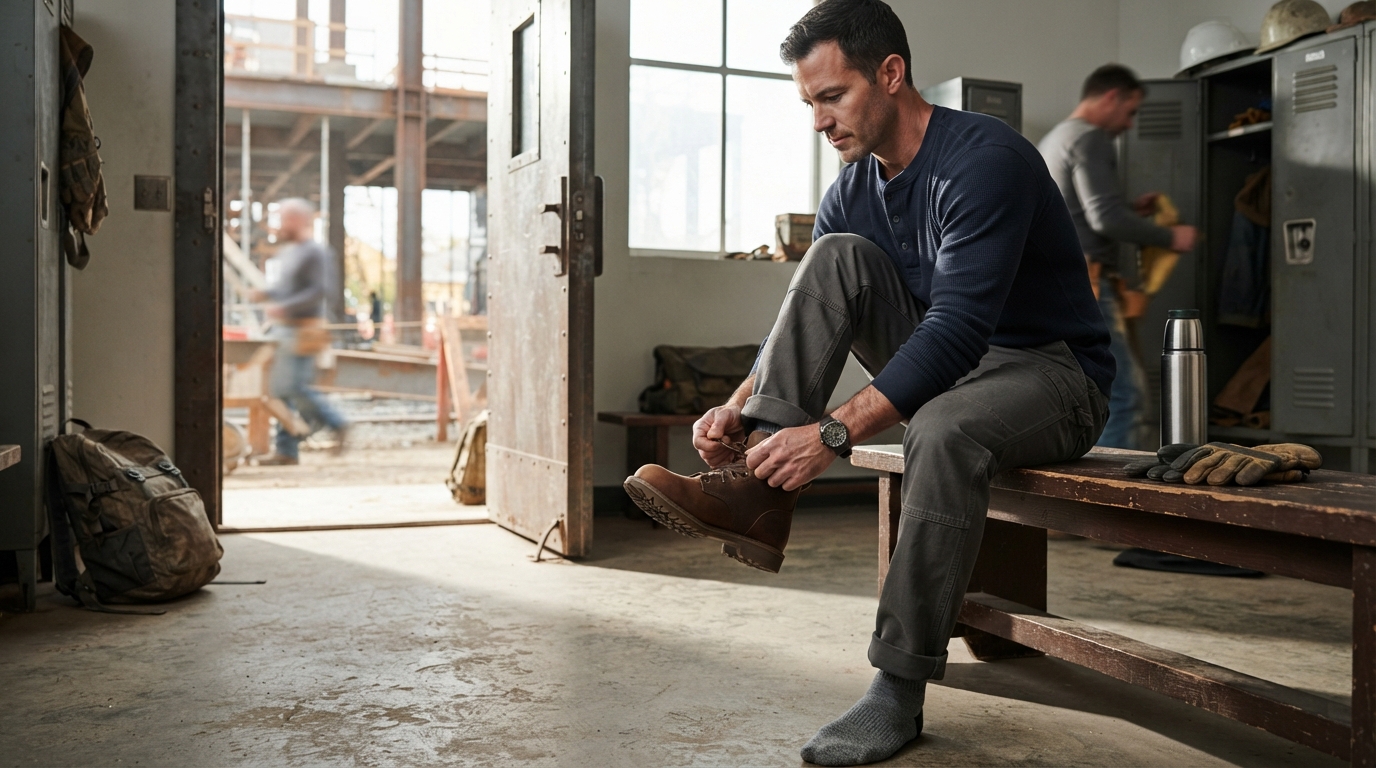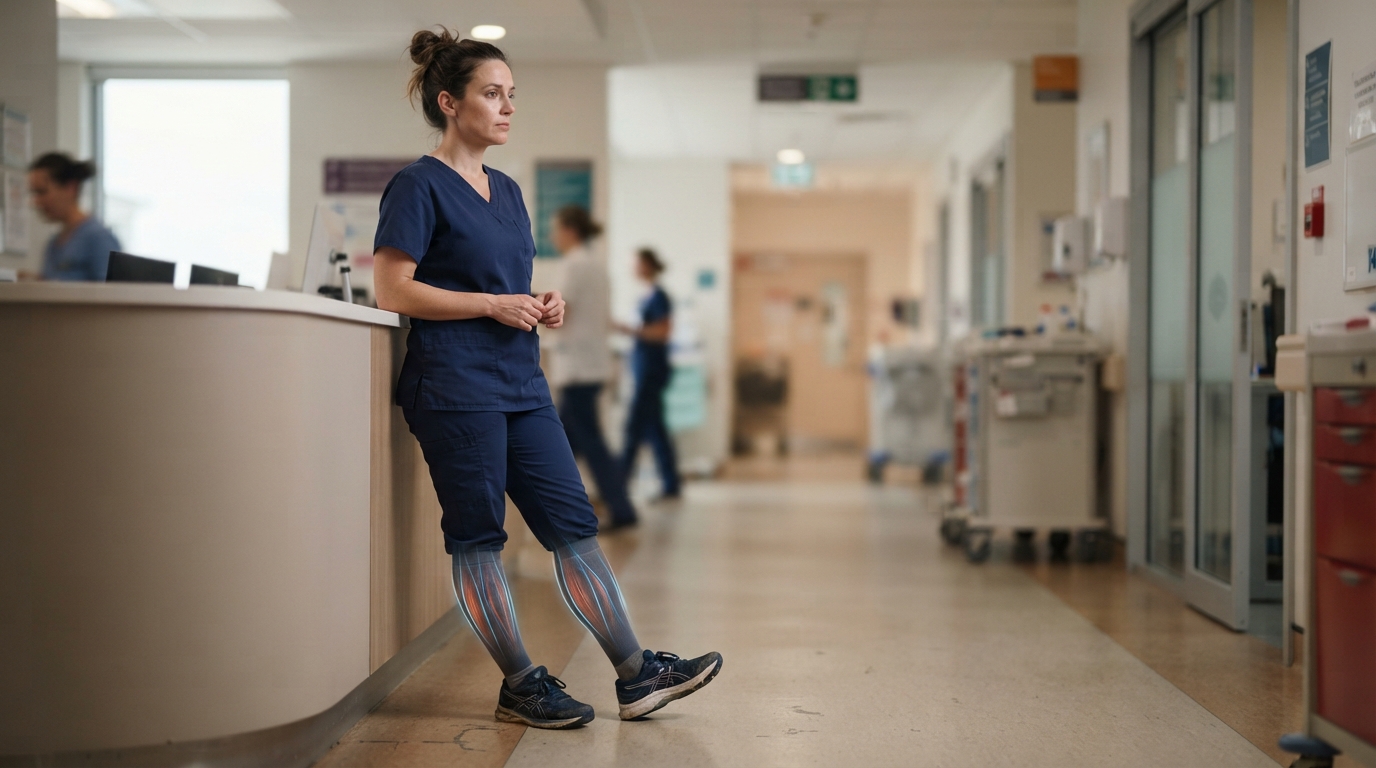
If your legs ache after standing all day, the problem is not necessarily that you "did too much exercise." Prolonged standing creates a different kind of physical stress: muscles remain active at low levels for long periods, blood and fluid can accumulate in the lower legs, and the same tissues repeatedly bear your body weight without the movement that normally helps redistribute the load.
Occupational-health research consistently links prolonged standing with lower-leg discomfort, physical fatigue, muscle pain, swelling and low-back symptoms. NIOSH concluded that allowing workers to move, walk, sit or change posture appears to be one of the most useful ways to reduce the problems associated with standing in one place.
A controlled study comparing prolonged standing with walking found that standing produced lower-leg swelling and measurable muscle fatigue, while walking did not produce the same response. The researchers concluded that intermittent walking may help counteract the effects of quasi-static standing.
The practical lesson is straightforward:
If standing is the problem, simply continuing to stand in a different position is often not enough. Your legs usually benefit from movement, changes in posture, appropriate footwear and recovery strategies that address the actual source of the fatigue.
Key Takeaways
- Standing for hours can create muscular fatigue even when you are not exercising intensely.
- Prolonged static standing is associated with leg discomfort, swelling, fatigue and low-back symptoms.
- Standing and walking are not physiologically equivalent. In controlled research, prolonged standing caused lower-leg edema and muscle fatigue while walking did not.
- Movement helps activate the lower-leg muscle pump, which assists venous return from the legs.
- Changing position, walking intermittently, using appropriate footwear and reducing hard-surface exposure can be more useful than trying to remain perfectly still.
- Cushioned flooring and insoles have evidence for reducing discomfort and fatigue in people who stand for work, although results vary by intervention.
- Compression stockings can reduce occupational lower-leg swelling in some people, but they are not appropriate for everyone.
- Sudden or unexplained swelling in one leg, warmth, redness, significant calf pain, chest pain or shortness of breath should not be dismissed as ordinary standing fatigue.
- LactiGo's current U.S. label lists menthol 1.5% as a topical analgesic for temporary relief of minor muscle and joint aches associated with conditions including strains and sprains.
- A topical analgesic may help with minor aches, but it does not replace movement, ergonomic changes or evaluation of unexplained swelling or pain.
Table of Contents
- Why do your legs ache after standing all day?
- Why standing still can be harder than walking
- What happens to circulation when you stand?
- What is the calf muscle pump?
- Why your feet and calves get tired
- Why your ankles may swell
- Is this the same as workout soreness?
- Who is most affected by prolonged standing?
- How to reduce leg fatigue while you are working
- Do movement breaks actually help?
- Do anti-fatigue mats and cushioned insoles work?
- What about compression socks?
- What should you do after work?
- Does strength training help?
- When tired legs may be more than normal fatigue
- Where LactiGo fits
- Frequently asked questions
Why Do Your Legs Ache After Standing All Day?
The simplest answer is that standing is active work.
It may look passive, but your body does not simply stack your skeleton vertically and switch the muscles off.
Your postural muscles continually make adjustments to keep:
- Your ankles stable
- Your knees controlled
- Your hips positioned
- Your pelvis balanced
- Your trunk upright
- Your center of mass over your feet
The contractions involved are much less dramatic than a squat or sprint, but they can continue for hours.
That matters.
NIOSH's review of occupational standing found consistent reports of physical fatigue, muscle pain, leg swelling, tiredness and other discomfort among workers required to remain standing for prolonged periods.
Researchers studying long-duration standing have also documented persistent lower-limb muscle fatigue following standing work.
So when your legs feel "worked" after a shift, they often have been.
Just in a very different way from a gym workout.
Standing Is Not the Same as Walking
This distinction explains a lot.
You might reasonably assume:
"If standing hurts my legs, walking should make them even more tired."
But walking changes the mechanical and circulatory situation.
When you walk:
- Muscles repeatedly contract and relax.
- Body weight shifts from one leg to the other.
- Ankles move through a larger range.
- The calf muscles actively compress veins.
- Different muscles share the workload.
- Pressure is redistributed across the feet.
Standing in one place lacks much of that movement.
A 2020 study had participants complete 4.5 hours of either standing or walking with seated breaks. Prolonged standing produced lower-leg edema and muscle fatigue, whereas walking did not.
The authors concluded that intermittent walking may be an effective strategy for counteracting some of the detrimental effects of quasi-static standing.
This is why "resting your legs" does not always mean standing still.
Sometimes the better response to static standing is gentle movement.
What Happens to Circulation When You Stand?
Gravity matters.
When you are upright, blood returning from your feet and lower legs has to travel upward toward the heart.
Your veins contain valves that help keep blood moving in the right direction.
But another important part of the system is movement.
Muscle contractions—particularly in the calf—help push venous blood upward.
When you stand relatively still for long periods, that pumping action is reduced compared with walking.
NIOSH and OSHA occupational guidance both identify static standing as a contributor to leg fatigue and lower-extremity discomfort and emphasize the value of movement and posture changes.
This does not mean that every feeling of heaviness is a circulation disorder.
It means normal physiology partly explains why motionless standing can make the lower legs feel increasingly heavy as the day continues.
What Is the Calf Muscle Pump?
Your calf muscles do more than move your ankle.
They also contribute to venous return.
When the calf contracts during walking and ankle movement, pressure inside the lower leg helps move blood through the veins toward the heart.
This mechanism is often called the calf muscle pump.
Research describes the calf muscle pump as an important contributor to venous return from the lower extremities.
Imagine gently squeezing a flexible tube from the bottom upward.
That is not literally what happens anatomically, but it captures the basic principle.
Walking repeatedly activates that system.
Static standing does much less of it.
That is one reason a short walk can sometimes feel better than simply remaining upright after hours on your feet.
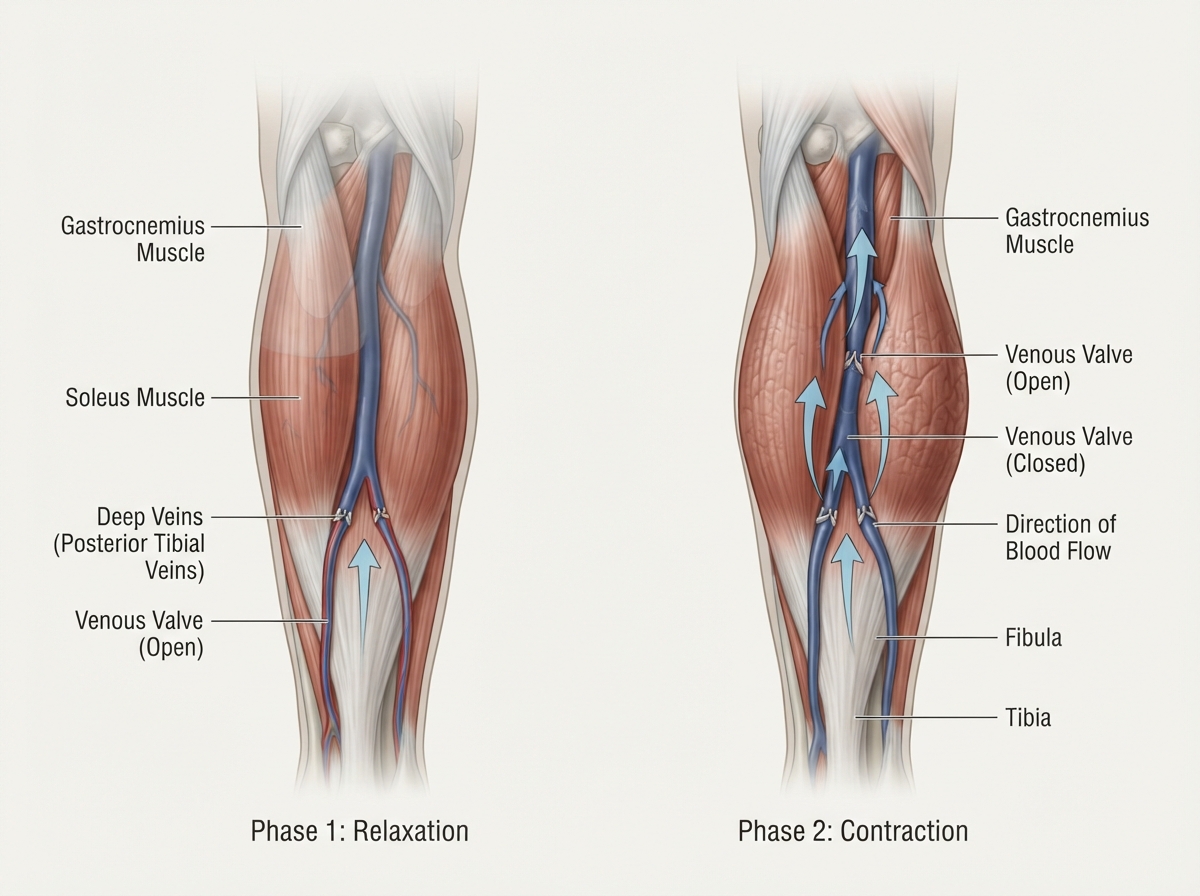
The calf muscle pump helps move venous blood upward from the lower leg during walking and ankle movement.
Why Do Your Feet, Calves and Lower Back Get Tired?
Standing creates what ergonomics researchers call a static load.
Instead of repeatedly generating large forces and then relaxing, muscles may remain active at relatively low levels for long periods.
OSHA notes that prolonged standing places stress on the back and legs and recommends opportunities to change position, along with tools such as footrests, resilient floor mats and adjustable seating where appropriate.
Several factors can contribute simultaneously:
Sustained muscular activity
Postural muscles continue working to maintain balance.
Hard flooring
Concrete and other rigid surfaces offer little cushioning.
Limited foot movement
Standing at a counter or workstation may keep your feet in nearly the same place for hours.
Footwear
Shoes influence comfort, pressure distribution and the interaction between your feet and the floor.
Poor workstation fit
A counter that is too high or too low can make standing more mechanically demanding.
Lack of posture variation
The same structures repeatedly carry the load.
This is why the solution often requires more than simply "getting stronger."
The work environment matters too.
Why Do Your Ankles and Lower Legs Swell?
Some people notice that shoes feel tighter at the end of a standing-heavy day.
Sock lines become more visible.
Ankles may look fuller.
This can occur because prolonged upright posture promotes fluid accumulation in the lower extremities.
Controlled research has directly measured increased lower-leg swelling during prolonged standing.
Mayo Clinic also notes that standing or sitting for a long time can contribute to leg swelling from fluid buildup.
Mild, symmetrical swelling after prolonged standing is therefore not unusual.
But that does not mean all swelling should be assumed to be harmless.
The pattern matters.
We will return to that distinction later.
Is This the Same as DOMS After a Workout?
Usually not.
Delayed-onset muscle soreness, or DOMS, typically follows unfamiliar or demanding exercise—especially activity with substantial eccentric muscle contractions.
The discomfort after prolonged standing may instead involve:
- Muscular fatigue
- Static loading
- Foot pressure
- Venous pooling
- Lower-leg swelling
- Repetitive postural stress
Someone can experience both.
For example, a restaurant worker who completed a new leg workout the previous evening may have DOMS and accumulate standing-related fatigue during the following shift.
But the mechanisms are not identical.
That distinction matters because the best response may also differ.
Why Standing Jobs Can Be Physically Demanding
People often reserve the word "physical" for jobs involving lifting, carrying or walking.
But long-duration standing is itself an occupational exposure.
NIOSH's review identified problems across occupations where workers have limited opportunity to sit or move, including retail and healthcare environments.
Research involving nurses has likewise identified prolonged standing environments as an occupational risk factor for foot and ankle disorders.
Examples of standing-heavy jobs include:
- Nurses
- Surgeons and operating-room staff
- Teachers
- Retail employees
- Cashiers
- Bartenders
- Servers
- Chefs
- Hairstylists
- Barbers
- Manufacturing workers
- Warehouse workers
- Security staff
- Trade-show personnel
- Laboratory workers
- Assembly-line employees
For these people, recovery is not just an athletic concept.
It is part of being physically ready to work again tomorrow.
What Actually Helps Reduce Leg Fatigue While You Work?
The most useful strategy may be surprisingly simple:
Stop treating standing as the only acceptable posture.
NIOSH's review concluded that dynamic movement appeared to be the best overall solution among the interventions considered for reducing problems associated with prolonged standing.
That can mean alternating among:
- Standing
- Walking
- Sitting
- Leaning
- Using a footrest
- Shifting stance
The goal is not to find one perfect posture and hold it for eight hours.
The goal is to avoid asking the same tissues to tolerate the same load continuously.
Do Movement Breaks Really Matter?
Yes.
A study examining lower-extremity discomfort after standing found that brief ankle and hip movements following 30 minutes of prolonged standing reduced discomfort.
Combined with the standing-versus-walking research, this supports a practical idea:
Movement does not have to be a workout to be useful.
During a standing-heavy day, consider opportunities to:
- Walk briefly
- Perform several calf raises
- Alternate heel raises and toe raises
- Flex and extend the ankles
- Shift weight between legs
- Place one foot on a low footrest
- Sit briefly when work allows
The exact schedule will depend on the job.
Someone working in an operating room has different constraints from someone working at a retail counter.
But the physiological principle remains:
Frequent movement is generally more favorable than remaining motionless for long periods.
A Five-Minute Movement Reset
When your job allows it, a simple reset can look like this:
1. Walk
Take a brief walk instead of simply standing somewhere else.
2. Move the ankles
Alternate raising your heels and toes.
3. Shift position
Avoid locking yourself into the same stance.
4. Sit or lean briefly
Reduce continuous loading when the work environment permits.
5. Return to work in a different stance
Small changes throughout the day can be more useful than waiting until your legs already feel exhausted.
This is not a medical treatment.
It is basic load management.
Do Anti-Fatigue Mats Work?
They can help.
A systematic review examining cushioned flooring and shoe insoles found a moderate level of evidence supporting cushioning materials for reducing discomfort and fatigue among workers who stand.
NIOSH and OSHA also include mats among workplace strategies commonly used to reduce prolonged-standing discomfort.
That does not mean any soft mat is automatically better.
A workplace surface still needs to be:
- Stable
- Appropriate for the task
- Safe from trip hazards
- Compatible with footwear
- Suitable for the environment
But if someone stands on hard flooring for hours every day, the interface between the foot and floor deserves attention.
What About Shoes and Insoles?
Footwear cannot eliminate the physiological effects of prolonged standing, but it can influence comfort and loading.
The same systematic review found evidence supporting cushioned materials, with some evidence favoring insoles, although the research was not strong enough to establish one universal solution for every worker.
Good work footwear generally needs to match:
- The person's foot
- The work surface
- Required safety standards
- Amount of standing
- Amount of walking
- Job-specific movement
A nurse walking thousands of steps per shift has different footwear requirements from a cashier who remains within a narrow workstation.
The best shoe is not simply the softest shoe.
Comfort, fit, support, stability and occupational requirements all matter.
Should You Use Compression Socks?
Compression stockings can reduce lower-leg swelling in some people who spend long periods sitting or standing.
In one occupational study, below-knee compression stockings reduced evening lower-leg edema, with pressures above approximately 10 mmHg improving subjective symptoms in that study population.
That makes compression a legitimate option for some standing workers.
But compression is not something every person should automatically self-prescribe.
People with certain arterial, vascular, skin or medical conditions may require professional guidance regarding whether compression is appropriate and what pressure level to use.
If leg swelling is new, unexplained, persistent or markedly different between legs, determine why it is happening before simply covering the symptom with stronger compression.
What Should You Do After Standing All Day?
A useful after-work routine should address what the day actually did to your legs.
1. Move Before You Collapse Onto the Couch
After hours of static standing, going immediately from stationary standing to completely stationary sitting may not be the only option.
A comfortable walk can activate the calf muscle pump and change the loading pattern.
Research directly comparing standing and walking supports intermittent walking as a strategy for reducing standing-related lower-leg swelling and fatigue.
This is not an argument for a hard cardio session.
Think:
gentle movement, not another workout.
2. Elevate Your Legs If They Feel Swollen
If your legs feel mildly and symmetrically swollen after prolonged standing, lying down with the legs supported can help change the gravitational situation.
Mayo Clinic includes leg elevation among measures that may help reduce swelling caused by fluid accumulation.
Persistent or unexplained swelling deserves medical evaluation rather than indefinite self-treatment.
3. Let Your Feet Out of Work Shoes
This sounds obvious, but your feet have spent hours interacting with the same footwear.
Removing restrictive work shoes lets you:
- Inspect the feet
- Notice pressure areas
- Check for blisters
- Assess swelling
- Identify whether one side looks different
That information can help distinguish ordinary fatigue from a footwear problem or something that needs attention.
4. Use Gentle Movement
Ankle pumps, comfortable walking and easy mobility can help restore movement after a static day.
You do not need an elaborate "recovery protocol."
Five minutes of appropriate movement may be more relevant to standing-related fatigue than a complicated sequence of gadgets.
5. Sleep
Muscular recovery still depends on adequate recovery time.
If your occupation is physically demanding, sleep is part of occupational recovery just as it is part of athletic recovery.
No topical product replaces it.
Can Strength Training Help People Who Stand for Work?
Potentially, yes—but strength training and workplace ergonomics solve different parts of the problem.
Stronger lower-body muscles may improve physical capacity.
Exercises involving:
- Calves
- Quadriceps
- Hamstrings
- Glutes
- Trunk musculature
can help build general physical capacity.
Exercise has also been shown to improve calf muscle pump function in clinical research involving venous disease, illustrating that calf strength and pump performance can respond to training.
But being strong does not make eight hours of motionless standing ideal.
A strong worker can still experience static loading, swelling and discomfort.
Think of it this way:
Fitness improves the capacity of the worker.
Ergonomics improves the demands of the work.
Ideally, address both.
What About Stretching?
Stretching may feel good when muscles feel tight, but it should not become the automatic explanation for every aching leg.
If the primary problem is:
- Prolonged static loading
- Fluid accumulation
- Hard flooring
- Poor footwear
- Lack of movement
then stretching alone does not directly correct those issues.
Use stretching if it feels appropriate and comfortable.
Just do not mistake it for the entire recovery strategy.
Why Your Legs May Feel "Heavy" Rather Than Sore
People use different words for standing-related discomfort:
- Achy
- Heavy
- Tight
- Tired
- Throbbing
- Puffy
- Stiff
- Drained
"Heavy legs" can reflect ordinary fatigue and lower-leg fluid accumulation, but it can also occur in venous conditions.
Varicose veins and chronic venous problems, for example, may cause aching, heaviness, cramping and swelling that become worse after prolonged sitting or standing.
If the same symptoms recur frequently, progressively worsen or are accompanied by visible vein changes, discussing them with a healthcare professional is reasonable.
When Leg Pain After Standing Is Not Something to "Recover Through"
This section matters.
Not every painful or swollen leg after work represents normal fatigue.
Seek prompt medical attention for new, unexplained swelling in one leg.
Deep vein thrombosis can cause:
- Swelling
- Calf pain or soreness
- Warmth
- Skin-color changes
and it can occur without obvious symptoms.
Seek emergency care if leg symptoms occur with:
- Sudden shortness of breath
- Chest pain
- Difficulty breathing
- Fainting or severe dizziness
- Coughing up blood
These can be symptoms of pulmonary embolism or another serious condition.
Also seek medical evaluation when:
- Swelling appears suddenly
- One leg becomes substantially more swollen than the other
- Pain is severe
- The skin becomes unusually warm or red
- Symptoms persist rather than improving
- You have significant weakness or loss of function
- Symptoms follow an injury
- You have known vascular, heart, kidney or other relevant medical conditions
Do not use a topical pain-relief product to mask symptoms that need diagnosis.
Where Does Carnosine Fit Into Everyday Leg Fatigue?
Carnosine is naturally present in skeletal muscle and has established roles in muscle physiology, particularly intracellular buffering during high-intensity exercise.
But prolonged standing is not the same physiological challenge as repeated sprinting or other high-intensity exercise.
The discomfort produced by a standing-heavy workday can involve:
- Sustained postural loading
- Muscular fatigue
- Fluid accumulation
- Venous pressure
- Foot and joint loading
For that reason, research involving muscle carnosine during high-intensity performance should not simply be repurposed into a claim that topical carnosine treats standing-related leg fatigue.
That would go beyond the evidence.
This distinction is especially important as carnosinegel.com expands beyond athletes.
The goal is to make the science relevant to everyday people without turning every everyday problem into a carnosine claim.
Where LactiGo Fits
LactiGo can still have a clear role.
The current DailyMed label, updated March 25, 2026, identifies:
- Menthol 1.5% as the active ingredient
- Topical analgesic as its purpose
- Temporary relief of minor muscle and joint aches associated with simple backache, arthritis, strains, bruises and sprains as its labeled use
The label lists L-carnosine and magnesium sulfate among the inactive ingredients.
For adults and children age 2 and older, the current label directs users to apply a thin layer to the affected area no more than three to four times daily and massage until absorbed. The label also states not to use the product on wounds or damaged skin or with a heating pad.
The appropriate positioning is therefore:
Movement addresses static loading.
Ergonomic changes address the work environment.
Medical evaluation addresses unexplained or concerning symptoms.
A topical analgesic may provide temporary relief from appropriate minor muscle and joint aches.
Those roles should not be confused.
A Practical After-Work Recovery Routine
If your legs are simply tired and achy from an ordinary standing-heavy day—and you do not have concerning symptoms—a realistic routine might look like this:
Step 1: Walk for a Few Minutes
Use comfortable movement to transition out of static standing.
Step 2: Move Your Ankles
Perform gentle ankle pumps or calf raises.
Step 3: Get Out of Work Footwear
Check your feet and give them a break from the day's pressure points.
Step 4: Elevate the Legs if Mild Swelling Is Present
Support the legs comfortably while resting.
Step 5: Eat, Hydrate and Recover Normally
Standing all day does not require a special detox.
Step 6: Address Minor Aches if Needed
If appropriate for you, a labeled topical analgesic such as LactiGo may be incorporated for temporary relief of qualifying minor muscle or joint aches. Use it according to the current product directions.
Step 7: Fix Tomorrow's Problem Tonight
Ask:
- Can I take more movement breaks?
- Can I alternate standing and sitting?
- Are my shoes working for me?
- Would an anti-fatigue mat help?
- Can I use a footrest?
- Is my workstation set up appropriately?
Recovery is useful.
Prevention is better.
The Best Recovery Strategy May Start Before Your Legs Hurt
There is a tendency to think about recovery only after discomfort begins.
But prolonged-standing research points toward a better model:
Reduce the continuous exposure while it is happening.
NIOSH emphasizes allowing workers control over posture and opportunities to move throughout the shift.
OSHA similarly recommends approaches such as footrests, resilient mats, adjustable chairs or stools and opportunities to change position when extended standing is required.
That means the most effective "recovery tool" for an eight-hour standing shift might actually be:
not waiting eight hours to move.
The Bottom Line
Standing all day can be genuinely physically demanding.
The fatigue is not imaginary, and it is not simply a sign that you need to "toughen up."
Research consistently associates prolonged standing—especially standing primarily in one place—with:
- Lower-leg discomfort
- Physical fatigue
- Muscle pain
- Swelling
- Low-back discomfort
The important insight is that standing and moving are not the same thing.
In controlled research, prolonged standing produced lower-leg swelling and muscle fatigue while walking did not, supporting intermittent movement as a practical countermeasure.
So if your legs ache after a day on your feet, think beyond "rest."
Think about:
movement + posture variation + footwear + flooring + load management + appropriate recovery.
If minor muscle or joint aches remain, LactiGo's current label supports its use as a menthol topical analgesic for temporary relief in the labeled circumstances.
But a topical product should complement—not replace—the fundamentals.
And if swelling or pain is sudden, one-sided, unexplained or accompanied by breathing problems or chest symptoms, skip the recovery routine and seek medical attention.
For the millions of people whose "workout" is an eight-hour shift on their feet, recovery science belongs outside the gym too.
[[AUTHOR_BIO]]
Frequently Asked Questions
Why do my legs hurt after standing all day?
Prolonged standing can produce sustained muscular activity, static loading and lower-leg fluid accumulation. Occupational research consistently associates long-duration standing with fatigue, muscle discomfort and leg swelling.
Why does walking sometimes feel better than standing still?
Walking repeatedly contracts the lower-leg muscles, redistributes body weight and activates the calf muscle pump. A controlled study found that prolonged standing produced lower-leg swelling and muscle fatigue while walking did not.
Is standing all day considered exercise?
Standing requires muscular work and can contribute to fatigue, but it does not provide the same physiological stimulus as structured aerobic or resistance exercise. Its challenge is largely sustained and static rather than high-intensity.
Why do my ankles swell after standing?
Remaining upright for long periods can promote lower-extremity fluid accumulation. Research has directly measured lower-leg edema during prolonged standing.
Do movement breaks help?
Evidence supports intermittent movement. NIOSH found dynamic movement to be the most consistently recommended intervention in its review, and experimental research has shown reduced discomfort with brief lower-extremity movement following standing.
Do anti-fatigue mats work?
A systematic review found moderate evidence supporting cushioned materials for reducing discomfort and fatigue in standing workers.
Are compression socks useful for people who stand all day?
Compression stockings can reduce occupational lower-leg edema in some people. One study found that calf-length stockings in the tested pressure ranges reduced or prevented evening swelling. Compression is not appropriate for everyone, so people with vascular or medical concerns should seek guidance before using it.
Should I elevate my legs after standing all day?
Leg elevation may help mild swelling related to fluid accumulation. Mayo Clinic includes elevation among self-care measures for leg swelling, while persistent or unexplained swelling should be medically evaluated.
When should swelling after standing concern me?
New unexplained swelling in one leg, especially with pain, warmth or color change, requires prompt evaluation because these can occur with deep vein thrombosis. Chest pain, shortness of breath, fainting or coughing blood require emergency care.
Can LactiGo help aching legs after work?
LactiGo's current U.S. Drug Facts label identifies menthol 1.5% as a topical analgesic for temporary relief of minor aches and pains of muscles and joints associated with the labeled conditions. It should not be used to mask unexplained swelling, serious pain or symptoms requiring medical evaluation.
Does LactiGo contain carnosine?
Yes. The current DailyMed label lists L-carnosine among the inactive ingredients, along with magnesium sulfate and other formulation ingredients.
References
- Waters TR, Dick RB. Evidence of Health Risks Associated with Prolonged Standing at Work and Intervention Effectiveness. Rehabilitation Nursing. 2015;40(3):148–165. PMID: 25041875. PubMed
- Wall R, Garcia G, Läubli T, et al. Physiological changes during prolonged standing and walking considering age, gender and standing work experience. Ergonomics. 2020;63(5):579–592. PMID: 32009579. DOI: 10.1080/00140139.2020.1725145. PubMed
- Garcia MG, Läubli T, Martin BJ. Long-Term Muscle Fatigue After Standing Work. Human Factors. 2015. PMID: 26048874. PubMed
- Speed G, Harris K, Keegel T. The effect of cushioning materials on musculoskeletal discomfort and fatigue during prolonged standing at work: A systematic review. Applied Ergonomics. 2018. PMID: 29866322. PubMed
- Partsch H, Winiger J, Lun B. Compression stockings reduce occupational leg swelling. Dermatologic Surgery. 2004. PMID: 15099316. PubMed
- Lin YH, Chen CY, Cho MH. Study examining leg movement and lower-extremity discomfort following prolonged standing. PMID: 22472344. PubMed
- National Institute for Occupational Safety and Health. Prolonged Standing at Work. CDC/NIOSH. CDC
- DailyMed / U.S. National Library of Medicine. LACTIGO — Menthol Gel. Updated March 25, 2026. DailyMed
Get evidence-based performance and recovery guidance
Join CarnosineGel.com for practical articles that separate exercise myths, plausible mechanisms, preliminary findings, and proven outcomes—without hype.