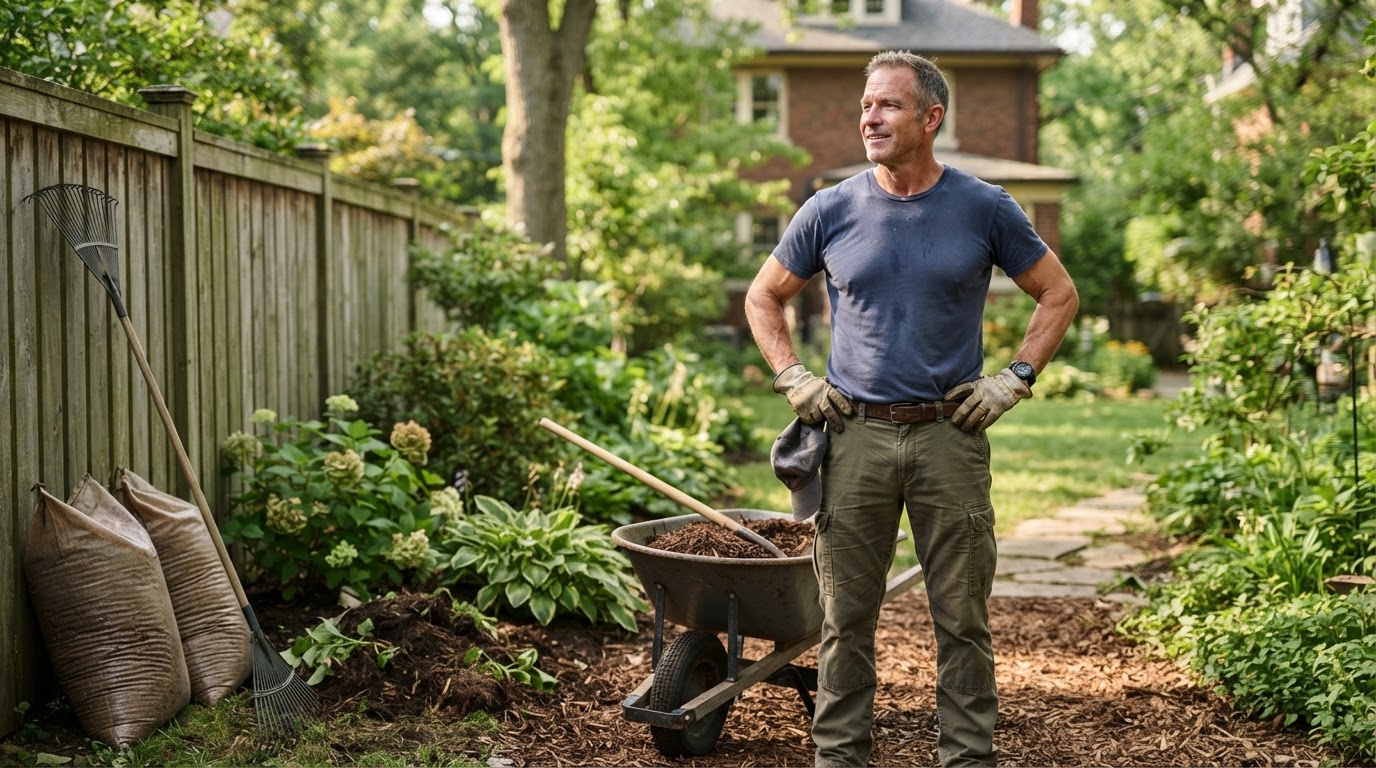
Quick answer: Yard work can absolutely function like a workout. Pushing a mower, carrying mulch, digging, raking, pruning and repeatedly getting up and down can load your legs, back, shoulders, arms and grip for hours. General yard work can reach moderate exercise intensity, while demanding digging or shoveling can become vigorous. If the work is unfamiliar, the combination of repeated loading, eccentric muscle actions, awkward positions and sheer duration can leave you stiff or sore for the next day or two. The best recovery strategy starts before the project: plan the workload, rotate tasks, manage heat and hydration, use better leverage, then recover with gentle movement, normal food, sleep and time. [1–6]
You may not think of Saturday's yard project as exercise.
Your muscles do not care what you call it.
Carry ten bags of mulch across a driveway.
Push a mower up a slope for an hour.
Dig through compacted soil.
Rake leaves into piles.
Pull weeds while crouching.
Lift those piles into bags.
Then carry everything to the curb.
By Sunday morning, your legs, back, shoulders and forearms may feel as though you spent the previous day in the gym.
That reaction is not strange.
Yard work combines many of the same physical demands found in structured exercise—except that people often do it for much longer, with fewer planned rest periods and less attention to technique.
And if you only do major yard projects occasionally, your body may be especially unaccustomed to the workload.
Table of Contents
- Does yard work really count as exercise?
- Why yard work makes muscles sore
- Which yard tasks are hardest on the body?
- Why unfamiliar work hits harder
- What to do before you start
- How to pace yard work during the day
- Why posture and leverage matter
- How to recover after yard work
- Does stretching prevent soreness?
- What about food, water and sleep?
- What if you are still sore the next day?
- When soreness may be an injury
- Where LactiGo fits
Yes, Yard Work Can Be Real Exercise
Public-health guidance does not treat yard work as inactivity.
CDC lists general yard work and home repair among examples of moderate-intensity physical activity.
Heavy yard tasks such as digging or shoveling can reach vigorous intensity when they substantially raise heart rate and breathing. [1]
That makes sense when you look at what the body is doing.
Yard work can include:
- Walking
- Carrying
- Pushing
- Pulling
- Squatting
- Kneeling
- Reaching
- Lifting
- Rotating
- Gripping
- Repeated arm movement
And unlike a carefully timed gym session, a yard project may continue for several hours.
The workload adds up.
"I'm Fit—Why Did Gardening Make Me So Sore?"
Because fitness is specific.
You may be able to:
- Run five miles
- Bench press your body weight
- Cycle for two hours
- Play tennis several times per week
and still become sore after a day of landscaping.
Your normal training may not prepare you for:
- Repeated shovel work
- Long periods bent toward the ground
- Hundreds of rake pulls
- Carrying awkward bags
- Kneeling and standing repeatedly
- Grip-heavy pruning
- Working with your arms overhead
Being fit helps.
It does not make every unfamiliar movement familiar.
Yard Work Is Often a Full-Body Circuit You Never Planned
Think about a basic mulch project.
Loading bags into a wheelbarrow
That requires:
- Hip and knee extension
- Trunk stabilization
- Grip
- Upper-body pulling
Pushing the wheelbarrow
Now the demand shifts toward:
- Legs
- Calves
- Trunk
- Shoulders
- Grip
Emptying and spreading mulch
Now you add:
- Rotation
- Bending
- Reaching
- Repeated shovel or rake work
Standing back up
Your quadriceps and hips repeatedly control and reverse your body weight.
Do that for three hours and the total muscular workload can become substantial.
The challenge is not necessarily one maximal effort.
It is the accumulation of hundreds of smaller ones.
Why Yard Work Can Trigger DOMS
Delayed-onset muscle soreness is particularly common after unfamiliar loading, especially when muscles perform repeated eccentric contractions.
An eccentric contraction occurs when an active muscle produces force while lengthening.
Classic exercise examples include:
- Lowering a dumbbell
- Descending into a squat
- Running downhill
Yard work contains its own versions.
Your quadriceps lengthen under load as you lower yourself toward the ground.
Your back and hip muscles control your trunk as you bend.
Your shoulders control tools through parts of a pulling or lowering motion.
Your legs absorb force as you step down from landscaping borders or slopes.
Unaccustomed eccentric work is well established as a strong trigger for temporary strength loss, stiffness and delayed soreness. If you want to understand why unfamiliar eccentric exercise causes soreness, the lengthening-under-load demand is the key. [2,3]
Soreness Is More Complicated Than "Tiny Tears"
It is common to hear:
"You are sore because you tore your muscles."
That is an oversimplification.
Exercise-induced muscle soreness can involve changes in:
- Muscle fibers
- Cytoskeletal structures
- Excitation-contraction coupling
- Calcium regulation
- Connective tissue
- Inflammatory signaling
- Pain-sensing nerve endings
The soreness you feel is therefore not a direct meter showing exactly how much structural damage occurred.
That is why one person can feel extremely sore after yard work while another person who did the same project does not.
Why Sunday Can Feel Worse Than Saturday Night
DOMS is delayed.
You may finish the project tired but reasonably comfortable.
The next morning can be different.
Soreness often develops during the hours after unfamiliar exercise and can become more noticeable over the following day or two.
That timing is another reason yard-work soreness is sometimes confusing.
People think:
"I felt fine when I finished. Why do I hurt now?"
Because the sensation of DOMS does not need to peak during the activity that triggered it.
The Tasks That Challenge Your Body Are Not All the Same
Different yard jobs load different regions.
| Yard Task | Common Physical Demands |
|---|---|
| Raking | Repeated pulling, trunk rotation, grip and shoulder work |
| Digging | Forceful leg and arm work, bending, lifting and trunk stabilization |
| Shoveling | Repeated lifting, carrying, rotation and grip |
| Weeding | Prolonged bending, crouching, kneeling or repeated transitions |
| Mowing | Walking, pushing, turning and sustained grip |
| Hedge trimming | Shoulder work, gripping and sometimes prolonged arm elevation |
| Carrying soil or mulch | Loaded carrying, grip, legs and trunk stabilization |
| Moving stones or pavers | Higher-force lifting and carrying |
| Pruning | Grip, forearm and shoulder repetition |
| Hillside work | Additional leg demand, balance and eccentric loading |
That variety is exactly why a full yard day can produce soreness in places you did not expect.
Weeding Is a Good Example of Why Position Matters
A 2026 biomechanics study compared five common manual-weeding positions in 20 adults using motion capture and muscle-activity measurements.
The researchers found different tradeoffs depending on posture.
Standing while bent forward produced the greatest lumbar load.
Crouching produced the greatest shoulder, arm and knee demands.
Sitting on a bucket produced the lowest spinal muscle activation among the positions tested, with moderate joint loading. [4]
The lesson is not that everyone should weed from one perfect position.
It is that changing position changes where the work goes.
That gives us a better practical strategy:
Do not stay in one demanding posture for the entire project.
Repetition Matters as Much as Weight
A bag of mulch does not need to feel like a maximal deadlift to become tiring.
If you lift it:
- From the ground
- Away from your body
- While turning
- Over and over
the repeated demand matters.
NIOSH's lifting-risk framework considers more than the weight of an object.
Relevant variables include:
- How far the load is from the body
- How high or low the hands begin
- How far the object travels
- Whether the body twists
- How often lifting occurs
- How long the task continues
- How well the object can be gripped [5]
That is useful outside the workplace too.
A manageable object can become much more demanding when leverage, repetition and fatigue work against you.
The Combination to Avoid: Bend, Reach, Twist, Lift
Many yard projects naturally encourage this pattern.
You bend toward an object.
Reach forward.
Grab it.
Then twist while standing.
The farther the load moves from your body, the greater the mechanical demand on your trunk.
NIOSH and OSHA ergonomics guidance consistently identify repetitive lifting, bending, twisting, awkward posture and prolonged forceful work as important musculoskeletal risk factors. [5,6]
For a weekend project, you do not need an industrial ergonomics calculation.
Use the principle.
Better option
Step toward the object.
Get closer.
Face the direction you are moving.
Split a heavy load when possible.
Use a wheelbarrow, cart or another tool when the job allows it.
Yard Work Gets Harder When Fatigue Changes Your Technique
Early in the morning you may lift carefully.
Three hours later:
- You stop getting as close to the bag
- You yank the rake harder
- You bend instead of repositioning
- You carry more because you want to finish
- You rush
That is when a manageable workload can become less manageable.
Fatigue changes decisions.
It can also change movement quality.
This is one reason the smartest time to take a break is before your body forces one.
Why the First Big Yard Day of Spring Hits So Hard
If you have not raked, shoveled, dug or weeded for months, your body has lost some of its task-specific familiarity.
This does not mean you became unhealthy over the winter.
It means your tissues have not recently experienced that particular loading pattern.
Research on unfamiliar eccentric exercise shows a powerful adaptation called the repeated-bout effect.
After one unfamiliar exposure, a similar later exposure generally produces:
- Less soreness
- Less strength loss
- Smaller changes in several markers of exercise-induced muscle damage [2,7]
Your second major yard weekend may therefore feel much easier than your first—even if the workload is similar.
Yard Work Has Its Own Repeated-Bout Effect
You may have noticed this without knowing the name.
The first weekend you spend three hours cleaning up the yard leaves you sore for days.
Two weeks later, you do another long project and barely notice it.
That does not mean the second project was useless exercise.
It means your body adapted to the loading.
The same concept explains why experienced gardeners and landscapers can tolerate tasks that leave an occasional weekend gardener exhausted.
Repeated exposure builds task-specific capacity.
Before Yard Work: Prepare the Project, Not Just Your Muscles
Recovery begins before the first shovel hits the soil.
You can reduce unnecessary fatigue by organizing the work.
1. Look at the whole project
Instead of thinking:
"I need to finish the yard today."
Break the project into physical categories.
For example:
- Heavy carrying
- Digging
- Ground-level work
- Raking
- Mowing
- Detail work
Avoid scheduling every high-demand task back to back when you have a choice.
2. Put the Hardest Work Earlier
If a project includes moving stones, soil or large bags, consider doing that work while you are fresher.
Save lighter tasks for later.
This is the same idea used in training.
High-force work usually makes more sense before fatigue has accumulated.
3. Start Moving Before You Start Loading
You do not need a complicated gym warm-up.
A few minutes of easy movement can help you assess how your body feels before the work becomes demanding.
Try:
- Walking around the yard
- Easy bodyweight squats
- Gentle hip movement
- Shoulder circles
- A few unloaded practice repetitions of the task
The goal is not to prevent DOMS through stretching.
It is to transition from sitting to physical work and notice any limitations before adding heavy loads.
4. Choose Tools That Improve Leverage
The tool changes the task.
Longer handles can reduce how far you need to bend for some jobs.
Carts and wheelbarrows reduce carrying.
A smaller shovel load may be better than repeatedly struggling with an overloaded one.
Research in agricultural and landscaping work supports the basic ergonomic principle that tool design and posture can change musculoskeletal demand. [4–6]
Do not make a project harder just because you technically can lift the load.
5. Plan for Heat Before You Are Hot
Outdoor physical work creates metabolic heat.
Sun, humidity and air temperature add environmental heat on top of it.
CDC and NIOSH identify physical exertion, dehydration, direct sun and lack of heat acclimatization among factors that increase heat-stress risk. [8]
If the day will be hot:
- Start earlier when practical
- Make water easy to reach
- Plan shade or indoor cooling breaks
- Wear appropriate clothing
- Reduce continuous heavy work as heat rises
Heat management is part of recovery because severe heat strain is not a normal consequence of "working hard."
During Yard Work: Rotate Before Something Starts Complaining
Task rotation is one of the simplest ways to redistribute physical demand.
Instead of:
90 minutes bent over weeding
try alternating among tasks that use different positions.
For example:
Weeding
↓
Walking and moving light debris
↓
Raking
↓
Standing pruning
↓
Ground-level work again
You are not eliminating workload.
You are changing which tissues carry it continuously.
That can be particularly useful for the:
- Lower back
- Knees
- Shoulders
- Hands and forearms
Switch Sides When the Task Allows It
Many yard tools encourage one dominant pattern.
You rake to one side.
Carry a bag on one side.
Turn the same direction with every shovel.
Use the same hand for pruning.
When it is safe and practical, changing hands or stance can reduce how much one side repeatedly does.
Do not force unfamiliar coordination with hazardous equipment.
But for simple manual tasks, a little symmetry can be useful.
Use Smaller Loads More Often
People often try to save trips by carrying more.
That can be a bad bargain.
A load that makes you:
- Lean heavily
- Hold your breath
- Twist
- Lose grip
- Change your walking pattern
is giving you useful information.
Split it.
You may make an extra trip while reducing peak load and keeping movement cleaner.
Hydration Matters More When the Yard Becomes a Hot Worksite
For moderate physical activity in the heat lasting less than two hours, NIOSH workplace guidance recommends roughly one cup of water every 15–20 minutes, while prolonged heavy sweating can increase the need for electrolyte-containing fluids. [8]
That is occupational guidance, not a personalized prescription.
Fluid needs differ with:
- Body size
- Temperature
- Humidity
- Sweat rate
- Medical conditions
- Medications
But the practical lesson is straightforward:
Do not wait until a multi-hour hot-weather project is nearly finished to think about water.
If You Feel Faint or Weak in the Heat, Stop
Do not treat heat illness as a toughness test.
CDC guidance for outdoor workers specifically advises stopping activity and getting to a cool place if you feel faint or weak during hot conditions. [9]
Symptoms such as:
- Confusion
- Fainting
- Severe dizziness
- Altered mental status
- Very high body temperature
need urgent attention.
Ordinary muscle fatigue and dangerous heat illness are not the same thing.
After Yard Work: Do Not Turn Recovery Into Another Workout
You finished the project.
You do not need a complicated 12-step recovery protocol.
Start with the basics.
Move a little
An easy walk around the house or yard can feel better than immediately becoming completely sedentary.
Light activity may reduce the perception of soreness for some people.
That does not mean it is "flushing lactic acid" or rapidly repairing muscle.
Cool down if you worked in heat
Get out of direct sun.
Change out of hot or sweat-soaked clothing.
Drink according to your needs.
Give your body time to dissipate heat.
Eat normally
A normal meal containing protein, carbohydrate and sufficient total energy gives the body resources it uses during recovery.
You do not need to turn yard work into an excuse for an elaborate supplement routine.
Sleep
Recovery continues long after the tools are put away.
Give yourself a normal opportunity for adequate sleep rather than treating a physically demanding day as if it has no effect on the rest of your routine.
You Do Not Need to "Flush Out Lactic Acid"
This myth follows physical activity everywhere.
Yard work is no exception.
The soreness you notice the next day is not lactate trapped in your back or legs.
Lactate turnover occurs on a much shorter timeline than DOMS.
Stretching, massage, sweating or using a topical product should therefore not be described as flushing old lactic acid from the muscles.
The recovery target is not "lactic acid removal."
It is allowing your body to recover from the overall workload.
Does Stretching Prevent Yard-Work Soreness?
Probably not in any meaningful way.
A 2021 systematic review and meta-analysis of randomized trials found no convincing benefit of post-exercise stretching for reducing DOMS at 24, 48 or 72 hours compared with passive recovery. [10]
That does not mean stretching is useless.
Gentle stretching may:
- Feel good
- Help you explore comfortable range of motion
- Reduce the sense of stiffness temporarily
But do it because it feels useful—not because you believe it will erase tomorrow's soreness.
Do not force a sore muscle aggressively into painful positions.
What About Massage or Foam Rolling?
Recovery-technique research suggests massage can reduce perceived DOMS and fatigue after exercise, while several other modalities show smaller effects. [11]
That can make gentle self-massage or foam rolling reasonable if you enjoy it.
The important word is:
comfort.
Less soreness does not prove that:
- Strength is fully restored
- Tissue repair is complete
- An injury has healed
- You are ready for another maximal workload
Use symptom-relief tools as symptom-relief tools.
Do You Need a Protein Shake After Gardening?
Probably not simply because you gardened.
Protein contributes to muscle remodeling and recovery, and research suggests protein intake can support some aspects of muscle-function recovery after damaging resistance exercise. [12]
But you can get protein from normal food.
A post-yard-work meal might be as ordinary as:
- Eggs and toast
- Yogurt and fruit
- Chicken and rice
- Beans and tortillas
- Fish and potatoes
- Tofu and noodles
There is no special "yard-work anabolic window."
Eat a reasonable meal.
Tomorrow Morning: Move Before You Judge the Damage
The first few steps out of bed may feel worse than the rest of the morning.
Before deciding that you "wrecked yourself," give your body a chance to move.
Try:
- Easy walking
- Comfortable joint motion
- A warm shower if you like one
- Normal daily activity
Typical DOMS often loosens somewhat once you start moving.
The question is whether the symptoms fit the familiar pattern of post-exercise soreness.
If You Are Still Sore, Can You Be Active?
Usually, mild familiar soreness does not require complete inactivity.
Use the same readiness principles you would use after a workout.
If you have ever wondered whether you should exercise while still sore, the same logic applies here.
If you have:
- Mild diffuse soreness
- Normal walking
- Normal range of motion
- No obvious weakness
- No sharp pain
ordinary movement may be completely reasonable.
If your next planned activity is demanding—heavy lifting, sprinting, another major yard project—judge whether your function has returned enough for that task.
You do not need zero soreness.
You do need enough function to perform the next activity well.
When Yard-Work Soreness May Be More Than DOMS
Not every painful back, shoulder or knee after yard work is delayed-onset muscle soreness.
Be more cautious if you experienced:
- Sudden pain during one specific movement
- A pop or tearing sensation
- Sharp localized pain
- Significant swelling
- Bruising
- New numbness or tingling
- Marked weakness
- Inability to use the limb normally
- Pain that continues worsening instead of gradually improving
Those patterns deserve a different response than ordinary diffuse post-work soreness.
Back Pain Deserves Special Attention to the Pattern
A tired, diffusely achy back after hours of manual work can occur.
But severe or unusual back pain should not automatically be explained away as muscle fatigue.
Seek appropriate medical evaluation for symptoms such as:
- Significant weakness
- New numbness
- Loss of bladder or bowel control
- Numbness around the groin or saddle region
- Major trauma
- Severe progressive pain
A recovery article should help readers distinguish ordinary post-activity discomfort from symptoms that need more attention.
Where LactiGo Fits Before Yard Work
Yard work is one of the everyday physical-demand contexts the current LactiGo Science page explicitly discusses.
The brand page describes LactiGo as part of a routine for activities ranging from athletic training to strenuous yard work, and its application framework refers to muscle groups a user plans to train or recover. [13]
That gives LactiGo a natural before-activity position in this article.
But the evidence levels need to remain clear.
LactiGo's direct peer-reviewed performance trial was not a yard-work study.
It involved seven world-class rugby sevens players performing intermittent high-intensity cycling. [14]
The gel was applied 40 minutes before exercise.
That study establishes a real pre-exercise product research context.
It does not establish that LactiGo:
- Prevents gardening fatigue
- Prevents DOMS from yard work
- Prevents back strain
- Allows safer lifting
- Prevents heat illness
- Makes poor ergonomics harmless
Those questions have not been demonstrated by that trial.
The Brand's Timing Framework and the Study Timing Are Similar—but Not Identical
The LactiGo Science page describes an approximately 45-minute pre-activity framework. [13]
The peer-reviewed 2025 trial used 40 minutes. [14]
Keep those two numbers attached to the sources they belong to.
Do not turn them into a claim that muscle carnosine has been proven to "peak" 40–45 minutes after topical application.
The study did not measure intramuscular carnosine concentration.
Where LactiGo Fits After Yard Work
After physical activity, the product has another relevant context.
The current U.S. DailyMed label identifies LactiGo as a topical product with menthol 1.5% as the active ingredient and L-carnosine among the inactive ingredients. Its labeled purpose is topical analgesia for specified minor muscle and joint aches. [15]
That is separate from the pre-exercise performance study.
The useful evidence framework is:
Before demanding activity
LactiGo has a product-specific pre-exercise performance study.
After activity
Follow the product's applicable directions when using it for a qualifying minor ache.
What it does not replace
- Smart lifting
- Task rotation
- Heat management
- Rest
- Food
- Sleep
- Medical assessment of an injury
A topical product belongs inside a recovery plan.
It should not become the recovery plan.
Yard Work Is Physical Work. Prepare for It That Way.
A long project can challenge your muscles before you ever call it exercise. LactiGo is designed to fit into an active routine before demanding physical activity and afterward when appropriate.
Explore the human performance research, the pre-activity application framework and the science behind topical carnosine.
Learn More About LactiGoThe Bottom Line
Yard work can feel like a workout because, physiologically, it often is one.
CDC classifies general yard work as moderate physical activity, while demanding digging and shoveling can reach vigorous intensity. [1]
But the reason you wake up sore is not only heart rate.
A long yard project can combine:
- Unfamiliar eccentric loading
- Repeated lifting
- Carrying
- Bending
- Pulling
- Grip work
- Awkward positions
- Hours of accumulated fatigue
That combination can challenge muscles differently from your normal exercise routine.
The best strategy is not waiting until afterward to think about recovery.
Start before the project.
Plan the work.
Use better leverage.
Rotate positions.
Split heavy loads.
Respect heat.
Drink appropriately.
Then, when the work is finished:
Move gently.
Eat normally.
Sleep.
Use comfort strategies for what they actually do.
Stretching may feel good, but current evidence does not support it as a reliable way to prevent DOMS. [10]
Massage or foam rolling may reduce perceived soreness, but less pain does not prove full recovery. [11]
And when you tackle a similar project again, there is a good chance it will feel easier because the body adapts to repeated exposure. That protective response is part of the repeated-bout effect. [2,7]
LactiGo can fit into that bigger picture before as well as after activity.
Its direct human research includes pre-exercise topical application, while its brand science page also frames use around muscle groups a person plans to train or recover. [13,14]
But no gel turns poor mechanics into good mechanics.
No gel replaces water in the heat.
And no gel makes an injury disappear.
The smartest weekend-warrior strategy is therefore simple:
Treat yard work like physical work before it reminds you that it was.
Frequently Asked Questions
Does yard work count as exercise?
It can. CDC lists general yard work among moderate-intensity physical activities, while heavy digging or shoveling can reach vigorous intensity. [1]
Why am I so sore after yard work?
Yard work often combines unfamiliar movements, repeated eccentric muscle actions, lifting, carrying, awkward positions and long duration. That combination can trigger DOMS even in otherwise fit people.
Why does my back hurt after gardening?
Gardening can involve prolonged bending, lifting, pulling and twisting. A 2026 biomechanics study found that standing while bent forward during simulated weeding produced the greatest lumbar load among the positions tested. [4]
Is weeding actually hard on your body?
It can be. Different weeding positions shift load among the back, shoulders, arms and knees. Changing posture and taking work-rest breaks can reduce prolonged exposure to one demanding position. [4]
Why am I sore after gardening even though I exercise?
Fitness is activity-specific. Your regular workout may not prepare you for hours of bending, digging, carrying, kneeling, pulling and gripping.
Is yard-work soreness caused by lactic acid?
No. Next-day DOMS is not caused by lactate remaining trapped in the muscle.
Should I stretch after yard work?
You can stretch gently if it feels good, but evidence does not show that post-exercise stretching meaningfully prevents or reduces DOMS compared with passive recovery. [10]
Does massage help after yard work?
Massage may reduce perceived soreness and fatigue. It should be considered a comfort strategy rather than proof that muscle function has fully recovered. [11]
Should I drink electrolytes while doing yard work?
For shorter moderate work in ordinary conditions, water may be sufficient for many people. Prolonged heavy sweating can increase electrolyte losses. NIOSH specifically notes balanced electrolyte drinks for sweating that lasts several hours in hot work environments. [8]
How often should I drink when working outside in the heat?
NIOSH workplace guidance suggests about 8 ounces of water every 15–20 minutes for moderate activity in heat lasting less than two hours. Individual needs vary, particularly with health conditions, medications and environmental conditions. [8]
Why is the first yard-work day of spring always the worst?
The activity is relatively unfamiliar after months without exposure. After one bout, the repeated-bout effect can make similar later work less disruptive. [2,7]
Should I rest completely if I am sore the next day?
Not necessarily. Mild familiar soreness with normal movement usually does not require complete inactivity. Adjust more demanding activity if strength, range of motion or movement quality remains clearly impaired.
When should I worry that yard-work pain is an injury?
Be more cautious with sharp or focal pain, a specific painful incident, major swelling, bruising, marked weakness, numbness or an inability to use the affected area normally.
Can LactiGo be used before yard work?
The LactiGo Science page includes strenuous yard work within its everyday-activity positioning and describes applying the product to muscle groups planned for activity or recovery. LactiGo also has direct human research involving pre-exercise application, although that study was conducted in elite rugby players rather than people doing yard work. [13,14]
Was LactiGo tested specifically for gardening soreness?
No. The peer-reviewed LactiGo performance study did not evaluate yard work, gardening or DOMS prevention. [14]
Does LactiGo prevent muscle soreness after yard work?
That has not been established in applicable human research.
External References
- Centers for Disease Control and Prevention. How to Measure Physical Activity Intensity. CDC Physical Activity Basics. General yard work and home repair are listed as examples of moderate-intensity activity; heavy digging or shoveling can qualify as vigorous activity. CDC
- Hody S, Croisier JL, Bury T, Rogister B, Leprince P. Eccentric Muscle Contractions: Risks and Benefits. Frontiers in Physiology. 2019;10:536. PMID: 31130877. PMCID: PMC6510035. DOI: 10.3389/fphys.2019.00536. PubMed
- McHugh MP, Connolly DAJ, Eston RG, Gleim GW. Exercise-induced muscle damage and potential mechanisms for the repeated bout effect. Sports Medicine. 1999;27(3):157–170. PMID: 10222539. DOI: 10.2165/00007256-199927030-00002. PubMed
- Wu Y, Dunleavy K, Hu B. Biomechanical evaluation of manual weeding postures in nursery and landscaping tasks. International Journal of Occupational Safety and Ergonomics. 2026. PMID: 42468030. DOI: 10.1080/10803548.2026.2696143. PubMed
- National Institute for Occupational Safety and Health. Revised NIOSH Lifting Equation. CDC/NIOSH. Use for general lifting-risk principles including load distance, vertical position, asymmetry, frequency, duration and grip quality. CDC/NIOSH
- Occupational Safety and Health Administration. Landscape and Horticultural Services — Hazards and Solutions. OSHA identifies lifting, awkward postures, heat, equipment and other hazards in landscaping and horticultural work. OSHA
- McHugh MP. Recent advances in the understanding of the repeated bout effect: the protective effect against muscle damage from a single bout of eccentric exercise. Scandinavian Journal of Medicine & Science in Sports. 2003;13(2):88–97. PMID: 12641640. DOI: 10.1034/j.1600-0838.2003.02477.x. PubMed
- National Institute for Occupational Safety and Health. Workplace Recommendations — Heat Stress. Updated July 16, 2026. Includes current NIOSH recommendations on heat exposure, hydration, acclimatization, rest breaks and work-demand reduction. CDC/NIOSH
- Centers for Disease Control and Prevention. Heat and Outdoor Workers. CDC Heat Health. Advises outdoor workers to stop activity and move to a cool place if faint or weak during heat exposure. CDC
- Afonso J, Clemente FM, Nakamura FY, et al. The Effectiveness of Post-exercise Stretching in Short-Term and Delayed Recovery of Strength, Range of Motion and Delayed Onset Muscle Soreness: A Systematic Review and Meta-Analysis of Randomized Controlled Trials. Frontiers in Physiology. 2021;12:677581. PMID: 34025459. DOI: 10.3389/fphys.2021.677581. PubMed
- Dupuy O, Douzi W, Theurot D, Bosquet L, Dugué B. An Evidence-Based Approach for Choosing Post-exercise Recovery Techniques to Reduce Markers of Muscle Damage, Soreness, Fatigue, and Inflammation: A Systematic Review With Meta-Analysis. Frontiers in Physiology. 2018. PMID: 29755363. PubMed
- Pearson AG, Hind K, Macnaughton LS. The impact of dietary protein supplementation on recovery from resistance exercise-induced muscle damage: A systematic review with meta-analysis. European Journal of Clinical Nutrition. 2023;77(8):767–783. PMID: 36513777. PMCID: PMC10393778. DOI: 10.1038/s41430-022-01250-y. PubMed
- LactiGo. The Science Behind Transdermal Carnosine Gel. Use for current product positioning, the brand-described pre-activity framework, targeted application and everyday physical-activity context. LactiGo Science
- Beaven CM, James C, McMaster DT, Brockelbank N. Topical carnosine gel improves intermittent high-intensity exercise performance in world-class rugby sevens players. Journal of the International Society of Sports Nutrition. 2025;22(1):2550311. PMID: 40859880. PMCID: PMC12427510. DOI: 10.1080/15502783.2025.2550311. PubMed
- DailyMed / U.S. National Library of Medicine. LACTIGO — Menthol Gel. Updated March 25, 2026. Current label: menthol 1.5% active ingredient; L-carnosine listed among inactive ingredients. DailyMed