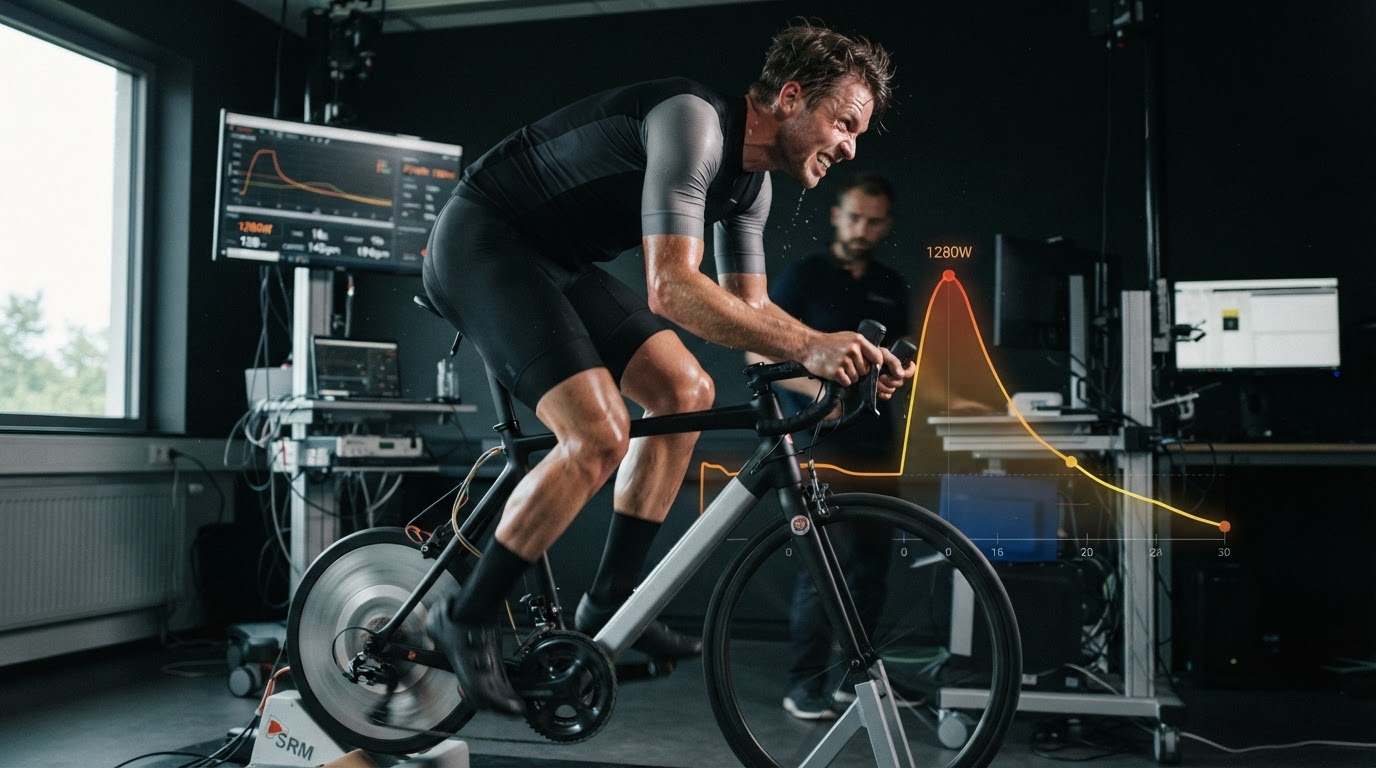
The Wingate Anaerobic Test is one of exercise physiology's best-known laboratory tests of short-duration maximal cycling. The traditional protocol asks a participant to pedal all-out against resistance for approximately 30 seconds while researchers measure variables such as peak power, mean power, total work, and the decline in power across the effort.
That makes the Wingate test an obvious place to investigate carnosine.
Carnosine is concentrated inside skeletal muscle and contributes to intracellular buffering as muscle chemistry changes during intense exercise. Beta-alanine supplementation can increase muscle carnosine, which has led researchers to ask whether greater muscle-buffering capacity can help athletes maintain power during demanding cycling efforts.
The answer is more nuanced than:
"Carnosine improves Wingate performance."
Research has produced different results depending on the protocol.
A 2014 study using four repeated modified Wingate bouts found that four weeks of beta-alanine supplementation increased total work performed in both trained and non-trained men. The reported increases were approximately 3.64% in trained participants and 2.52% in non-trained participants.
In contrast, a 2015 study in trained female cyclists found that an acute 1.6-gram dose of beta-alanine before three repeated Wingates did not improve peak power, mean power, fatigue index, lactate, or heart rate, although ratings of perceived exertion were lower at several measurement points.
Another study increased skeletal-muscle carnosine by 33% after four weeks and 52% after ten weeks of beta-alanine supplementation, yet beta-alanine did not increase work performed during a six-week sprint-interval program consisting of four to six Wingates per training session, nor did it add to the training adaptations measured.
Topical carnosine research adds another layer. A 2023 randomized crossover trial in 15 trained male cyclists tested a mentholated topical carnosine gel before five repeated Wingate sprints and reported no statistically significant improvement in the measured performance outcomes.
Yet in 2025, a different topical carnosine protocol—LactiGo applied before repeated six-second efforts in world-class rugby sevens players—was associated with higher peak power during Sprints 2, 4, and 7. That trial was not a Wingate test, and the difference in protocol matters.
The most useful conclusion is therefore:
Wingate research shows why exercise duration, repetition, recovery interval, training status, dosing strategy, and the performance variable being measured all matter when evaluating carnosine-related interventions.
Key Takeaways
- The traditional Wingate test is an approximately 30-second all-out cycling test used to characterize short-duration power and capacity.
- Peak power, mean power, total work, and power decline describe different aspects of performance.
- A Wingate is not metabolically "pure." Phosphagen, glycolytic, and oxidative energy pathways all contribute, although their relative contribution changes during the effort.
- Carnosine is relevant because it contributes to intracellular buffering inside skeletal muscle.
- A single short explosive effort may not reveal the same benefit as repeated efforts that create progressively greater metabolic disturbance.
- Four weeks of beta-alanine improved total work during four repeated modified Wingates in both trained and non-trained men in a 2014 study.
- An acute 1.6-gram beta-alanine dose did not improve performance during three repeated Wingates in trained female cyclists.
- Increasing muscle carnosine does not guarantee improvement in every Wingate protocol or every training adaptation.
- A 2023 topical carnosine study did not improve five repeated Wingate efforts in trained male cyclists.
- A separate 2025 LactiGo study found higher peak power during selected six-second repeated sprints in world-class rugby sevens players, demonstrating why different sprint protocols should not be treated as equivalent.
- Lactate should not be described as a metabolic waste product or the direct cause of the muscle "burn."
- The Wingate test is valuable precisely because it shows that "anaerobic performance" is not one single variable.
Table of Contents
- What is the Wingate test?
- What happens during 30 seconds of all-out cycling?
- What does peak power measure?
- What does mean power measure?
- What is the fatigue index?
- Is the Wingate test purely anaerobic?
- Why is carnosine relevant?
- Why might repeated Wingates matter more?
- What did the 2014 beta-alanine study find?
- Does training status change the response?
- What happens after an acute beta-alanine dose?
- What happens when muscle carnosine increases but performance does not?
- What does the topical carnosine Wingate study show?
- How does the 2025 LactiGo trial differ?
- Why Wingate results cannot be generalized to every sport
- What athletes should take from the research
- Where LactiGo fits
- Frequently asked questions
What Is the Wingate Anaerobic Test?
The Wingate Anaerobic Test—often abbreviated WAnT—is a laboratory cycling protocol designed to evaluate short-duration maximal power and work capacity.
The test was developed through exercise-physiology research associated with the Wingate Institute and became widely used because it provides several performance measurements from one intense bout.
The traditional version is simple to describe:
Pedal as hard as possible for approximately 30 seconds against a predetermined resistance.
Simple does not mean easy.
A properly performed Wingate demands near-maximal effort from the beginning and asks the athlete to continue driving the pedals as power inevitably changes across the test.
Classic exercise-physiology reviews identify the Wingate as a widely used method for evaluating anaerobic power and capacity, while also emphasizing important methodological issues involving resistance, measurement, reliability, and interpretation.
Want to See What a Wingate Test Actually Looks Like?
The Wingate is easier to understand once you see an athlete perform it. This exercise-physiology laboratory demonstration from Ohio Dominican University shows the basic setup and all-out cycling effort used during Wingate testing.

Peak power usually occurs early in a Wingate, while mean power and total work reflect performance across the entire effort.
What Happens During 30 Seconds of All-Out Cycling?
A Wingate compresses several physiological events into half a minute.
At the start, the athlete accelerates rapidly.
Power rises quickly.
The phosphagen system contributes heavily to the first seconds of work.
As the sprint continues, glycolytic ATP production becomes increasingly important.
Oxidative metabolism also contributes during the effort, which is why describing the Wingate as though it were powered by a single "anaerobic system" is an oversimplification.
Meanwhile:
- ATP is being turned over rapidly.
- Phosphocreatine availability changes.
- Glycolytic flux increases.
- Hydrogen-ion handling becomes increasingly important.
- Inorganic phosphate and other metabolites change.
- Muscle activation must be maintained.
- Power commonly declines from its early peak.
By the final seconds, the athlete may still be giving maximal effort even though the bicycle is recording substantially less power than earlier.
That is one reason the test is so useful.
It allows researchers to distinguish:
How high did power get?
from:
How much power could the athlete sustain?
Peak Power and Mean Power Are Not the Same Thing
A major mistake when reading Wingate studies is to treat every watt value as though it means the same thing.
It does not.
Peak Power
Peak power represents the highest power output achieved during the test.
Depending on the equipment and sampling method, this may occur within the early seconds.
Peak power is heavily influenced by:
- Neuromuscular explosiveness
- Rapid force production
- Cadence
- Resistance
- Muscle fiber characteristics
- Phosphagen availability
- Test setup
An athlete can have exceptional peak power yet experience a large decline afterward.
What Does Mean Power Measure?
Mean power is the average power produced across the test interval.
During a 30-second Wingate, this tells us more about the athlete's ability to sustain high work output across the entire effort.
Mean power and total work are therefore highly relevant when the research question involves:
- Sustained supramaximal exercise
- Glycolytic contribution
- Buffering
- Resistance to declining power
This distinction becomes especially important for carnosine.
Carnosine's intracellular-buffering role would not necessarily be expected to influence the very first instant of power production in exactly the same way it might influence later portions of a demanding bout.
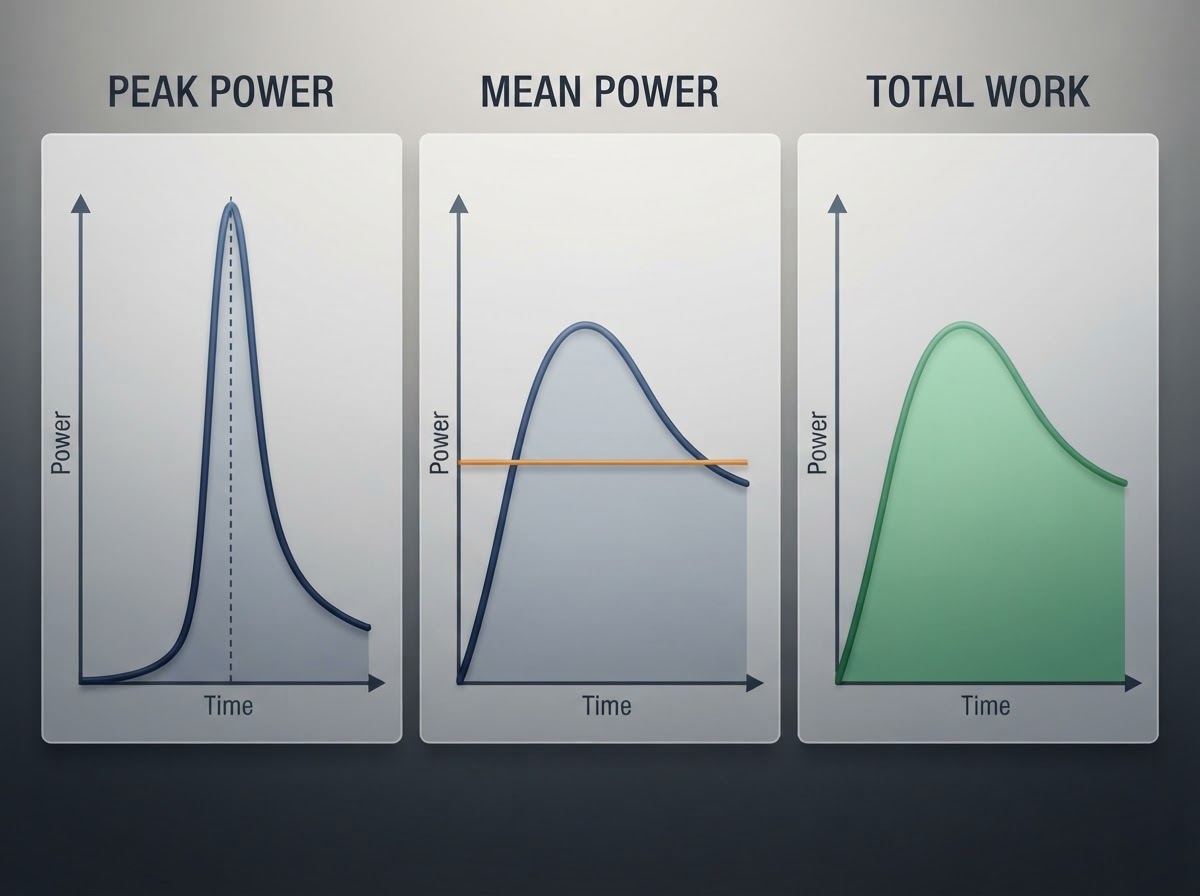
Peak power, mean power and total work answer different performance questions and should not be treated as interchangeable outcomes.
What Is the Wingate Fatigue Index?
The fatigue index attempts to describe how much power falls during the test.
A simplified version compares:
peak power
with
lowest power
and expresses the decline as a percentage.
A larger decline is often interpreted as greater fatigue across the effort.
But this metric needs caution.
Classic analyses of anaerobic testing have questioned how reliably power decline can be interpreted as a pure measure of "anaerobic fatigue." Aerobic capacity, muscle-fiber characteristics, pacing behavior, equipment methodology, and other factors can affect the result.
So avoid saying:
"Fatigue index directly measures how much lactic acid made the athlete tired."
That is not physiologically accurate.
Is the Wingate Test Really "Anaerobic"?
The name can be misleading if interpreted literally.
The Wingate strongly stresses pathways commonly described as anaerobic, but oxygen-dependent metabolism does not switch off for 30 seconds.
Energy production operates simultaneously.
The relative contribution changes over time.
The earliest seconds rely heavily on immediately available ATP and phosphocreatine.
Glycolysis contributes substantially as the effort continues.
Oxidative metabolism contributes as well.
A better description is:
The Wingate is a maximal, short-duration test with a very large anaerobic contribution.
That is different from saying:
The Wingate uses no oxygen-dependent metabolism.
Where Does Lactate Fit?
Wingate tests can produce high blood-lactate concentrations.
That does not mean lactate itself is the substance causing the athlete's power to decline.
Modern exercise physiology recognizes lactate as an important metabolic intermediate.
Lactate can:
- Move between tissues
- Be oxidized as fuel
- Participate in energy metabolism
During high-intensity exercise, lactate production occurs alongside many other changes.
Hydrogen-ion handling, inorganic phosphate, potassium shifts, phosphocreatine depletion, calcium handling, neural factors, and multiple other processes contribute to fatigue.
This matters because carnosine should not be described as:
"removing lactic acid from muscle."
Its best-established role is as part of the muscle's intracellular buffering system.
Why Is Carnosine Relevant to the Wingate Test?
Carnosine is a naturally occurring dipeptide made from:
beta-alanine + histidine
It occurs at high concentrations inside skeletal muscle.
One of its best-established physiological functions is helping buffer changes in intracellular pH.
During sufficiently demanding high-intensity exercise, that buffering capacity may help muscle tolerate part of the chemical disturbance associated with rapid ATP turnover.
That provides the biological rationale for this research pathway:
Beta-alanine supplementation
↓
Higher muscle carnosine
↓
Greater intracellular buffering potential
↓
Possible improvement in high-intensity exercise capacity
The word possible matters.
Increasing muscle carnosine does not guarantee improved performance in every test.
Why Beta-Alanine Appears in So Many "Carnosine" Studies
Researchers frequently administer beta-alanine rather than carnosine itself.
Beta-alanine is an important precursor used to synthesize carnosine inside skeletal muscle.
Chronic beta-alanine supplementation has repeatedly been shown to raise muscle carnosine concentrations.
That allows researchers to manipulate muscle carnosine indirectly and examine whether performance changes.
But scientifically:
A beta-alanine trial is still a beta-alanine intervention.
It provides evidence about the consequences of increasing muscle carnosine through that route.
It does not automatically validate:
- Oral carnosine
- Acute beta-alanine dosing
- Topical carnosine
- Another topical formulation
- A specific finished product
Each delivery strategy needs evidence appropriate to itself.
Does Beta-Alanine Help a Single 30-Second Wingate?
Not necessarily.
This is where exercise duration matters.
A major beta-alanine meta-analysis found that the clearest benefits were not concentrated in exercise lasting less than 60 seconds. Instead, performance effects were more evident in exercise durations where acidosis and intracellular buffering were more likely to become consequential.
That does not mean a 30-second Wingate is metabolically easy.
It means the physiological contribution of carnosine may be more detectable when:
- The high-intensity effort lasts longer
- Multiple bouts are performed
- Recovery is incomplete
- Metabolic stress accumulates
This is why repeated Wingate studies are particularly interesting.
Why Repeated Wingates May Reveal More About Buffering
Imagine two tests.
Test A
One 30-second all-out effort.
Test B
Four 30-second all-out efforts with limited recovery.
By the later efforts in Test B, the athlete is starting with a very different physiological background.
Previous bouts have already changed:
- Phosphocreatine availability
- Muscle metabolites
- Acid-base balance
- Neuromuscular state
- Recovery status
That means buffering capacity may become progressively more relevant.
A 2014 study explicitly used repeated modified Wingate testing to examine this question.
What Did the 2014 Repeated-Wingate Beta-Alanine Study Find?
Researchers Vitor de Salles Painelli and colleagues examined whether training status influenced the response to beta-alanine supplementation.
Forty young men were separated by training status.
Participants performed a four-bout modified lower-body Wingate protocol before and after supplementation.
The researchers were particularly interested in whether trained athletes—who may already possess greater muscle-buffering capacity from training—would respond differently from non-trained participants.
After four weeks of beta-alanine supplementation, total work performed increased in both groups.
The reported improvements were:
- 2.52 ± 2.64% in non-trained participants
- 3.64 ± 2.87% in trained participants
The researchers reported that the improvement in total work was related to a better ability to maintain mean power across the Wingate bouts.
This finding is important because the benefit did not appear simply as:
a dramatically higher first-bout peak.
Instead, it was consistent with maintaining work across repeated high-intensity efforts.
Did Trained Athletes Respond Differently?
The study was designed specifically because trained athletes may already have greater buffering capacity.
Before supplementation, trained participants performed more total work and showed less work decrement across the repeated protocol than non-trained participants.
Yet beta-alanine improved total work in both groups.
The investigators concluded that training status did not prevent an ergogenic response under this protocol.
That does not mean all trained athletes respond.
Other beta-alanine studies in trained populations have reported neutral findings.
The more useful interpretation is:
Training status is one potential modifier, but test design remains extremely important.
Why the Later Wingates Matter
The first 30-second effort begins with relatively fresh muscle.
The later bouts do not.
This distinction provides a logical explanation for why an intervention aimed at intracellular buffering might influence later repeated work more clearly than an isolated early burst.
In the 2014 study, the researchers specifically discussed the possibility that a single 30-second effort may not be sufficiently limited by reduced intracellular pH for increased buffering to produce an obvious effect.
Repeated supramaximal efforts create a different environment.
That distinction should be kept in mind whenever someone says:
"A Wingate study proved beta-alanine works."
The correct follow-up is:
Which Wingate protocol?
What Happens After One Acute Dose of Beta-Alanine?
A different study asked a very different question.
Instead of loading beta-alanine for weeks, researchers gave trained female cyclists 1.6 grams of beta-alanine 30 minutes before exercise.
Twelve women then completed:
- Wingate 1
- Two minutes of active recovery
- Wingate 2
- Two minutes of active recovery
- Wingate 3
Researchers measured:
- Peak power
- Mean power
- Fatigue index
- Lactate
- Heart rate
- Rating of perceived exertion
The acute beta-alanine dose did not significantly improve the performance or physiological measurements.
Ratings of perceived exertion were lower at several measurement points, but the final Wingate did not show a significant RPE difference.
This makes biological sense when considering the mechanism.
Beta-alanine's classic performance rationale depends on increasing muscle carnosine over time.
An acute dose 30 minutes before exercise is not equivalent to weeks of muscle-carnosine loading.
Chronic and Acute Beta-Alanine Should Not Be Treated as the Same Intervention
This is a recurring mistake in sports-supplement discussions.
Acute Strategy
Take beta-alanine shortly before exercise.
Chronic Strategy
Consume beta-alanine repeatedly over weeks so skeletal muscle can synthesize additional carnosine.
These are different biological strategies.
The 2015 trained-female-cyclist study showed that a single acute dose did not improve Wingate power.
Chronic loading studies can produce different results because they alter muscle carnosine concentration.
This is why simply seeing "beta-alanine" in two study titles does not mean the experiments tested the same mechanism.
What If Muscle Carnosine Increases but Wingate Training Does Not Improve More?
This happened in another important study.
Andrew Cochran and colleagues studied 24 active men who received either beta-alanine or placebo.
Beta-alanine was taken for ten weeks.
After four weeks of supplementation, participants began six weeks of sprint-interval training.
Each training session included:
4–6 Wingate tests
with:
4 minutes of recovery between 30-second maximal bouts.
Muscle biopsies showed that beta-alanine increased muscle carnosine by:
- 33% after four weeks
- 52% after ten weeks
That proves the supplementation changed muscle carnosine.
Yet total work during the sprint-training sessions was similar between the beta-alanine and placebo groups.
Both groups improved with training.
Sprint-interval training increased:
- Markers of mitochondrial content
- VO₂peak
- Repeated-sprint capacity
- Time-trial performance
But beta-alanine did not significantly augment those adaptations compared with placebo.
Why Is That Study So Important?
Because it demonstrates one of the central lessons in carnosine science:
More muscle carnosine does not guarantee a detectable improvement in every performance outcome.
The biochemical effect happened.
Muscle carnosine increased.
The hypothesized additional performance effect was not demonstrated under that training protocol.
This prevents us from turning a physiological mechanism into an automatic promise.
Study Results at a Glance
| Study | Intervention | Wingate-Related Protocol | Main Finding |
|---|---|---|---|
| de Salles Painelli et al., 2014 | Chronic beta-alanine | 4 repeated modified Wingates | Total work increased in trained and non-trained participants |
| Glenn et al., 2015 | Acute 1.6 g beta-alanine | 3 Wingates, 2-min recovery | No mechanical performance improvement; RPE lower at several points |
| Cochran et al., 2015 | Chronic beta-alanine + SIT | 4–6 Wingates/session | Muscle carnosine increased; no additional training benefit |
| Harnish & Miller, 2023 | Topical carnosine gel | 5 Wingates, ~4–5-min recovery | No significant improvement in performance measures |
| Beaven et al., 2025 | LactiGo topical carnosine gel | 12 × 6-s maximal sprints | Higher peak power in selected sprints |
The final study is included for comparison but is not a Wingate protocol.
What Did the 2023 Topical Carnosine Wingate Study Test?
Christopher Harnish and Brian Miller investigated a mentholated topical carnosine gel in trained male cyclists.
Fifteen cyclists completed the study.
The testing sequence included:
- A 15-second sprint
- Recovery
- Five 30-second Wingate sprints
- Approximately four to five minutes of active recovery between Wingates
During the topical carnosine condition, 10 mL of the gel was applied to the legs at least 60 minutes before the session.
Researchers measured power output and blood lactate.
What Did the Topical Wingate Study Find?
The investigators reported no statistically significant improvement in the performance measures between the familiarization, placebo, and topical carnosine conditions.
Their conclusion was that the tested single-dose topical carnosine protocol did not improve repeated Wingate performance in the trained male cyclists who completed the study.
That result needs to remain part of any balanced discussion of topical carnosine and high-intensity exercise.
Leaving it out because another topical study produced a positive result would weaken scientific credibility.
Does That Mean Topical Carnosine Cannot Influence Sprint Performance?
No.
It means the 2023 study did not demonstrate improved performance in that repeated-Wingate protocol.
Two years later, researchers tested a different high-intensity protocol in a different athlete population.
The 2025 study involved world-class rugby sevens players performing 12 repeated six-second maximal cycling sprints.
LactiGo was applied 40 minutes before exercise.
Peak power was significantly higher during:
- Sprint 2
- Sprint 4
- Sprint 7
compared with placebo.
These two studies should not be forced into a contradiction that one must "win."
The 2023 and 2025 Topical Studies Asked Different Questions
2023 Cyclist Study
Athletes: Trained male cyclists
Protocol: Five 30-second Wingates
Recovery: Approximately 4–5 minutes
Topical timing: At least 60 minutes before testing
Finding: No statistically significant performance improvement.
2025 Rugby Study
Athletes: World-class rugby sevens players
Protocol: Twelve 6-second maximal sprints embedded in intermittent cycling
Recovery pattern: Short repeated work-to-rest sequence with a longer break after Sprint 6
Topical timing: 40 minutes before testing
Finding: Higher peak power during Sprints 2, 4, and 7.
The difference is not trivial.
Thirty seconds of all-out cycling places very different demands on an athlete from a six-second maximal sprint.
Why Exercise Duration Changes the Question
Imagine an athlete who can produce enormous power for six seconds.
Now ask the same athlete to continue all-out for 30 seconds.
These are not merely different lengths of the same event.
The balance among physiological limitations changes.
Very Short Sprint
Greater emphasis on:
- Immediate ATP
- Phosphocreatine
- Rapid neuromuscular power
- Acceleration
Thirty-Second Wingate
Increasing importance of:
- Glycolytic ATP production
- Maintaining force as metabolites change
- Sustaining cadence
- Intracellular acid-base regulation
- Oxidative contribution as the effort continues
Repeated Wingates
Now add:
- Incomplete restoration between bouts
- Repeated metabolic disturbance
- Accumulated fatigue
- Repeated requirement to generate high work output
That is why an ergogenic intervention can produce one result in a six-second sprint protocol and another in a 30-second repeated Wingate protocol.
Why Recovery Duration Matters Too
Compare:
30 seconds all-out + 4–5 minutes recovery
with:
6 seconds all-out + 30 seconds recovery
The second protocol gives the athlete far less recovery relative to the pattern of work.
But the sprint itself is much shorter.
That changes:
- Phosphocreatine recovery
- Glycolytic contribution
- Accumulation of metabolites
- Ability to reproduce peak power
- Exercise specificity
Research protocols are not interchangeable simply because both use stationary bicycles.
Peak Power Is Not the Same as Total Work
This distinction also helps reconcile apparently different results.
The 2025 LactiGo rugby trial detected differences in peak power during selected sprints.
The 2014 repeated-Wingate beta-alanine study found improvements in total work performed, associated with maintaining mean power across repeated bouts.
These outcomes represent different athletic qualities.
Peak Power
How high can output get?
Mean Power
How much power can be maintained across an interval?
Total Work
How much mechanical work is completed across the test or repeated sequence?
An intervention could influence one without meaningfully changing another.
A Wingate Test Is a Laboratory Model, Not a Sport
Wingate tests are useful precisely because laboratories can standardize them.
Researchers can control:
- Resistance
- Test duration
- Recovery
- Equipment
- Warm-up
- Timing
- Environmental conditions
That makes scientific comparisons easier.
But rugby is not a Wingate test.
Soccer is not a Wingate test.
Road cycling is not a Wingate test.
Hockey is not a Wingate test.
Combat sports are not a Wingate test.
Each sport adds:
- Decision-making
- Technique
- Movement variability
- Opponents
- Tactical pacing
- Psychological pressure
- Sport-specific muscle recruitment
A laboratory performance effect can be relevant without automatically translating into an identical competition effect.
What Does the Wingate Test Tell Cyclists?
For cyclists, the test has obvious movement specificity because it occurs on a bicycle.
But even here, context matters.
A road cyclist may need to:
- Attack on a climb
- Close a gap
- Accelerate out of a corner
- Respond to repeated surges
- Sprint after hours of riding
A track sprinter may prioritize much shorter maximal-power efforts.
A BMX athlete faces another demand.
A repeated 30-second laboratory test provides useful information about high-intensity cycling capacity but cannot perfectly reproduce every cycling discipline.
What Does It Tell Team-Sport Athletes?
The movement is less sport-specific, but the physiology may still be useful.
A rugby, soccer, hockey, or basketball athlete repeatedly has to:
- Accelerate
- Produce force
- Recover incompletely
- Repeat the effort
Laboratories use cycle ergometers because they allow precise measurement of mechanical power without the variability of field movement.
The test becomes a controlled physiological model.
It is not an imitation of the sport.
Can You Compare Two Wingate Studies Directly?
Only after checking the methods.
Before comparing results, look for:
Duration
Was it 20, 30, or 60 seconds?
Number of Bouts
One Wingate or several?
Resistance
What braking force was used?
Recovery
Two minutes? Four minutes? Five minutes? Passive or active?
Training Status
Untrained? Recreational? Trained cyclists? Elite athletes?
Sex
Who was studied?
Supplement Strategy
Acute beta-alanine? Four weeks? Ten weeks? Topical formulation?
Outcome
Peak power? Mean power? Total work? Fatigue index?
Familiarization
Did participants practice the test first?
These differences can change the answer.
Why Familiarization Matters
A Wingate is unusual.
Someone performing it for the first time may not know:
- How aggressively to accelerate
- What the resistance will feel like
- How difficult the final seconds become
- How to maintain technique under fatigue
Familiarization helps reduce learning effects.
This is especially important in crossover studies where researchers are looking for differences that may be only a few percentage points.
A performance change caused by learning the test is not the same thing as a physiological treatment effect.
What Does the Broader Beta-Alanine Literature Say?
The Wingate literature fits into a broader pattern.
Meta-analyses have generally found that beta-alanine's ergogenic effects depend strongly on the duration and nature of exercise.
A 2012 meta-analysis found an overall improvement in exercise outcomes with beta-alanine, with clearer effects in exercise lasting 60–240 seconds than in efforts shorter than 60 seconds.
A larger 2017 meta-analysis also concluded that beta-alanine has an overall ergogenic effect while identifying exercise modality and duration as important modifiers.
That provides useful context for Wingate research.
A single 30-second sprint lies in a range where beta-alanine may not consistently produce detectable benefits.
Repeated 30-second bouts can create a substantially different metabolic challenge.
What Wingate Research Does NOT Prove About Carnosine
Wingate research does not establish that:
- Carnosine eliminates fatigue.
- Carnosine prevents power from declining.
- Beta-alanine improves every 30-second sprint.
- Higher carnosine always means higher peak power.
- An acute beta-alanine dose immediately raises muscle carnosine enough to improve performance.
- Oral beta-alanine research proves topical carnosine delivery.
- A positive six-second sprint study predicts a positive 30-second Wingate study.
- A neutral Wingate study means a formulation cannot affect any other performance protocol.
Those are all broader claims than the evidence supports.
What Wingate Research DOES Tell Us
It gives us a controlled way to examine questions such as:
Can an athlete reach a higher peak?
Can the athlete maintain higher power?
Can the athlete complete more total work?
Does performance decline differently across repeated bouts?
Does an intervention alter perceived exertion without changing mechanical output?
Does increasing muscle carnosine produce a measurable change?
Does a topical formulation produce an acute performance effect?
Those are much more precise—and scientifically useful—questions.
Where LactiGo Fits
LactiGo belongs in this conversation because:
- It contains L-carnosine.
- Carnosine has established relevance to skeletal-muscle physiology.
- LactiGo has been directly studied in a controlled human high-intensity exercise trial.
- That 2025 trial demonstrated higher peak power during selected repeated six-second sprints in world-class rugby sevens players.
But LactiGo should not borrow positive Wingate findings from oral beta-alanine research as though they were product-specific results.
Likewise, the 2023 neutral topical repeated-Wingate study should be included when discussing the topical literature.
The current U.S. DailyMed label identifies:
- Menthol 1.5% as the active ingredient
- Topical analgesic as the product purpose
- L-carnosine and magnesium sulfate among the inactive ingredients.
The label indicates temporary relief of specified minor muscle and joint aches and provides its own directions and warnings.
The evidence layers should remain separate:
Carnosine physiology
≠
Beta-alanine intervention research
≠
Topical carnosine Wingate research
≠
LactiGo's 2025 repeated-sprint research
≠
LactiGo's labeled topical analgesic use
That separation is a strength, not a weakness.
What Should Athletes Take From All of This?
The Wingate literature demonstrates why the phrase:
"improves high-intensity performance"
is not specific enough.
Athletes should ask:
What kind of high-intensity performance?
Six seconds? Thirty seconds? Repeated 30-second efforts? Several minutes?
Which outcome?
Peak watts? Average watts? Total work? Time to exhaustion? Sport performance?
What intervention?
Beta-alanine loading? Acute beta-alanine? Topical carnosine? A specific finished product?
Which athletes?
Trained cyclists? Team-sport athletes? Recreational participants?
These details determine how relevant a study is to your situation.
The Bottom Line
The Wingate test is one of exercise physiology's most useful demonstrations that power and fatigue are not one-dimensional.
An athlete can produce enormous peak power and still lose substantial output across 30 seconds.
Another athlete may peak lower but maintain more work.
Repeat the test several times and the physiological question changes again.
Carnosine is relevant because it is naturally concentrated inside skeletal muscle and contributes to intracellular buffering.
Beta-alanine can increase muscle carnosine.
But increased carnosine does not automatically improve every Wingate result.
The research demonstrates this clearly.
In 2014, four weeks of beta-alanine improved total work during repeated modified Wingates in both trained and non-trained men.
In 2015, an acute beta-alanine dose did not improve mechanical performance during three repeated Wingates in trained female cyclists.
Another 2015 study increased muscle carnosine substantially during a ten-week beta-alanine intervention without producing additional Wingate-training work or greater training adaptations compared with placebo.
In 2023, a mentholated topical carnosine gel did not improve five repeated Wingate efforts in trained male cyclists.
In 2025, LactiGo was associated with higher peak power during selected six-second repeated sprints in world-class rugby sevens players.
Those findings are not a reason to dismiss the research as inconsistent.
They are a reason to read the methods.
Thirty seconds is not six seconds.
One sprint is not five sprints.
Two minutes of recovery is not five minutes.
Peak power is not mean power.
Beta-alanine is not topical carnosine.
A laboratory test is not a sport.
The Wingate test teaches us something more useful than whether carnosine simply "works."
It teaches us when, where, and how to ask the performance question correctly.
Frequently Asked Questions
What is the Wingate test?
The Wingate Anaerobic Test is a short-duration maximal cycling test, traditionally performed for approximately 30 seconds against resistance. Researchers use it to measure variables including peak power, mean power, total work, and power decline.
What does peak power mean in a Wingate?
Peak power is the highest mechanical power output reached during the test. It usually reflects the athlete's ability to generate rapid, explosive cycling power early in the effort.
What does mean power mean?
Mean power is the average power maintained throughout the test interval. It reflects a different quality from peak power and is more sensitive to how effectively an athlete sustains high output across the full effort.
What is the fatigue index?
The fatigue index describes the decline in power from the higher to lower portions of the test. It should not be interpreted as a direct measure of lactic acid or as a perfect standalone measurement of fatigue.
Is a Wingate test completely anaerobic?
No. The Wingate has a very large anaerobic contribution, but oxidative metabolism contributes as well. Exercise energy systems operate simultaneously rather than switching on and off independently.
Why is carnosine relevant to the Wingate test?
Carnosine contributes to intracellular pH buffering in skeletal muscle. During demanding high-intensity exercise—especially repeated bouts—this buffering capacity may influence the muscle's ability to maintain work as its internal chemical environment changes.
Does beta-alanine improve Wingate performance?
Sometimes, depending on the protocol. A 2014 study found improved total work during four repeated modified Wingates after four weeks of beta-alanine supplementation, while other Wingate-related studies have reported no additional performance benefit.
Did trained athletes benefit in the 2014 study?
Yes. Total work improved by approximately 3.64% in the trained participants and 2.52% in the non-trained participants after beta-alanine supplementation.
Does one dose of beta-alanine improve a Wingate test?
The evidence does not support assuming that it does. A 2015 randomized study gave trained female cyclists 1.6 grams of beta-alanine 30 minutes before three repeated Wingates and found no significant improvement in peak power, mean power, fatigue index, or the physiological variables measured.
Can muscle carnosine increase without Wingate performance improving?
Yes. In a 2015 sprint-interval-training study, beta-alanine increased muscle carnosine by 33% after four weeks and 52% after ten weeks, but did not increase training-session work or add to the measured training adaptations compared with placebo.
Has topical carnosine been tested with repeated Wingates?
Yes. A 2023 randomized crossover trial tested a mentholated topical carnosine gel before five repeated Wingates in 15 trained male cyclists and found no statistically significant improvement in the measured performance outcomes.
Does that conflict with the 2025 LactiGo study?
The studies produced different results, but they also used very different protocols and athlete populations. The 2025 LactiGo study used 12 repeated six-second maximal sprints in world-class rugby sevens players rather than 30-second Wingates and found higher peak power during Sprints 2, 4, and 7.
Is lactate what makes power fall during a Wingate?
No. Fatigue during maximal exercise is multifactorial. Lactate is a useful metabolic intermediate and should not be portrayed as simply a waste product. Changes in pH, phosphocreatine, inorganic phosphate, ions, calcium handling, neural drive, and other processes all contribute.
Does LactiGo contain carnosine?
Yes. The current U.S. DailyMed label lists L-carnosine among LactiGo's inactive ingredients. Menthol 1.5% is the labeled active topical analgesic ingredient.
Does LactiGo's 2025 study prove that carnosine entered the athletes' muscles?
No. The trial measured performance but did not directly measure changes in intramuscular carnosine. The researchers identified this mechanism as an area for further study.
References
- Bar-Or O. The Wingate anaerobic test. An update on methodology, reliability and validity. Sports Medicine. 1987;4(6):381–394. PMID: 3324256. DOI: 10.2165/00007256-198704060-00001. PubMed
- Vandewalle H, Pérès G, Monod H. Standard anaerobic exercise tests. Sports Medicine. 1987. PMID: 3306867. PubMed
- de Salles Painelli V, et al. Influence of training status on high-intensity intermittent performance in response to β-alanine supplementation. Amino Acids. 2014;46:1207–1215. PMID: 24500111. DOI: 10.1007/s00726-014-1678-2. PubMed
- Glenn JM, Smith K, Moyen NE, Binns A, Gray M. Effects of Acute Beta-Alanine Supplementation on Anaerobic Performance in Trained Female Cyclists. Journal of Nutritional Science and Vitaminology. 2015;61(2):161–166. PMID: 26052147. DOI: 10.3177/jnsv.61.161. PubMed
- Cochran AJR, Percival ME, Thompson S, et al. β-Alanine Supplementation Does Not Augment the Skeletal Muscle Adaptive Response to 6 Weeks of Sprint Interval Training. International Journal of Sport Nutrition and Exercise Metabolism. 2015;25(6):541–549. PMID: 26008634. DOI: 10.1123/ijsnem.2015-0046. PubMed
- Hobson RM, Saunders B, Ball G, Harris RC, Sale C. Effects of β-alanine supplementation on exercise performance: a meta-analysis. Amino Acids. 2012;43(1):25–37. PMID: 22270875. DOI: 10.1007/s00726-011-1200-z. PubMed
- Saunders B, Elliott-Sale K, Artioli GG, et al. β-Alanine supplementation to improve exercise capacity and performance: a systematic review and meta-analysis. British Journal of Sports Medicine. 2017. PMID: 27797728. PubMed
- Harnish CR, Miller B. Transdermal carnosine gel fails to improve repeated Wingate performance in trained male cyclists: A randomized controlled cross-over trial. Journal of Sports Science and Nutrition. 2023;4(2):106–111. DOI: 10.33545/27077012.2023.v4.i2b.193.
- Beaven CM, James C, McMaster DT, Brockelbank N. Topical carnosine gel improves intermittent high-intensity exercise performance in world-class rugby sevens players. Journal of the International Society of Sports Nutrition. 2025;22(1):2550311. PMID: 40859880. DOI: 10.1080/15502783.2025.2550311. PubMed
- DailyMed / U.S. National Library of Medicine. LACTIGO — Menthol Gel. Current label updated March 25, 2026. Menthol 1.5% active ingredient; L-carnosine and magnesium sulfate listed among inactive ingredients. DailyMed
Get evidence-based performance and recovery guidance
Join CarnosineGel.com for practical articles that separate exercise myths, plausible mechanisms, preliminary findings, and proven outcomes—without hype.