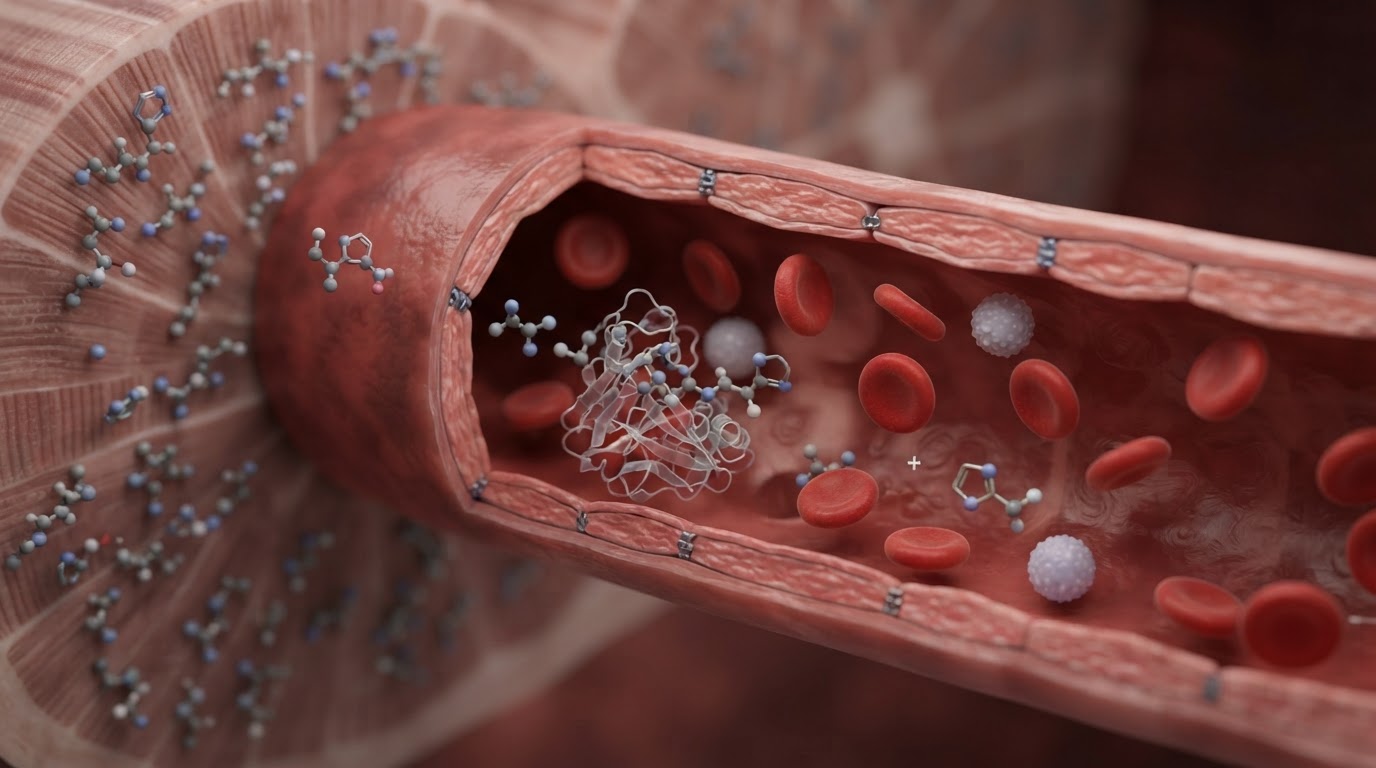
Quick answer: Carnosinase is an enzyme that breaks carnosine apart into its two building blocks, beta-alanine and histidine. Humans have two related enzymes commonly discussed in carnosine metabolism: CN1, also called serum carnosinase and encoded by CNDP1, and CN2, a broader cytosolic dipeptidase encoded by CNDP2. CN1 is especially important because it is highly active in adult human blood and can rapidly hydrolyze circulating carnosine. That helps explain why oral carnosine does not behave in humans the way it does in many animal models—and why oral beta-alanine became the more established strategy for increasing muscle carnosine. [1–6]
Your body does not only make carnosine.
It also breaks it down.
That sounds obvious, but the enzyme responsible for that breakdown explains several of the most confusing parts of carnosine research.
Why can skeletal muscle contain a large carnosine pool while blood contains very little?
Why can humans absorb at least some intact carnosine from the intestine, yet have difficulty measuring it in circulation?
Why does oral beta-alanine raise muscle carnosine so reliably?
And why can an oral carnosine experiment in a mouse be difficult to translate directly to humans?
A major part of the answer is:
carnosinase.
Table of Contents
- What does carnosinase do?
- What happens when carnosine is broken down?
- What is CN1?
- What is CN2?
- Are CN1 and CN2 the same enzyme?
- Where is serum carnosinase found?
- Why is blood carnosinase so important?
- What happens when people swallow carnosine?
- Why do some people retain more circulating carnosine?
- Why beta-alanine behaves differently
- Does skeletal muscle contain carnosinase?
- Why animal studies can be misleading
- Does carnosinase activity vary between people?
- What do CNDP1 genetics tell us?
- Can carnosinase be inhibited?
- What carnosinase means for topical carnosine
- Where LactiGo fits
Carnosinase Does the Opposite of Carnosine Synthase
In the previous article, we looked at how your body makes carnosine.
The synthesis reaction is:
Beta-alanine + L-histidine
↓
CARNS1
↓
Carnosine
Carnosinase works in the opposite direction.
It catalyzes hydrolysis, which means water is used to break the peptide bond connecting beta-alanine and histidine.
The simplified breakdown reaction is:
Carnosine + water
↓
Carnosinase
↓
Beta-alanine + L-histidine [1,2]
So carnosine concentration is not determined only by how quickly the molecule is made.
It also depends on how quickly it is transported, stored and degraded.
Carnosine Turnover Is a Balance
A useful way to think about carnosine biology is as a balance between:
Synthesis
The body uses beta-alanine and histidine to make carnosine through CARNS1.
Storage
Certain tissues—especially skeletal muscle—maintain relatively large intracellular carnosine pools.
Breakdown
Carnosinase enzymes hydrolyze carnosine back into its constituent molecules.
Transport
Carnosine and its precursors can move through different transporter systems depending on the tissue and biological compartment.
The amount measured in one place therefore does not necessarily tell you what is happening everywhere else.
This is especially important when comparing:
muscle carnosine
with:
plasma carnosine.
They are very different biological pools.
There Are Two Main Human Enzymes to Know
Researchers commonly discuss two related enzymes with carnosinase activity.
CN1 — Serum Carnosinase
Also called:
- Carnosinase-1
- Carnosine dipeptidase 1
- Beta-alanyl-histidine dipeptidase
Gene:
CNDP1
CN2 — Cytosolic Nonspecific Dipeptidase
Also called:
- Carnosinase-2
- Carnosine dipeptidase 2
- Cytosolic nonspecific dipeptidase
Gene:
CNDP2 [1,2]
The two proteins are related.
But their locations and biological roles are not identical.
What Is CN1?
CN1 is the enzyme most people mean when they talk about the "carnosinase problem" for oral carnosine.
It is a secreted enzyme found prominently in human:
- Serum
- Cerebrospinal fluid
and its activity has also been identified in tissues including the kidney. [2,3]
CN1 preferentially hydrolyzes histidine-containing dipeptides, with carnosine being an important substrate.
The reaction is rapid enough that healthy adult humans normally have little circulating carnosine in the fasting state despite having substantial carnosine stores inside skeletal muscle. [2,3]
That contrast is one of the defining features of human carnosine physiology.
What Is CN2?
CN2 is different.
It is located inside cells and has much broader dipeptidase activity.
That is why its preferred modern description is often:
cytosolic nonspecific dipeptidase.
CN2 can hydrolyze multiple dipeptides rather than behaving like a highly specialized circulating carnosine enzyme.
Carnosine can be a substrate under some experimental conditions, but its role in physiological carnosine breakdown appears less straightforward.
The original molecular characterization found that CN2 hydrolyzed carnosine most effectively at an alkaline pH around 9.5, well above ordinary physiological intracellular pH. [1]
More recent work suggests some carnosine hydrolysis may still occur under physiological conditions, but CN1 remains the much more important enzyme when discussing circulating human carnosine. [2]
CN1 and CN2 Should Not Be Treated as Interchangeable
Here is the simplest comparison.
| Feature | CN1 | CN2 |
|---|---|---|
| Gene | CNDP1 | CNDP2 |
| Common name | Serum carnosinase | Cytosolic nonspecific dipeptidase |
| Location | Secreted; prominent in serum and CSF | Inside cells |
| Carnosine specificity | Relatively high | Broader substrate range |
| Importance for circulating carnosine | High | Low |
| Typical discussion | Oral carnosine bioavailability | Intracellular dipeptide metabolism |
| Best-known issue | Rapid degradation of blood carnosine | Uncertain contribution to physiological carnosine turnover |
That difference is why saying only:
"carnosinase breaks carnosine"
is accurate but incomplete.
There is more than one enzyme in the story.
Why Serum Carnosinase Matters So Much in Humans
Suppose you eat or swallow carnosine.
For that intact molecule to circulate for long periods, it would have to survive several steps.
First, it must survive digestion.
Then it must be absorbed.
Then it reaches the bloodstream.
And that is where humans have a major obstacle:
CN1.
Human serum contains enough carnosinase activity to hydrolyze carnosine quickly.
This makes intact circulating carnosine difficult to sustain.
That does not mean zero intact carnosine is ever absorbed.
Human research shows that some is.
But absorption and sustained circulation are different questions.
Humans Can Absorb Intact Carnosine
A landmark 1991 study addressed this directly.
Healthy adults consumed carnosine, and researchers monitored:
- Plasma carnosine
- Urinary carnosine
- Beta-alanine
over the following five hours. [4]
Up to approximately:
14% of the ingested dose
was recovered as intact carnosine in urine.
That tells us intact carnosine had crossed the intestinal barrier to a meaningful extent.
So the old idea that all dietary carnosine must be completely broken down before absorption is too simple.
But the experiment also revealed the next obstacle.
Carnosine Was Difficult to Detect in Plasma
When the researchers collected ordinary blood samples, carnosine was essentially undetectable.
It became measurable only when the research team took special precautions to inhibit carnosinase activity during and after blood collection. [4]
That is a striking demonstration of how active the enzyme can be.
The problem was not only:
Can carnosine get through the intestine?
The problem was:
Can intact carnosine survive once it reaches human blood?
The answer depended heavily on carnosinase.
People Also Showed Large Differences
The amount of intact carnosine recovered in urine varied substantially between participants.
Importantly, urinary carnosine recovery was inversely related to plasma carnosinase activity.
People with higher carnosinase activity tended to recover less intact carnosine. [4]
That was an early clue that human carnosine pharmacokinetics can vary considerably from person to person.
Later work confirmed it more directly.
A 25-Person Study Put Carnosinase to the Test
In 2012, researchers gave 25 healthy adults an acute oral dose of:
60 mg carnosine per kilogram of body weight. [5]
The research team measured:
- Plasma carnosine
- Urinary carnosine
- Plasma carnosinase activity
- Carnosinase protein
- CNDP1 genotype
Only:
8 of 25 participants
showed a measurable increase in plasma carnosine after ingestion.
The remaining:
17 participants
did not show the same detectable circulating increase. [5]
This gave researchers an opportunity to compare the two groups.
The Difference Was Carnosinase
Compared with the participants who showed measurable plasma carnosine, the nonresponders had approximately:
2× higher plasma carnosinase protein
and:
1.5× higher carnosinase activity. [5]
Urinary carnosine recovery was:
2.6× higher
in the responders.
The study therefore provided direct human evidence that lower plasma carnosinase activity allows more intact carnosine to remain detectable after an oral dose. [5]
That is one of the clearest demonstrations of why CN1 matters for human carnosine bioavailability.
Oral Bioavailability Is More Than Intestinal Absorption
This is an important distinction.
An ingredient can cross the gut wall and still have poor circulating availability.
The pathway can look like this:
Oral carnosine
↓
Intestinal absorption
↓
Intact carnosine reaches circulation
↓
Serum CN1 rapidly hydrolyzes much of it
↓
Beta-alanine + histidine
That means:
absorption ≠ persistence.
The intestine is one barrier.
Metabolism after absorption is another.
Why Beta-Alanine Takes a Different Route
This helps explain why sports nutrition usually uses beta-alanine rather than relying on oral carnosine to increase skeletal-muscle carnosine.
Beta-alanine is already one of the breakdown products of carnosine.
It does not need to survive as the intact beta-alanyl-histidine dipeptide in blood.
Instead, beta-alanine can become available to muscle.
Inside the muscle cell:
Beta-alanine + histidine
are joined by:
CARNS1
to form:
carnosine.
That route sidesteps the need to keep intact carnosine circulating for prolonged periods.
This is one reason repeated beta-alanine supplementation can reliably raise muscle carnosine over several weeks.
Carnosinase Does Not "Destroy" the Value of Carnosine
This wording should be avoided.
When CN1 hydrolyzes carnosine, the molecule becomes:
- Beta-alanine
- Histidine
Those components still participate in metabolism.
Beta-alanine can contribute to carnosine synthesis if it becomes available to the relevant tissue.
Histidine has many functions throughout the body.
So carnosinase is not a waste enzyme.
It is part of normal peptide metabolism.
The question is not whether carnosine becomes "useless."
It is whether the intact dipeptide survives long enough to produce whatever effect researchers are trying to study.
Why Muscle Can Hold Carnosine Even Though Blood Does Not
This seems contradictory at first.
If carnosinase breaks carnosine so quickly, why doesn't it eliminate muscle carnosine?
Because skeletal muscle and serum are different compartments.
CN1 is a secreted serum enzyme.
It is not simply floating throughout the interior of every skeletal-muscle fiber.
Human skeletal muscle can therefore maintain substantial intracellular carnosine concentrations even while circulating carnosine remains very low. [2,6]
The muscle carnosine pool is built and regulated locally.
That is why measuring carnosine in plasma tells you very little about the absolute amount stored inside skeletal muscle.
Does Skeletal Muscle Have CN2?
Human skeletal muscle expresses genes involved in carnosine metabolism, including CNDP2.
But CN2 is a broad intracellular dipeptidase and its exact role in skeletal-muscle carnosine degradation under physiological conditions remains less certain than CN1's role in blood. [1,6]
This is another reason not to reduce carnosine biology to:
"CN1 in blood, CN2 in muscle, end of story."
The enzyme system is more nuanced than that.
Carnosine Synthesis and Breakdown Are Spatially Separated
This is a useful way to picture the system.
Inside skeletal muscle
CARNS1 helps build carnosine.
A substantial intracellular carnosine pool can accumulate.
In the circulation
CN1 rapidly hydrolyzes much of the intact carnosine that appears there.
Inside other tissues
CN2 and tissue-specific expression of CNDP1/CNDP2 create additional local metabolism.
Where a molecule is located matters.
The same compound can be relatively stable in one compartment and short-lived in another.
Humans and Rodents Do Not Handle Carnosine the Same Way
This is one of the most important consequences of carnosinase biology.
Many common laboratory rodents do not have the same abundant circulating serum CN1 system found in humans.
That means intact carnosine can behave very differently after administration.
A mouse or rat may maintain circulating carnosine in a way an adult human does not.
So when a rodent study gives carnosine and reports a biological effect, the appropriate question is:
Would humans achieve the same exposure to intact carnosine?
Sometimes the answer is unknown.
Serum CN1 Is Unusual Across Species
Serum carnosinase is characteristic of humans and other higher primates.
Most non-primate mammals do not have comparable circulating CN1 activity.
One notable exception is the:
Syrian golden hamster. [2,7]
That species difference is large enough that researchers have proposed the golden hamster as a useful model for studying oral histidine-containing dipeptides in a system that, unlike standard laboratory mice, includes circulating carnosinase.
New 2026 Research Reinforces the Species Problem
A 2026 study compared plasma carnosinase activity in humans and golden hamsters.
Interestingly, the hamsters had substantially higher carnosinase activity than the human samples in that experiment.
Carnosine-degrading activity was approximately:
19.5 times higher
in hamster plasma than human plasma. [7]
After an oral mixture of carnosine and anserine was administered to hamsters, the intact dipeptides were not detected in plasma, while breakdown-related molecules increased. [7]
This is not evidence about LactiGo.
It is useful because it reinforces a broader research principle:
species-specific carnosinase activity changes pharmacokinetics.
Animal Evidence Needs an Extra Translation Step
Suppose an animal study reports that oral carnosine:
- Raises plasma carnosine
- Reaches an organ
- Changes a disease marker
Before transferring that conclusion to humans, researchers need to consider:
- Does the species have circulating CN1?
- How active is it?
- Was carnosine measured intact?
- What dose was used?
- Was the route oral, intravenous or something else?
- Were tissue concentrations measured?
- Can humans reproduce the same exposure?
This does not make animal research useless.
It makes pharmacokinetics essential.
Does Carnosinase Activity Change With Age?
Yes.
Serum carnosinase activity is very low early in life and generally rises as humans mature.
Reviews of human data indicate that activity increases through childhood and adolescence toward adult levels. [2,3]
That helps explain why circulating carnosine biology in an infant is not identical to that of a healthy adult.
It also means "human carnosinase activity" is not one fixed number across every age.
Men and Women May Also Differ
Research has reported sex-related differences in serum carnosinase activity, with higher average activity described in females in some datasets. [2,3]
But individual variability is large.
Sex is therefore only one influence among several.
Others can include:
- Genetics
- Age
- Diet
- Health status
- Liver function
- Other physiological factors
You cannot predict an individual's carnosinase activity from sex alone.
CNDP1 Genetics Can Influence Carnosinase Activity
The gene encoding serum carnosinase is:
CNDP1.
Variants in this gene can influence how efficiently the enzyme is produced or secreted.
One frequently studied variation involves a repeated leucine sequence in the enzyme's signal peptide.
Experimental research found that the number of repeats can influence secretion of CN1 into the circulation. [8]
That creates a biological explanation for some of the differences in serum carnosinase activity between people.
But genetics does not tell the whole story.
More Carnosinase Is Not Simply "Bad"
This is where mechanistic discussions can become misleading.
If carnosine has potentially useful biological actions, it may sound logical to say:
less carnosinase must always be better.
Human biology does not support that simple conclusion.
Low CN1 activity has been studied in relation to certain kidney outcomes, particularly diabetic kidney disease.
But extreme or abnormal carnosinase deficiency is also associated with rare metabolic disorders involving unusually high circulating histidine-containing dipeptides. [2,3]
This suggests carnosinase is part of a regulated metabolic system rather than an enzyme the body would ideally eliminate.
CNDP1 and Kidney Disease Is a Research Topic—not a Supplement Recommendation
Certain CNDP1 variants have been associated with diabetic nephropathy risk in some populations.
Other studies have failed to replicate the association consistently across different populations or types of diabetes. [2,3]
That means CNDP1 genetics should not be used to tell consumers:
- They need a carnosinase inhibitor
- They should take carnosine for kidney disease
- Lower carnosinase is universally protective
Those would be medical conclusions far beyond the evidence.
The research is useful for understanding carnosine metabolism.
It is not a self-treatment protocol.
Can Scientists Inhibit Carnosinase?
Yes—at least experimentally.
Because CN1 limits the persistence of intact carnosine in humans, researchers have investigated ways to:
- Inhibit CN1
- Modify carnosine so the enzyme recognizes it less effectively
- Use related histidine-containing dipeptides with greater resistance
- Develop drug-delivery systems that protect carnosine from hydrolysis
A 2024 review found that selective CN1 inhibition remains an early-stage drug-development field. [3]
One experimental molecule called:
carnostatine
has been studied as a selective serum-carnosinase inhibitor.
That does not make carnosinase inhibition a routine nutritional strategy.
Researchers Are Also Trying to Make Carnosine Harder to Break Down
A separate 2024 study chemically attached polyethylene glycol to carnosine—a process known as PEGylation.
In laboratory testing with human serum carnosinase, the modified carnosine was much more resistant to hydrolysis than ordinary L-carnosine. [9]
The researchers then studied the molecules in mice.
Because mice do not reproduce the human circulating CN1 system, the animal pharmacokinetic results need to be interpreted carefully.
Still, the experiment demonstrates a broader pharmaceutical idea:
If an enzyme destroys a molecule quickly, one strategy is to redesign the molecule so the enzyme cannot recognize it as easily.
This remains drug-development research.
Anserine Is Also More Resistant Than Carnosine
Anserine is closely related to carnosine.
It is a methylated histidine-containing dipeptide.
Human serum carnosinase can hydrolyze it, but anserine tends to be more resistant than carnosine.
That has led researchers to study anserine/carnosine combinations as another way of changing circulating exposure.
Some human studies have reported higher detectable plasma carnosine when carnosine is consumed together with anserine, potentially because the two substrates compete for CN1. [3]
This is one reason anserine/carnosine studies should not be treated as equivalent to carnosine-alone studies.
What Does Carnosinase Mean for Oral Carnosine Supplements?
It means that the pharmacology needs to be taken seriously.
The oversimplified claim:
"Oral carnosine is completely destroyed before your body absorbs any of it"
is incorrect.
Human research shows intact absorption occurs. [4]
But this opposite claim is also misleading:
"If carnosine is absorbed, it can circulate freely and reach every tissue intact."
Human serum CN1 creates a substantial post-absorption barrier. [4,5]
The most accurate summary is:
Some intact carnosine can be absorbed, but rapid human serum hydrolysis limits how long and how much of that intact dipeptide remains in circulation.
Does This Mean Oral Carnosine Can Never Have an Effect?
No.
An intervention can have biological effects even if the parent compound has limited circulating persistence.
Possible routes include:
- Brief exposure to intact carnosine
- Delivery to protected compartments
- Effects of beta-alanine or histidine released during hydrolysis
- Formation of carnosine-derived adducts
- Repeated dosing
- Tissue-specific uptake
Human oral-carnosine trials exist and some have reported biological or performance outcomes.
Carnosinase means those results need to be interpreted with pharmacokinetics in mind.
It does not mean the outcome must be zero.
What Does Carnosinase Mean for Topical Carnosine?
This requires a different kind of caution.
Carnosinase explains an important limitation of circulating intact carnosine, particularly after oral administration.
It does not prove that applying carnosine to the skin solves the delivery problem.
To make that conclusion, a topical study would need to establish relevant things such as:
- Skin penetration
- Tissue concentration
- Depth of delivery
- Intramuscular concentration
- Local metabolism
- Systemic exposure
depending on the claim being made.
You cannot reason:
Oral carnosine meets serum carnosinase
therefore:
topical carnosine automatically reaches muscle intact.
The second conclusion requires its own evidence.
This Is Where "Topical" and "Transdermal" Must Stay Separate
A product can be applied topically without having proven transdermal delivery into skeletal muscle.
The words describe different evidence levels.
Topical
Applied to the skin.
Skin penetration
Moves into one or more skin layers.
Transdermal delivery
Crosses the skin barrier sufficiently to reach deeper tissue or systemic circulation.
Intramuscular delivery
Reaches muscle at a measurable concentration.
Each step needs appropriate evidence.
Carnosinase does not allow us to skip those steps.
Where LactiGo Fits
LactiGo contains L-carnosine and is applied topically.
The LactiGo Science page explicitly frames the product as a way to avoid the digestive route and describes transdermal delivery of carnosine and magnesium into muscle tissue. [10]
Those are the brand's product-science claims.
They should be presented as such.
The strongest peer-reviewed LactiGo-specific human evidence currently answers a different question:
Did the finished topical product affect performance under a particular pre-exercise protocol?
What the Peer-Reviewed LactiGo Trial Actually Measured
In the 2025 randomized, crossover, triple-blind study:
- 7 world-class rugby sevens players
- 10 mL topical carnosine gel
- Applied 40 minutes before exercise
- Compared with placebo
- Followed by an intermittent high-intensity cycling protocol [11]
Peak power was higher in:
- Sprint 2
- Sprint 4
- Sprint 7
Mean power, heart rate and perceived exertion did not show treatment effects. [11]
That is product-specific human performance evidence.
What the Trial Did Not Measure
The researchers did not directly measure:
- Intramuscular carnosine concentration
- Serum carnosine
- CN1 activity
- Skin penetration depth
- Carnosine concentration in the dermis
- Carnosine concentration in skeletal muscle
The authors specifically identified intramuscular carnosine as a question for future research. [11]
So carnosinase provides a plausible reason researchers are interested in non-oral delivery routes.
It does not by itself prove the mechanism of LactiGo.
That distinction needs to remain explicit.
The Brand Timing and Study Timing Should Also Stay Separate
The LactiGo Science page describes:
approximately 45 minutes
as its brand timing framework. [10]
The peer-reviewed human study used:
40 minutes before exercise. [11]
Do not convert either number into:
"muscle carnosine peaks at 40–45 minutes."
Intramuscular carnosine was not measured.
Want to Try a Different Approach to Carnosine?
Oral carnosine enters a human metabolic system with highly active serum carnosinase. LactiGo takes a different route: it is a topical carnosine gel designed for use around physically demanding activity, with direct human performance research using pre-exercise application.
Try LactiGoThe Bottom Line
Carnosinase is one of the most important enzymes for understanding why carnosine behaves the way it does in humans.
Its basic job is simple:
Carnosine
↓
Carnosinase
↓
Beta-alanine + histidine
But the consequences of that reaction are much bigger.
Humans have two related enzymes.
CN1, encoded by CNDP1, is the major serum carnosinase.
CN2, encoded by CNDP2, is a broader intracellular dipeptidase whose physiological role in carnosine turnover is less clear.
CN1 is especially important because adult human blood can hydrolyze intact carnosine rapidly. [1–3]
That explains an apparent contradiction in human nutrition research.
People can absorb intact oral carnosine.
A 1991 study recovered up to about 14% of an ingested dose as intact carnosine in urine. [4]
But the same study showed how difficult it was to detect carnosine in blood unless researchers actively stopped carnosinase from continuing to degrade the molecule in the sample.
Then a 2012 study made the effect even clearer.
After an oral carnosine challenge in 25 adults, only 8 people showed a measurable rise in plasma carnosine.
The participants without a detectable rise had approximately:
2× more carnosinase protein
and:
1.5× greater carnosinase activity. [5]
So carnosinase is not a theoretical obstacle.
It measurably changes human carnosine pharmacokinetics.
It also helps explain why beta-alanine is such an effective strategy for raising muscle carnosine.
Instead of asking intact carnosine to survive in blood, beta-alanine becomes available to muscle, where CARNS1 can build new carnosine intracellularly.
Carnosinase also changes how animal studies should be read.
Most standard laboratory rodents do not have the same circulating CN1 system as humans.
That means an oral dose of carnosine may create a very different exposure in a mouse than it does in a person.
And finally, carnosinase explains why researchers are interested in alternative delivery strategies—but it does not validate them automatically.
The existence of serum carnosinase does not prove that a topical carnosine product reaches skeletal muscle.
That requires direct delivery evidence.
LactiGo does have direct human performance research using topical pre-exercise application. [11]
What it does not yet have, based on the study reviewed here, is direct measurement showing that topical application raises intramuscular carnosine.
That is the difference between:
a measured outcome
and:
a proposed mechanism.
Understanding carnosinase makes that difference much easier to see.
Frequently Asked Questions
What is carnosinase?
Carnosinase is an enzyme that hydrolyzes carnosine, breaking the dipeptide into beta-alanine and histidine.
What are CN1 and CN2?
CN1 is serum carnosinase encoded by CNDP1. CN2 is a cytosolic nonspecific dipeptidase encoded by CNDP2. They are related but have different locations and substrate behavior.
What does CN1 do?
CN1 is highly active in adult human serum and rapidly hydrolyzes circulating carnosine.
What does CN2 do?
CN2 is a broader intracellular dipeptidase. Its contribution to normal carnosine breakdown appears less important and less clearly defined than CN1's role in blood.
Why is there so little carnosine in human blood?
One major reason is the high activity of serum CN1, which rapidly breaks circulating carnosine down.
Does that mean there is no carnosine in muscle?
No. Skeletal muscle contains a large intracellular carnosine pool. Plasma and muscle are separate biological compartments.
Can humans absorb intact carnosine?
Yes. A human ingestion study recovered up to about 14% of the ingested dose as intact carnosine in urine, indicating meaningful intact absorption. [4]
Why is oral carnosine hard to detect in blood?
Serum carnosinase hydrolyzes it rapidly. In the 1991 study, special sample-handling precautions were needed to prevent continued breakdown during blood collection and analysis. [4]
Does carnosinase activity differ between people?
Yes. Human studies show considerable interindividual variation.
How much difference can carnosinase make after oral carnosine?
In a 25-person study, only 8 participants had a measurable plasma-carnosine rise. Nonresponders had roughly twice as much carnosinase protein and about 1.5 times the activity of responders. [5]
Does age affect carnosinase?
Yes. Serum carnosinase activity is low early in life and generally rises toward adult levels during maturation.
Do genetics affect carnosinase?
Yes. Variants in CNDP1 can influence secretion and activity of serum carnosinase.
Is lower carnosinase always better?
No. Lower CN1 activity has been investigated in some disease contexts, but carnosinase is part of normal metabolism and abnormal deficiency can also occur.
Can people take a carnosinase inhibitor?
Selective carnosinase inhibition is currently a research and drug-development topic, not a routine supplement strategy.
Why is beta-alanine used instead of oral carnosine to raise muscle carnosine?
Beta-alanine does not need to remain as intact circulating carnosine. Muscle can take up beta-alanine and use CARNS1 to synthesize carnosine internally.
Do mice have serum carnosinase?
Most standard laboratory rodents do not have the abundant circulating CN1 found in humans. This is an important species difference in carnosine research.
What animal does have circulating carnosinase?
The Syrian golden hamster is a notable non-primate exception and has been investigated as a model for human histidine-dipeptide metabolism.
Does carnosinase explain why topical carnosine should work?
No. Carnosinase explains an oral/circulating metabolism issue. Topical delivery still requires direct evidence of skin penetration and delivery to the tissue relevant to the claim.
Does LactiGo bypass carnosinase?
The LactiGo Science page describes a topical/transdermal delivery model that bypasses digestion. However, the peer-reviewed performance trial did not directly measure intramuscular carnosine or carnosinase exposure, so complete avoidance of carnosinase should not be presented as independently proven.
Was LactiGo studied before exercise?
Yes. The 2025 peer-reviewed study applied topical carnosine gel 40 minutes before intermittent high-intensity exercise in seven world-class rugby sevens players. [11]
Did the LactiGo study measure muscle carnosine?
No. Intramuscular carnosine was not measured. [11]
External References
- Teufel M, Saudek V, Ledig JP, et al. Sequence identification and characterization of human carnosinase and a closely related non-specific dipeptidase. Journal of Biological Chemistry. 2003;278(8):6521–6531. PMID: 12473676. DOI: 10.1074/jbc.M209764200. PubMed
- Boldyrev AA, Aldini G, Derave W. Physiology and Pathophysiology of Carnosine. Physiological Reviews. 2013;93(4):1803–1845. DOI: 10.1152/physrev.00039.2012. PubMed
- Regazzoni L. State of the Art in the Development of Human Serum Carnosinase Inhibitors. Molecules. 2024;29(11):2488. PMID: 38893364. PMCID: PMC11173852. DOI: 10.3390/molecules29112488. PubMed
- Gardner ML, Illingworth KM, Kelleher J, Wood D. Intestinal absorption of the intact peptide carnosine in man, and comparison with intestinal permeability to lactulose. Journal of Physiology. 1991;439:411–422. PMID: 1910085. PMCID: PMC1180115. DOI: 10.1113/jphysiol.1991.sp018673. PubMed
- Everaert I, Taes Y, De Heer E, et al. Low plasma carnosinase activity promotes carnosinemia after carnosine ingestion in humans. American Journal of Physiology-Renal Physiology. 2012;302(12):F1537–F1544. PMID: 22496410. DOI: 10.1152/ajprenal.00084.2012. PubMed
- Everaert I, De Naeyer H, Taes Y, Derave W. Gene expression of carnosine-related enzymes and transporters in skeletal muscle. European Journal of Applied Physiology. 2013;113(5):1169–1179. DOI: 10.1007/s00421-012-2540-4. PubMed
- Shiotani S, Kawashima T, Takahashi C, et al. The Effect of Serum Carnosinase on the Tissue Distribution of Imidazole Dipeptides After Their Oral Administration in Golden Hamsters. Nutrients. 2026;18(6):999. PMID: 41901174. PMCID: PMC13029670. DOI: 10.3390/nu18060999. PubMed
- Riedl E, Koeppel H, Brinkkoetter P, et al. A CTG polymorphism in the CNDP1 gene determines the secretion of serum carnosinase in Cos-7 transfected cells. Diabetes. 2007;56(9):2410–2413. DOI: 10.2337/db07-0124. PubMed
- Zhang S, Yang G, Zhang Q, et al. PEGylation renders carnosine resistant to hydrolysis by serum carnosinase and increases renal carnosine levels. Amino Acids. 2024;56:44. DOI: 10.1007/s00726-024-03405-6. PubMed
- LactiGo. The Science Behind Transdermal Carnosine Gel. Use for LactiGo's current brand-described topical/transdermal model, approximately 45-minute timing framework and pre-/post-activity product positioning. LactiGo Science
- Beaven CM, James C, McMaster DT, Brockelbank N. Topical carnosine gel improves intermittent high-intensity exercise performance in world-class rugby sevens players. Journal of the International Society of Sports Nutrition. 2025;22(1):2550311. PMID: 40859880. PMCID: PMC12427510. DOI: 10.1080/15502783.2025.2550311. PubMed