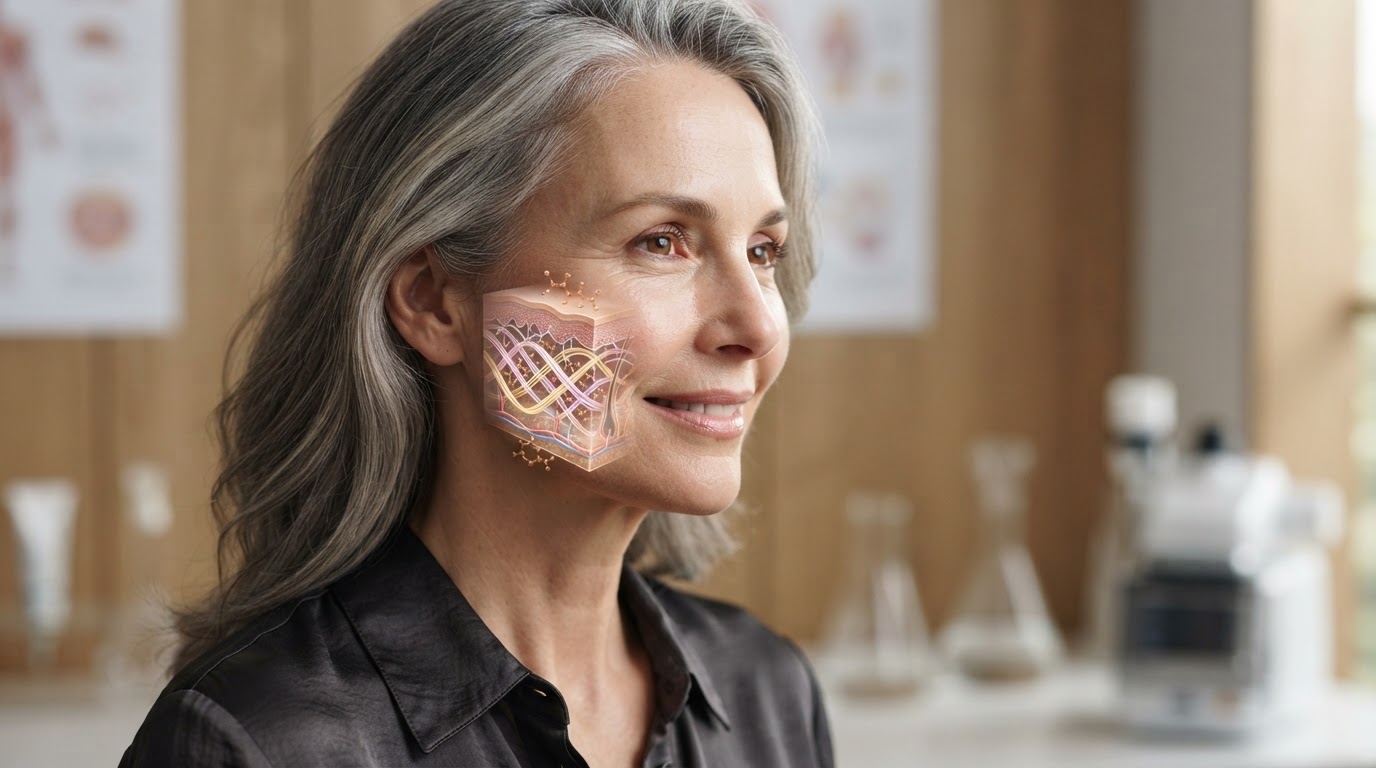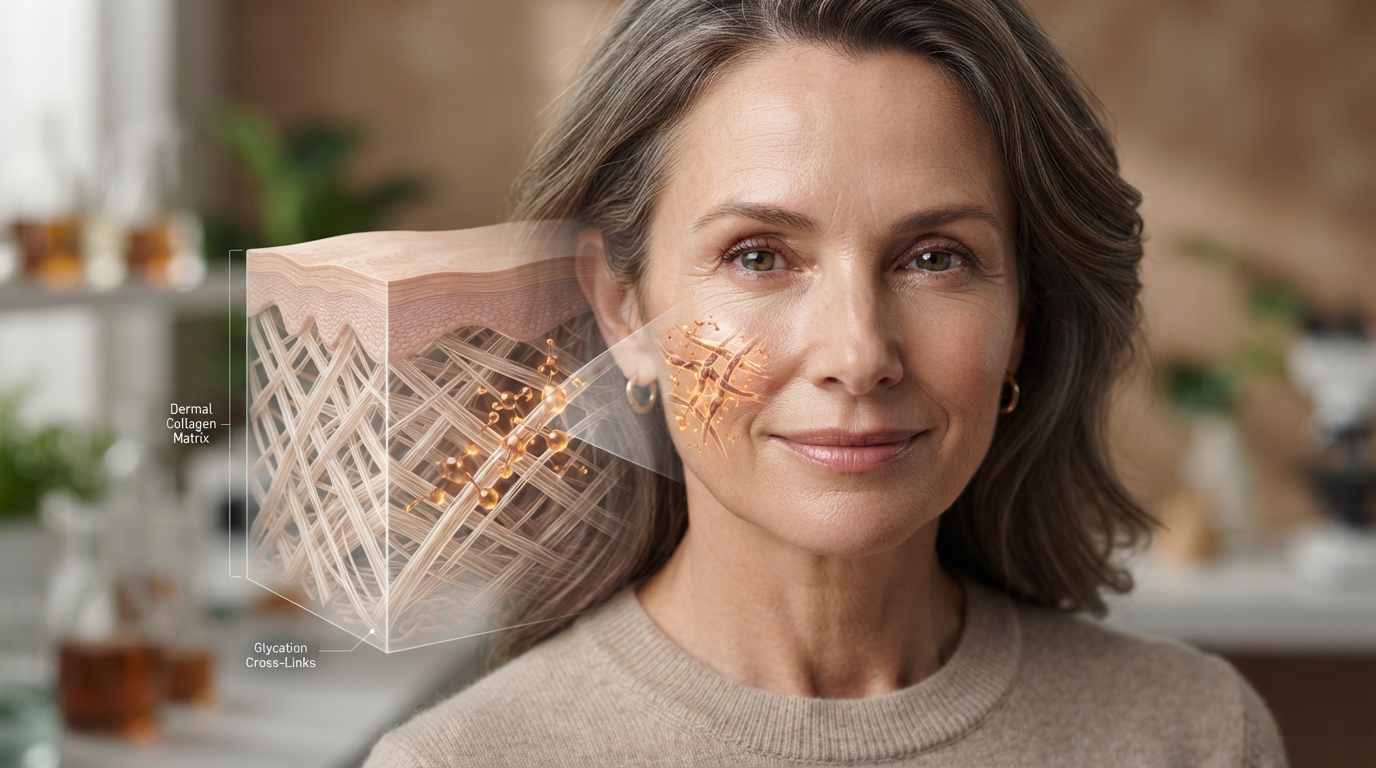
Skin glycation is a nonenzymatic chemical process in which sugars and reactive sugar-derived compounds interact with proteins and eventually contribute to the formation of advanced glycation end products, or AGEs. In skin, long-lived structural proteins such as collagen are especially relevant because chemical modifications can accumulate over time.
AGEs can contribute to abnormal cross-linking and changes in the physical behavior of collagen. A 2023 study of human dermal collagen found that collagen from aged skin was mechanically stiffer and harder than collagen from younger skin; the investigators identified elevated AGEs as an important contributor to those mechanical changes.
But glycation is not the entire explanation for skin aging. Ultraviolet exposure, collagen fragmentation, cellular senescence, oxidative processes, changes in fibroblast function, genetics, hormones, lifestyle, and other factors also influence how skin changes with time. Research examining human skin has found that glycation increases with intrinsic aging and can be enhanced in photoaged skin, illustrating that these mechanisms can interact.
Carnosine is scientifically interesting because it has demonstrated antiglycation activity in experimental systems. In a 2018 study, carnosine and a facial cream containing carnosine reduced specific AGE markers in methylglyoxal-treated human skin explants. That result supports further study of carnosine as a topical cosmetic ingredient—but it does not prove that every carnosine gel reverses wrinkles, restores collagen, or produces anti-aging effects in living human skin.
That distinction is the key to understanding anti-glycation skincare without turning plausible biochemistry into marketing mythology.
Key Takeaways
- Glycation is a nonenzymatic chemical reaction involving sugars or reactive carbonyl compounds and biological molecules such as proteins.
- Later stages of these reactions can produce advanced glycation end products, commonly abbreviated AGEs.
- Collagen is especially relevant because it is a long-lived structural protein in the dermis, allowing chemical modifications to accumulate over time.
- Human research has found greater dermal glycation with intrinsic aging and increased glycation in sun-exposed/photoaged tissue.
- Experimental skin models show that glycating collagen can alter both the dermal matrix and epidermal organization.
- AGEs can alter collagen's physical properties and contribute to increased stiffness.
- Glycation and oxidation are related biological processes but are not the same thing.
- Glycation is one contributor to skin aging—not the sole cause.
- Carnosine has demonstrated antiglycation activity in experimental research.
- A 2018 study found reduced AGE markers after topical carnosine treatment of glycated human skin explants, but that was an ex vivo experiment using a separate facial formulation, not a LactiGo trial.
- LactiGo's current U.S. label identifies menthol 1.5% as its active ingredient and topical analgesia as its purpose; L-carnosine is listed among the inactive ingredients.
- Current evidence does not justify describing LactiGo as a wrinkle treatment, collagen-restoring cosmetic, or anti-glycation facial cream.
Table of Contents
- What is skin glycation?
- What are advanced glycation end products?
- How does glycation happen?
- Why is collagen especially vulnerable?
- What does glycation do to collagen?
- How can glycation affect skin appearance?
- Does glycation cause wrinkles?
- Glycation vs. oxidation
- Does sunlight affect glycation?
- Does eating sugar immediately glycate your skin?
- Is glycation worse in diabetes?
- Can skin glycation be reversed?
- How do scientists measure skin glycation?
- What does anti-glycation skincare mean?
- What does the research say about carnosine?
- Does carnosine research prove LactiGo has skincare benefits?
- What can you realistically do about skin aging?
- Frequently asked questions
What Is Skin Glycation?
Skin glycation is the nonenzymatic reaction of sugars and reactive sugar-derived molecules with proteins and other biological molecules in skin. Over time, these reactions can generate advanced glycation end products that accumulate in tissue.
"Nonenzymatic" is important.
Your body performs many carefully controlled chemical reactions using enzymes.
Glycation is different.
It can occur spontaneously when chemically reactive compounds encounter susceptible parts of proteins.
One of the best-known pathways begins when a reducing sugar reacts with an amino group on a protein.
The chemistry can then proceed through multiple stages before relatively stable AGE structures form.
Glycation is therefore not one single molecule.
It is a family of chemical reactions that can create many different products.
Examples researchers commonly study include:
- Carboxymethyllysine, or CML
- Pentosidine
- Glucosepane
- Other protein-bound AGE structures
Different AGEs have different chemistry, which is one reason "AGEs" should not be treated as though they were one uniform substance. Human skin studies frequently use specific AGE markers rather than measuring an imaginary single "glycation level."
What Are Advanced Glycation End Products?
Advanced glycation end products are molecules formed after a progression of nonenzymatic reactions involving sugars or reactive carbonyl compounds and biological molecules.
The word advanced refers to later products in that reaction sequence.
The word end products can be misleading because AGE chemistry is diverse and does not represent one universal endpoint.
In skin research, AGEs matter particularly because some of them can:
- Modify structural proteins
- Produce abnormal molecular cross-links
- Alter physical properties of collagen
- Interact with cells
- Accumulate in relatively long-lived tissue
Human and reconstructed-skin research supports these structural and cellular effects.
How Does Glycation Happen?
A simplified pathway looks like this:
Sugar or reactive carbonyl
↓
Initial reaction with a protein
↓
Early glycation intermediates
↓
Chemical rearrangement and additional reactions
↓
Advanced glycation end products
Real biological chemistry is more complicated, but this framework helps explain the process.
Another important part of the story is the formation of highly reactive compounds such as methylglyoxal.
Methylglyoxal can react rapidly with proteins and is frequently used by researchers to create glycation stress experimentally. The 2018 carnosine skin-explant experiment, for example, induced glycation by exposing the tissue to methylglyoxal.
This is why anti-glycation science involves more than simply thinking about glucose.
Reactive carbonyl compounds are important intermediates too.
Why Is Collagen Especially Important?
The dermis contains a large extracellular matrix built substantially around collagen.
Collagen provides structural support and contributes to the mechanical properties of skin.
Unlike a rapidly replaced molecule, dermal collagen can remain in tissue long enough for chemical changes to accumulate.
Researchers studying aged human skin have documented substantial age-related differences in collagen structure and mechanical behavior. In one 2023 analysis using human skin from different age groups, aged dermal collagen was rougher, mechanically stiffer, and harder than younger dermal collagen.
AGE accumulation was identified as an important contributor to the increased stiffness and hardness observed in older collagen.
That creates a fundamental problem:
Collagen needs strength, but it also needs appropriate mechanical behavior.
Making a structural protein progressively more cross-linked is not necessarily the same thing as making the tissue function better.
What Does Glycation Do to Collagen?
One of the most important effects of AGE formation is cross-linking.
Think about collagen fibers as components of an organized flexible network.
Normal cross-links are part of healthy collagen biology.
But nonenzymatic AGE-derived cross-links can create additional molecular connections that alter how collagen behaves mechanically.
Experimental and human research supports an association between AGE accumulation and increased collagen stiffness.
This means collagen can become:
- Less mechanically adaptable
- More rigid
- Harder
- More difficult for normal tissue-remodeling systems to manage
A reconstructed human-skin study also found that collagen glycation altered the organization of both the dermal matrix and epidermal layers, demonstrating that glycating the underlying matrix can affect the broader skin model rather than only an isolated collagen fiber.
Glycation Does More Than Cross-Link Collagen
Cross-linking receives the most attention, but it is not the entire story.
AGE-related changes can also influence cells.
Human skin fibroblasts are responsible for important parts of extracellular-matrix maintenance.
In laboratory research, AGE preparations altered proliferation and increased cell death in cultured human skin fibroblasts.
Reconstructed skin models have also demonstrated changes in keratinocyte organization and cell-adhesion markers when the dermal collagen matrix was glycated.
So glycation can affect both:
the material surrounding skin cells
and
the cells interacting with that material.
Does Glycation Cause Wrinkles?
This question requires careful wording.
Glycation can contribute to biological changes associated with skin aging, but wrinkles cannot accurately be attributed to glycation alone.
Human skin aging reflects many overlapping mechanisms.
These include changes in:
- Collagen production
- Collagen degradation
- Elastin
- Fibroblasts
- Cellular senescence
- Pigmentation
- Ultraviolet exposure
- Tissue hydration
- Hormonal environment
- Genetics
- Mechanical forces
- Glycation
Experimental glycation models reproduce several features associated with aged skin, while human studies show AGE accumulation increases with age.
That supports glycation as a contributor.
It does not justify a statement such as:
"Wrinkles are caused by sugar."
That is too simplistic.
What About Skin Elasticity?
Again, the relevant issue is the extracellular matrix.
Skin's mechanical behavior depends on a complex architecture involving collagen, elastin, and surrounding matrix components.
AGE-related cross-linking can make collagen mechanically stiffer, while aging simultaneously alters collagen organization and degradation.
It is therefore biologically plausible that glycation contributes to age-related changes in tissue flexibility.
But demonstrating that mechanism is different from showing that a particular serum or cream measurably improves human skin elasticity.
Those are two different levels of evidence.
Glycation vs. Oxidation: What's the Difference?
These concepts often appear together in skincare advertising.
They should not be treated as synonyms.
Glycation
Involves nonenzymatic reactions between sugars or reactive carbonyl compounds and biological molecules.
Oxidation
Refers broadly to electron-transfer chemistry and reactions involving oxidizing species.
The two processes can influence each other.
Some glycation pathways generate oxidative stress.
Oxidative processes can also create reactive carbonyl compounds that participate in further chemical damage.
But "antioxidant" and "antiglycation" do not mean the same thing.
An ingredient with antioxidant properties is not automatically a clinically effective anti-glycation skincare ingredient.
And vice versa.
Does Sun Exposure Affect Glycation?
Evidence suggests an interaction between photoaging and glycation.
A human skin study using CML immunostaining found that dermal glycation increased with intrinsic aging and that glycation was enhanced in sun-exposed/photoaged tissue. The investigators also found stronger AGE formation when dermal tissue was irradiated before experimental glycation.
AGE structures themselves may also participate in photochemical processes. Experimental research has shown that certain AGE-related skin chromophores can act as UVA photosensitizers and contribute to photooxidative chemistry.
This means the relationship is not necessarily:
UV aging OR glycation.
It may be:
UV-related processes interacting with glycation-related processes.
Does This Make Sun Protection an Anti-Glycation Strategy?
Sun protection has strong evidence for reducing photoaging, although it should not be marketed as a direct AGE-removing treatment.
In a randomized human trial, participants assigned to daily sunscreen use showed less progression of measurable skin aging over 4.5 years than participants using sunscreen at their discretion.
That evidence supports sun protection because ultraviolet exposure is a major driver of skin aging.
It does not mean sunscreen chemically removes collagen AGEs.
Again, mechanism matters.
Does Eating Sugar Immediately Glycate Your Skin?
No credible scientific model supports the idea that eating one dessert immediately "caramelizes" your face.
The phrase "sugar aging" is memorable marketing language, but it can create a false mental model.
Glycation is an ongoing chemical process involving cumulative exposure, reactive intermediates, protein turnover, metabolism, and tissue biology.
A single meal does not provide enough information to predict visible skin aging.
This is particularly important because online skincare advice often leaps from legitimate glycation biochemistry to extreme dietary claims.
One recent cross-sectional study in university students, for example, did not find a statistically significant association between the percentage of ultra-processed food intake and skin AGE levels measured by autofluorescence.
That study cannot settle the dietary question, but it illustrates why the relationship should not be reduced to simplistic food rules.
The scientifically useful statement is:
Long-term metabolic conditions influence glycation biology.
That is different from claiming that individual foods create immediate visible glycation.
What About High Blood Sugar?
Persistent hyperglycemia provides greater opportunity for nonenzymatic glycation reactions.
This relationship is one reason AGE biology has been extensively studied in diabetes.
Human studies have measured AGE accumulation in skin collagen and linked it with long-term glycemic exposure and diabetes-related complications.
That does not mean everyone concerned about skin glycation has diabetes.
It means glycation biology becomes especially relevant under conditions of sustained elevated glucose exposure.
If someone has concerns about abnormal blood glucose, that is a medical issue—not a skincare-product decision.
Can You See Glycation in the Mirror?
Not specifically.
You cannot look at a wrinkle or area of laxity and reliably conclude:
"That is glycation."
Visible skin aging reflects overlapping mechanisms.
Researchers need more specific methods to investigate AGE accumulation.
One commonly studied technique is skin autofluorescence.
Certain AGEs naturally fluoresce when exposed to specific wavelengths of light, allowing investigators to estimate aspects of AGE accumulation noninvasively.
However, autofluorescence does not detect every AGE and can be influenced by measurement conditions and skin characteristics.
Can Skin Glycation Be Reversed?
This is where marketing frequently moves beyond the evidence.
Preventing or reducing new AGE formation is not the same thing as breaking apart all previously formed AGE cross-links.
Once long-lived proteins such as collagen have accumulated chemical modifications, reversal becomes considerably more difficult.
Normal tissue remodeling can eventually remove and replace proteins, but collagen turnover is relatively slow.
That means terms such as:
- "Deglycate your skin"
- "Erase sugar damage"
- "Reverse glycation"
- "Melt AGEs"
should require very strong human evidence before being taken literally.
Most topical ingredient studies do not demonstrate wholesale removal of previously accumulated human dermal AGEs.
What Does "Anti-Glycation Skincare" Actually Mean?
An ingredient may be described as antiglycation for several very different reasons.
It may:
- Reduce AGE formation in a test-tube system.
- Trap reactive carbonyl compounds.
- Protect proteins from experimental glycation.
- Reduce AGE markers in cultured cells.
- Reduce AGE markers in reconstructed skin.
- Reduce AGE markers in ex vivo human skin.
- Produce measurable cosmetic improvements in living people.
Those are progressively different questions.
Evidence at a Glance
| Finding | What It Establishes |
|---|---|
| Ingredient inhibits glycation in a chemical assay | Biochemical activity |
| Ingredient protects cultured cells | Cellular evidence |
| Ingredient changes AGEs in reconstructed skin | Tissue-model evidence |
| Ingredient changes AGEs in human skin explants | Ex vivo human-tissue evidence |
| Topical product reaches target tissue in living people | Delivery evidence |
| Human trial improves elasticity/wrinkles/appearance | Clinical cosmetic evidence |
One level should not automatically be substituted for another.
Where Does Carnosine Enter the Glycation Story?
Carnosine is a naturally occurring dipeptide composed of beta-alanine and histidine.
Researchers have long been interested in its ability to interact with reactive carbonyl compounds and inhibit aspects of protein glycation in experimental systems.
That biochemical rationale eventually led investigators to test carnosine directly in human skin tissue.
In 2018, researchers published a study titled:
"Novel Facial Cream Containing Carnosine Inhibits Formation of Advanced Glycation End-Products in Human Skin."
The experiment used living human skin explants.
Researchers induced glycation using methylglyoxal and then applied either:
- An aqueous carnosine preparation
- A facial cream containing carnosine
They measured two AGE markers:
- CML
- Pentosidine
Both carnosine preparations affected AGE formation in the experimental model, and the facial cream produced significant reductions in AGE-marker levels in epidermal and reticular-dermal tissue.
That is legitimate topical carnosine research.
But the interpretation requires several important qualifications.
Qualification #1: This Was an Ex Vivo Study
The tissue came from human skin.
But the experiment was conducted outside a living human body.
The investigators deliberately induced glycation with methylglyoxal under controlled laboratory conditions.
That gives the research greater biological relevance than a basic chemical assay.
It still does not equal a randomized clinical trial showing fewer wrinkles or greater elasticity after carnosine application to living people.
Qualification #2: The Cream Was a Specific Formulation
The tested facial cream contained 0.2% carnosine plus numerous additional ingredients.
The investigators themselves noted that the cream's greater antiglycation activity compared with aqueous carnosine could have reflected enhanced delivery and/or effects from other ingredients in the formulation.
That is an extremely important formulation lesson.
You cannot take the result from one carnosine cream and automatically transfer it to every cream, serum, gel, lotion, or topical product containing carnosine.
The vehicle matters.
Concentration matters.
Penetration matters.
Other ingredients matter.
Qualification #3: Reduced AGE Markers Do Not Automatically Mean Fewer Wrinkles
The study measured biochemical markers in skin tissue.
It did not establish that carnosine alone:
- Removes wrinkles
- Firms sagging skin
- Restores lost collagen
- Improves pigmentation
- Reverses chronological aging
- Produces younger-looking skin in every user
Those would require applicable human clinical evidence.
The ex vivo finding should be described for what it is:
evidence that topically applied carnosine can influence experimentally induced glycation in human skin tissue under the tested conditions.
That finding is interesting enough without exaggerating it.
Does This Research Prove LactiGo Has Anti-Glycation Skincare Benefits?
No.
This distinction is essential.
The facial-cream study did not test LactiGo.
It tested a different formulation created for facial skincare research.
LactiGo's current U.S. Drug Facts label identifies:
- Menthol 1.5% as the active ingredient
- Topical analgesic as the product purpose
- L-carnosine and magnesium sulfate among the inactive ingredients
The labeled uses are for temporary relief of minor muscle and joint aches associated with conditions including simple backache, arthritis, strains, bruises, and sprains.
That means the responsible conclusion is:
LactiGo contains carnosine.
Carnosine has experimental topical antiglycation research.
The facial antiglycation study was not a LactiGo study.
LactiGo is not currently labeled as an anti-glycation facial treatment.
Those statements can all be true simultaneously.
Should You Use LactiGo as a Facial Anti-Aging Cream?
The current evidence and product labeling do not support positioning LactiGo that way.
The current DailyMed label identifies LactiGo as a topical analgesic and instructs users to avoid contact with the eyes and mucous membranes, not to apply it to wounds or irritated/damaged skin, and to avoid applying it into skin folds.
Its intended role should therefore remain distinct from a facial moisturizer or cosmetic anti-aging formulation.
A reader interested specifically in carnosine skincare should evaluate products and research designed for that cosmetic purpose.
What Can You Realistically Do About Glycation and Skin Aging?
There is no single "anti-glycation hack."
Skin aging is multifactorial.
A more evidence-based framework is to address modifiable contributors without pretending one intervention controls every pathway.
1. Protect Skin From Excessive UV Exposure
A randomized human trial demonstrated less progression of skin aging with regular sunscreen use over several years.
This addresses photoaging—not every AGE already present in collagen.
2. Manage Medical Metabolic Problems Appropriately
Persistent hyperglycemia can accelerate AGE formation, making appropriate medical management important for reasons extending far beyond cosmetic appearance.
Skincare cannot substitute for diabetes care.
3. Be Skeptical of Extreme "Sugar Face" Claims
Glycation is real.
That does not make every viral dietary rule evidence based.
Visible skin aging is not determined by whether you ate dessert yesterday.
4. Evaluate Ingredients by Evidence Level
Ask:
- Was the ingredient studied chemically?
- In cells?
- In reconstructed skin?
- In human skin explants?
- In living humans?
- Was the actual finished product tested?
- Were cosmetic outcomes measured?
That sequence can prevent a promising mechanism from turning into an unsupported product claim.
Where Topical Carnosine Research Becomes Interesting
Topical carnosine sits at an intriguing intersection.
Carnosine has:
- Relevant carbonyl chemistry
- Experimental antiglycation activity
- Human-skin-explant evidence
- Increasing interest as a topical ingredient
That is enough to justify serious research.
It is not enough to declare the cosmetic question settled.
The most valuable future research would clarify:
- Skin penetration
- Effective concentration
- Formulation effects
- Application frequency
- Changes in specific AGE markers
- Effects on collagen mechanics
- Effects on elasticity
- Effects on wrinkles
- Long-term outcomes
- Differences between formulations
Those are the studies needed to move from biochemical promise toward stronger cosmetic conclusions.
The Bigger Lesson: Ingredient Research Is Not Product Research
Suppose a laboratory study shows that molecule X can inhibit glycation.
That establishes something about molecule X.
Suppose a cream containing molecule X reduces AGE markers in an ex vivo skin model.
That establishes something about that formulation under those conditions.
Suppose another unrelated gel also contains molecule X.
You cannot simply copy every conclusion from the first formulation onto the second.
This principle matters far beyond carnosine.
It applies throughout skincare science.
Ingredient evidence ≠ finished-product evidence.
Mechanistic evidence ≠ cosmetic-outcome evidence.
Topical application ≠ proven dermal delivery.
Reduced biomarker ≠ visibly younger skin.
Those distinctions are what separate evidence-based skincare from ingredient storytelling.
What CarnosineGel.com Should Mean by "Anti-Glycation"
When we discuss carnosine and glycation, the term should refer to the evidence actually available.
It is reasonable to say:
Carnosine has demonstrated antiglycation properties in experimental research.
It is reasonable to say:
A carnosine-containing facial formulation reduced AGE markers in an ex vivo human skin model exposed to methylglyoxal.
It is not currently justified to turn those findings into universal statements such as:
- Carnosine reverses skin aging.
- Carnosine removes wrinkles.
- Every topical carnosine product rebuilds collagen.
- LactiGo reverses facial glycation.
- LactiGo is an anti-aging moisturizer.
Scientific credibility depends on preserving the boundaries between those statements.
The Bottom Line
Skin glycation is real biology.
Sugars and reactive carbonyl compounds can nonenzymatically modify proteins, eventually contributing to the formation of advanced glycation end products. In skin, long-lived structural proteins such as collagen provide an important target for these accumulating modifications.
Human research shows AGE accumulation increases with aging and may be enhanced in photoaged skin.
Modern measurements of human dermal collagen also show that aged collagen becomes mechanically stiffer and harder, with AGE accumulation contributing to those altered properties.
But glycation does not explain skin aging by itself.
And legitimate glycation science should not be turned into the simplistic message:
"Sugar causes wrinkles."
Carnosine makes this field particularly interesting.
A 2018 experiment demonstrated that topically applied carnosine could reduce specific AGE markers in methylglyoxal-treated human skin explants.
That is meaningful evidence.
It is also ex vivo evidence from a specific facial formulation.
It does not prove that every carnosine product produces cosmetic anti-aging results, and it does not establish LactiGo as a facial anti-glycation treatment.
The appropriate conclusion is more useful:
Carnosine has credible experimental antiglycation biology in human skin tissue, and topical formulation research deserves continued investigation.
That is a stronger foundation for long-term trust than promising readers that one ingredient can somehow erase aging.
Frequently Asked Questions
What is skin glycation in simple terms?
Skin glycation is a chemical process in which sugars or reactive sugar-derived molecules interact nonenzymatically with proteins and can eventually produce advanced glycation end products. In the dermis, collagen is particularly relevant because AGE-related modifications can accumulate over time.
What are AGEs?
AGEs are advanced glycation end products—a diverse group of chemical modifications that form during later stages of glycation reactions. Researchers study compounds including CML, pentosidine, and other AGE structures in skin and other tissues.
Does glycation damage collagen?
Research shows that AGE accumulation can alter the physical behavior of collagen and contribute to increased stiffness and hardness. Reconstructed-skin studies also demonstrate structural changes after collagen glycation.
Does glycation cause wrinkles?
Glycation can contribute to biological processes associated with skin aging, but wrinkles are produced by multiple interacting mechanisms. It is inaccurate to attribute every wrinkle specifically to glycation.
Is glycation the same as oxidation?
No. Glycation involves nonenzymatic reactions involving sugars or reactive carbonyl compounds, while oxidation refers to a different category of chemical reactions. The pathways can interact, but the terms are not interchangeable.
Does sunlight make glycation worse?
Human and experimental skin research has found increased glycation in photoaged tissue and enhanced AGE formation following irradiation under experimental conditions.
Can sunscreen prevent glycation?
Sunscreen has evidence for reducing photoaging, but it should not be described as a treatment that directly removes AGEs.
Does eating sugar immediately age your skin?
The biology is not that immediate or simple. Glycation is a cumulative chemical process influenced by metabolism, reactive intermediates, protein turnover, and other factors. Individual foods cannot be translated directly into a predictable amount of visible skin aging.
Is skin glycation worse in diabetes?
Persistent hyperglycemia can increase glycation, and skin-collagen AGE accumulation has been studied extensively in diabetes.
Can glycation be reversed?
Preventing additional AGE formation and reversing established AGE cross-links are different challenges. Existing evidence does not support the idea that ordinary skincare products can simply remove all previously accumulated glycation from dermal collagen.
Does carnosine have anti-glycation properties?
Experimental evidence supports antiglycation activity for carnosine. A 2018 study found that topical carnosine reduced specific AGE markers in methylglyoxal-treated human skin explants.
Was that carnosine study conducted on living people?
The 2018 antiglycation experiment used living human skin explants ex vivo, meaning the tissue was human but studied outside the body.
Did the 2018 study test LactiGo?
No. The study tested an aqueous carnosine preparation and a separate facial cream containing carnosine. It did not test LactiGo.
Does LactiGo contain carnosine?
Yes. The current U.S. DailyMed label lists L-carnosine among LactiGo's inactive ingredients. Menthol 1.5% is the labeled active ingredient.
Is LactiGo an anti-aging facial cream?
No. LactiGo's current U.S. label identifies it as a menthol topical analgesic for temporary relief of specified minor muscle and joint aches. The label does not identify it as an anti-aging facial cosmetic or glycation treatment.
References
- Jeanmaire C, Danoux L, Pauly G. Glycation during human dermal intrinsic and actinic ageing: an in vivo and in vitro model study. British Journal of Dermatology. 2001;145(1):10–18. PMID: 11453901. DOI: 10.1046/j.1365-2133.2001.04275.x. PubMed
- Pennacchi PC, de Almeida MES, Gomes OLA, et al. Glycated Reconstructed Human Skin as a Platform to Study the Pathogenesis of Skin Aging. Tissue Engineering Part A. 2015;21(17–18):2417–2425. PMID: 26132636. DOI: 10.1089/ten.TEA.2015.0009. PubMed
- He T, Fisher GJ, Kim AJ, Quan T. Age-related changes in dermal collagen physical properties in human skin. PLoS ONE. 2023;18(12):e0292791. PMID: 38064445. DOI: 10.1371/journal.pone.0292791. PubMed
- Narda M, Peno-Mazzarino L, Krutmann J, Trullas C, Granger C. Novel Facial Cream Containing Carnosine Inhibits Formation of Advanced Glycation End-Products in Human Skin. Skin Pharmacology and Physiology. 2018;31(6):324–331. PMID: 30199874. DOI: 10.1159/000492276. PubMed
- Peterszegi G, et al. Effect of advanced glycation end-products on cell proliferation and cell death. Human skin fibroblast experimental research. PMID: 16919894. PubMed
- Wondrak GT, Roberts MJ, Cervantes-Laurean D, Jacobson MK, Jacobson EL. 3-Hydroxypyridine chromophores are endogenous sensitizers of photooxidative stress in human skin cells. PMID: 15133022. PubMed
- Hughes MCB, Williams GM, Baker P, Green AC. Sunscreen and prevention of skin aging: a randomized trial. Annals of Internal Medicine. 2013. PMID: 23732711. PubMed
- DailyMed / U.S. National Library of Medicine. LACTIGO — Menthol Gel. Current label updated March 25, 2026. Active ingredient: menthol 1.5%. L-carnosine listed among inactive ingredients. DailyMed
Get evidence-based performance and recovery guidance
Join CarnosineGel.com for practical articles that separate exercise myths, plausible mechanisms, preliminary findings, and proven outcomes—without hype.