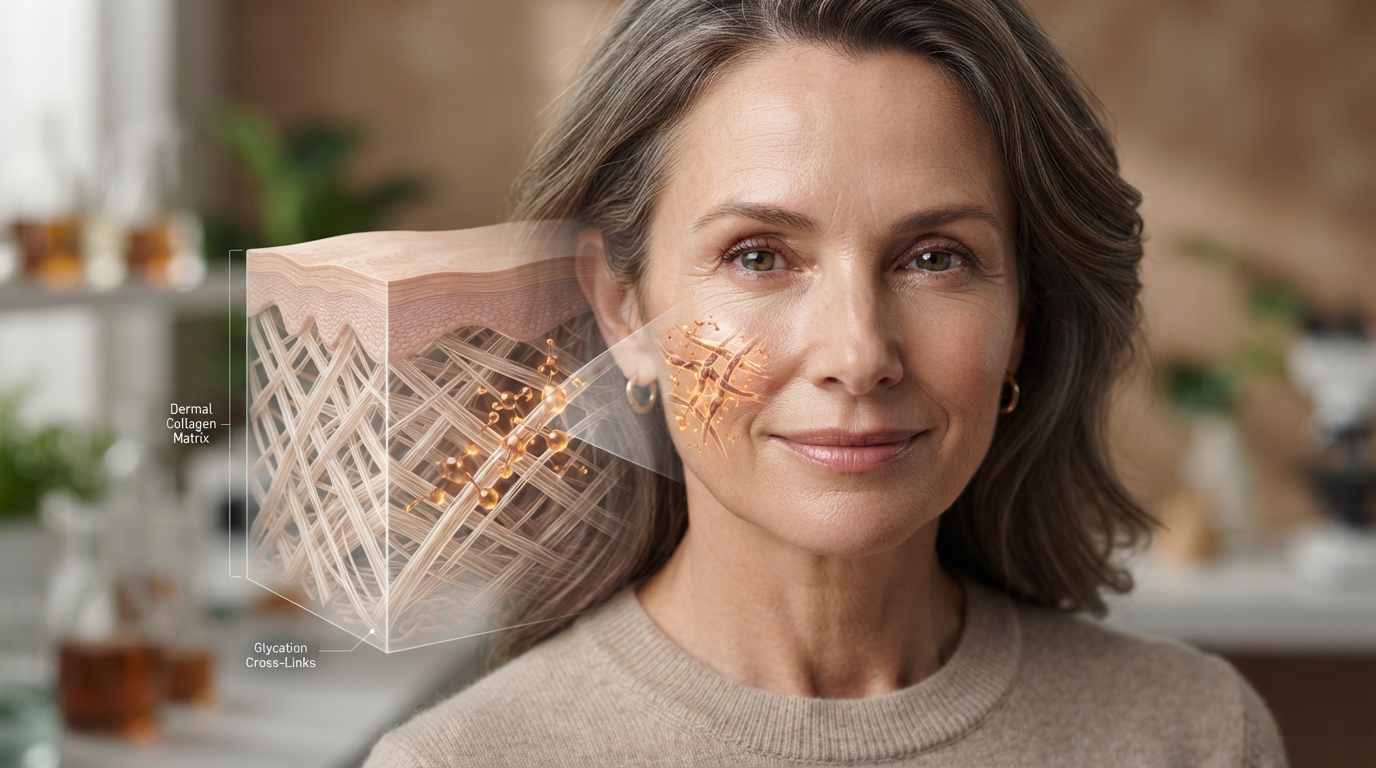
Quick answer: Advanced glycation end products, usually shortened to AGEs, are a diverse group of compounds that form when sugars or reactive carbonyl compounds modify proteins, lipids, or other biological molecules without normal enzyme control. In human skin, AGEs can accumulate in long-lived proteins such as collagen. Research links that accumulation with changes in collagen structure and mechanical properties, and human studies show that glycation increases with intrinsic aging and can be enhanced in photoaged skin. But AGEs are only one contributor to skin aging, and reducing AGE formation in a laboratory model is not the same as proving that a finished skincare product visibly reduces wrinkles or reverses aged skin.
If you have already read our guide to skin glycation, this article goes one step further.
Glycation is the process.
AGEs are some of the compounds that can emerge from that process.
And because skin contains proteins that can remain in the body for years, the relationship between AGEs and skin aging has become an important area of dermatology and aging research.
The science is interesting—but it is also easy to oversell.
AGEs do not mean that one dessert suddenly "ages" your face. They do not explain every wrinkle. And a topical ingredient that changes an AGE marker in an experimental model has not automatically been proven to make human skin look younger.
The useful question is more specific:
What do advanced glycation end products actually do in skin, and how strong is the evidence?
Table of Contents
- What are advanced glycation end products?
- How do AGEs form?
- Why is collagen vulnerable to glycation?
- Do AGEs actually accumulate in human skin?
- What is glucosepane?
- How can AGEs change collagen?
- Do AGEs make skin less elastic?
- What about wrinkles, firmness, and yellowing?
- How do glycation and sun exposure interact?
- What is RAGE?
- Does eating sugar automatically glycate your skin?
- Can you measure AGEs in skin?
- Can existing AGEs be removed?
- What does "anti-glycation skincare" actually mean?
- What does the carnosine research show?
- Is the carnosine facial-cream study a LactiGo study?
- Where LactiGo fits
- Frequently asked questions
What Are Advanced Glycation End Products?
Advanced glycation end products are not one molecule.
They are a large family of chemically modified compounds that can form through nonenzymatic reactions involving sugars, reactive carbonyl compounds, and biological molecules.
Proteins are particularly important in skin because several structural proteins remain in tissue for long periods.
Common AGE-related compounds discussed in skin and connective-tissue research include:
- CML, or Nε-carboxymethyllysine
- Pentosidine
- Glucosepane
- Other cross-links and chemically modified amino-acid residues
These compounds do not all behave the same way.
Some act as molecular cross-links.
Some serve as markers of glycation or oxidative chemistry.
Some can interact with cellular receptors.
So the phrase "AGEs damage collagen" is useful only as a broad starting point.
The chemistry underneath it is much more diverse.
Glycation Starts Before an AGE Exists
The formation of AGEs is a multistep process.
A reducing sugar can react nonenzymatically with an amino group on a protein.
Early reaction products can then undergo rearrangement, oxidation, dehydration, fragmentation, and additional chemical reactions.
Reactive compounds such as methylglyoxal can also modify proteins and contribute to AGE formation.
Over time, some of these reactions produce relatively stable advanced glycation end products.
A simplified pathway looks like this:
The pathway matters because "glycation" and "AGE" should not be used as exact synonyms.
Glycation describes the broader chemistry.
AGEs are downstream products of that chemistry.
Why Collagen Is So Important
Collagen is one of the major structural proteins of the dermis.
It helps give skin:
- Tensile strength
- Structural organization
- Mechanical resilience
Collagen is especially relevant to glycation because it turns over slowly compared with many cellular proteins.
That gives chemical modifications more time to accumulate.
Human research has shown that glycation-related changes increase in aging dermis and that long-lived extracellular-matrix proteins are important AGE targets.
This creates a basic biological problem:
The longer a structural protein remains in tissue, the longer it is exposed to the chemical environment around it.
That does not mean every collagen molecule inevitably becomes severely glycated.
It means long tissue residence time creates opportunity for gradual modification.
Do AGEs Actually Accumulate in Human Skin With Age?
Yes.
This is not only a cell-culture theory.
Human skin research has directly identified age-related increases in glycation.
In a 2001 study of intrinsic and actinic human skin aging, Jeanmaire, Danoux, and Pauly found that dermal glycation increased with intrinsic aging and was enhanced in photoaged skin. Their results indicated that glycation became increasingly evident in the adult dermis and rose with age.
A separate study examining collagen cross-links found that multiple AGE cross-links increased substantially with age in human skin.
One molecule stood out:
glucosepane.
What Is Glucosepane?
Glucosepane is an AGE-derived cross-link that can connect amino-acid residues within or between proteins.
It has attracted particular interest because human tissue research identified it as a major protein cross-link in aging extracellular matrix.
In the 2005 study by Sell and colleagues, glucosepane increased markedly with age in human skin collagen.
In nondiabetic controls, glucosepane reached approximately 2,000 pmol per milligram of collagen by age 90. Diabetes was associated with still higher levels.
This does not mean consumers need to memorize a glucosepane number.
The important principle is:
Some AGE cross-links accumulate progressively in long-lived human collagen over decades.
That provides a direct biochemical bridge between glycation chemistry and aging connective tissue.
Are All AGEs Cross-Links?
No.
This distinction gets lost frequently.
Some AGEs can form cross-links between protein molecules.
Others do not.
For example, CML is widely measured as an AGE marker but is not the same kind of collagen cross-link as glucosepane.
So when an article says:
"AGEs cross-link collagen,"
it is describing one important part of AGE biology—not every AGE molecule.
This becomes important when evaluating skincare studies.
A reduction in CML, for example, does not automatically prove that every established collagen cross-link has been removed.
How Can AGE Cross-Links Change Collagen?
Collagen fibers are not meant to behave like rigid plastic rods.
Their molecules and fibrils interact mechanically as tissue stretches, loads, and relaxes.
Additional nonenzymatic cross-links can change that behavior.
Human dermal research published in 2023 found that collagen in aged skin was rougher and mechanically stiffer or harder than collagen from younger skin, with AGEs contributing specifically to the altered mechanical properties.
This gives us a more useful description than saying:
"Sugar destroys collagen."
A better description is:
AGE accumulation can alter the physical behavior of the collagen-rich extracellular matrix.
That is scientifically meaningful without pretending the skin's entire aging process comes down to one reaction.
Does Glycated Collagen Become "Brittle"?
The word brittle appears often in consumer skincare.
It can become misleading if taken too literally.
Experimental and computational research suggests that AGE cross-linking can alter how collagen fibrils slide, deform, and dissipate mechanical energy.
However, tissue mechanics depend on:
- Cross-link type
- Cross-link density
- Collagen organization
- Hydration
- Enzymatic cross-links
- Other extracellular-matrix components
So the safest consumer-level explanation is:
AGE cross-linking can make collagen networks mechanically less flexible and can change how they respond to force.
That is more precise than suggesting dermal collagen simply "snaps."
Does That Mean AGEs Cause Wrinkles?
AGE accumulation is one contributor to the biological environment in which wrinkles and other visible age-related changes develop.
It is not the sole cause.
Visible skin aging reflects many overlapping processes, including:
- Ultraviolet exposure
- Collagen fragmentation
- Changes in collagen synthesis
- Elastin changes
- Oxidative stress
- Glycation
- Hormonal changes
- Cellular senescence
- Genetics
- Smoking and environmental exposures
- Repetitive facial movement
- Changes in subcutaneous tissues and facial structure
Researchers studying AGEs therefore describe glycation as one mechanism within a multifactorial aging process rather than a complete explanation for wrinkling.
That distinction protects readers from one of skincare marketing's most common mistakes:
finding one mechanism and presenting it as the mechanism.
Do AGEs Reduce Skin Elasticity?
There is a plausible and increasingly well-supported link between AGE accumulation and altered mechanical behavior of dermal collagen.
If collagen becomes more extensively modified and cross-linked, the matrix can become less mechanically adaptable.
Human dermal collagen research supports age-associated increases in stiffness and hardness, with AGEs contributing to those changes.
But there is an important step between:
collagen chemistry changes
and:
a consumer sees a measurable improvement in skin elasticity after using a particular product.
That second statement requires a human clinical study of the finished product.
Mechanism is not a cosmetic endpoint.
What About Skin Yellowing?
AGE-related chemistry has also been associated with changes in tissue coloration and fluorescence.
Some AGEs absorb or emit light differently than unmodified proteins.
That is part of the reason skin autofluorescence has been studied as a noninvasive way to estimate AGE accumulation.
But visible skin tone is influenced by many factors, including:
- Melanin
- Hemoglobin
- Carotenoids
- Photoaging
- Epidermal changes
- Inflammation
So "glycation makes skin yellow" is too simplistic as a universal cosmetic claim.
AGE chemistry can contribute to optical changes in tissue.
It should not be presented as the explanation for every change in complexion.
Glycation and Sun Exposure Can Interact
Intrinsic aging and photoaging are not separate universes.
Human research has found stronger glycation-related changes in sun-exposed aging skin than in intrinsically aged skin alone.
Experimental work has also examined interactions between glycation and UVA exposure, supporting the idea that glycated tissue can respond differently to ultraviolet stress.
This is why an anti-glycation skincare discussion should never imply that glycation prevention replaces sun protection.
For visible skin aging, ultraviolet exposure remains one of the most important modifiable environmental factors.
Sunscreen and sun-protective behavior address UV exposure.
They do not "remove AGEs," but they address another major pathway involved in skin aging.
What Is RAGE?
RAGE stands for the receptor for advanced glycation end products.
It is a cell-surface receptor that can interact with AGEs and several other molecular ligands.
AGE-RAGE signaling has been studied because receptor activation can influence pathways associated with:
- Oxidative stress
- Inflammation
- Cellular dysfunction
- Extracellular-matrix regulation
Experimental research in fibroblasts and other cell systems demonstrates that AGE exposure can affect cellular signaling and survival.
But RAGE should not become another marketing shortcut.
A cream that contains an antioxidant has not automatically been proven to block clinically meaningful AGE-RAGE signaling in human facial skin.
Again, the evidence level matters.
Structural Glycation and Cell Signaling Are Two Different Problems
AGEs may affect skin through more than one route.
Structural effects
Long-lived proteins such as collagen can accumulate chemical modifications and cross-links that alter the extracellular matrix.
Cellular effects
AGEs or AGE-related ligands can interact with receptors such as RAGE and influence intracellular signaling.
Those mechanisms can overlap.
But they are not identical.
This matters because an ingredient that interferes with AGE formation in a chemical assay may not necessarily alter:
- Established collagen cross-links
- RAGE signaling
- Fibroblast behavior
- Visible skin appearance
all at once.
Does Eating Sugar Automatically Glycate Your Face?
Not in the simplistic way social-media posts often suggest.
The human body is continually exposed to glucose because glucose is a normal and essential metabolic fuel.
Glycation chemistry occurs naturally over time.
The rate and extent of AGE formation are influenced by many factors.
Persistent elevations in blood glucose can accelerate glycation, which is one reason AGE accumulation has been studied extensively in diabetes. Human skin-collagen research shows substantially greater glucosepane accumulation in diabetes than in normal aging alone.
But that does not mean:
one dessert = new wrinkle
or:
fruit sugar = damaged collagen
or:
eliminating carbohydrates stops skin aging.
Those claims go well beyond the evidence.
Diet Still Matters—Just Not as a Moral Judgment
Long-term metabolic health matters to skin, as it does to the rest of the body.
A dietary pattern that contributes to persistent hyperglycemia or poor metabolic health can reasonably be discussed in relation to glycation biology.
But skincare articles should avoid turning this into guilt around individual foods.
The useful advice is familiar:
- Maintain an overall nutritious dietary pattern
- Address medically significant blood-glucose problems with qualified healthcare professionals
- Avoid smoking
- Stay physically active
- Protect skin from excessive UV exposure
The goal is metabolic and skin health.
It is not dietary perfection.
Can AGEs Come From Food?
AGEs can exist in foods, particularly foods exposed to certain high-temperature cooking processes.
However, translating dietary AGE exposure directly into a specific amount of facial skin aging is difficult.
Absorption, metabolism, renal clearance, gut physiology, overall diet, glucose control, and many other variables matter.
That is why claims such as:
"Never grill food because dietary AGEs cause wrinkles"
are much stronger than the skin-specific clinical evidence allows.
Can You Measure AGEs in Your Skin?
Researchers have several approaches.
Some studies use:
- Skin biopsy
- Chemical analysis of collagen
- Immunohistochemical markers
- Fluorescence-based methods
- Spectroscopic techniques
Skin autofluorescence has attracted interest because certain AGEs fluoresce when excited by specific wavelengths of light.
A noninvasive autofluorescence reader has been validated particularly in research involving diabetes-related AGE accumulation.
But not every AGE fluoresces.
Glucosepane, for example, is important even though fluorescence methods do not capture the entire AGE picture.
That means:
skin autofluorescence is not a complete "biological age meter."
Be Careful With Consumer "Glycation Scans"
A device can produce a number.
That does not mean the number represents every AGE in your skin or predicts exactly how quickly your face will age.
Measurement can be affected by:
- Device design
- Skin pigmentation
- Optical properties
- Anatomical site
- Which fluorescent compounds are present
A research biomarker should not automatically become a consumer diagnosis.
Can Existing AGEs Be Removed From Skin?
This is one of the biggest gaps between marketing language and evidence.
There is an important difference between:
Preventing or reducing new AGE formation
and:
Breaking established AGE cross-links that already exist in long-lived collagen
Those are not the same task.
Some experimental compounds have been investigated as potential AGE cross-link breakers, but the biology is difficult and translation to human skin outcomes remains limited.
So terms such as:
- "Deglycates skin"
- "Erases sugar damage"
- "Breaks all AGE cross-links"
- "Reverses glycated collagen"
require a much higher level of evidence than most topical skincare products possess.
Prevention Is Usually Easier to Study Than Reversal
Researchers can expose proteins, cells, reconstructed skin, or skin explants to a glycating agent and ask whether an ingredient reduces formation of a measured AGE.
That is a reasonable experiment.
But it is biologically different from asking whether the same ingredient can enter living human skin and reverse AGE cross-links that accumulated over decades.
Keep those research questions separate.
What Does "Anti-Glycation Skincare" Actually Mean?
The phrase can refer to several very different goals.
A skincare ingredient might be investigated for its ability to:
- Reduce formation of certain AGE markers
- Trap reactive carbonyl compounds
- Reduce oxidative reactions associated with glycation
- Interfere with AGE-related signaling
- Support normal extracellular-matrix biology
- Reduce visible skin changes in a clinical trial
These are different endpoints.
The strongest consumer claim depends on which one was actually measured.
Want a Dermatologist-Level Discussion of AGEs and Topical Skincare?
For readers who want to go deeper, dermatologists Dr. Patti Farris and Dr. Zoe Draelos discuss advanced glycation end products, skin aging, and what topical strategies are actually trying to accomplish.
The Anti-Glycation Evidence Ladder
When you see an "anti-glycation" claim, ask where the evidence sits.
| Evidence Level | What It Can Tell Us | What It Cannot Automatically Prove |
|---|---|---|
| Chemical assay | An ingredient interferes with a reaction in a test system | It works in human skin |
| Cell culture | Skin cells respond under laboratory conditions | A finished cream changes facial appearance |
| Reconstructed skin | A tissue model shows biological effects | Human clinical efficacy |
| Human skin explant | Human tissue responds ex vivo | Real-world delivery in living skin |
| Human delivery study | Ingredient reaches a target skin layer | It improves wrinkles or firmness |
| Human clinical trial | A finished product changes measured outcomes | Every formulation with that ingredient works |
| Replicated clinical evidence | Findings reproduce across studies | Claims beyond the measured endpoints |
This hierarchy is one of the most useful tools in skincare science.
It prevents:
"interesting mechanism"
from turning into:
"clinically proven anti-aging result."
Where Does Carnosine Enter the AGE Story?
Carnosine is scientifically interesting because its chemistry has led researchers to investigate it in carbonyl stress, glycation, and oxidative processes.
For skin specifically, one of the most relevant studies was published in 2018.
Researchers used living human skin explants and experimentally induced glycation with methylglyoxal.
They then evaluated:
- An aqueous carnosine solution
- A facial cream containing carnosine
The investigators measured two AGE-related markers:
- CML
- Pentosidine
Both carnosine approaches influenced the experimentally induced AGE markers under the conditions tested.
That is meaningful evidence.
But the exact evidence level matters.
What Did the Human Skin-Explant Study Actually Show?
The experiment used human skin tissue maintained outside the living body.
That is known as an ex vivo model.
Methylglyoxal was used to induce glycation.
The researchers then tested carnosine-containing treatments and measured AGE markers in skin layers.
The facial cream containing carnosine significantly reduced AGE-marker levels in both the epidermis and reticular dermis under the experimental conditions.
This supports the statement:
Topically applied carnosine can influence experimentally induced glycation in human skin tissue under the conditions tested.
That sentence is strong enough.
There is no need to turn it into something the study did not measure.
What the Study Did Not Prove
It did not establish that carnosine:
- Removes facial wrinkles
- Restores lost collagen
- Firms sagging skin
- Reverses decades of glucosepane accumulation
- Removes pigmentation
- Produces a visible anti-aging effect in living consumers
- Works identically in every formulation
- Reaches every dermal target in every topical vehicle
Those would require different experiments.
The distinction is particularly important because the tested product was a specific facial cream formulation, not carnosine in isolation.
Formulation influences:
- Solubility
- Stability
- Skin contact
- Penetration
- Delivery
So ingredient evidence should not be separated from formulation context.
Was the Facial-Cream Study a LactiGo Study?
No.
This needs to be completely clear.
The 2018 human skin-explant study used a facial cream containing carnosine.
It was not LactiGo.
Therefore:
Carnosine has experimental topical antiglycation research.
But:
That study is not evidence that LactiGo has been clinically demonstrated to reduce facial AGEs or visible skin aging.
Those statements can both be true.
Why Formulation Matters So Much
The skin barrier is specifically designed to limit entry of substances from the outside world.
Whether a topical ingredient reaches a particular skin layer depends on many factors, including:
- Molecular size
- Charge
- Water and lipid solubility
- Concentration
- Vehicle
- Skin hydration
- Anatomical site
- Contact time
- Penetration-enhancing ingredients
So the sentence:
"Carnosine worked in a topical skin experiment"
cannot be converted into:
"Every product containing carnosine delivers the same amount to the same skin layers."
Finished formulations matter.
This will be explored more deeply in the later article:
Why the Formulation Matters: The Same Skincare Ingredient Can Behave Differently in Different Products.
Do not link to that future article until it is live.
Is There Strong Human Clinical Evidence for Anti-Glycation Skincare?
The field is developing, but it is not as mature as the evidence for established skincare interventions such as broad-spectrum sun protection or topical retinoids.
Reviews of glycation-targeting skincare continue to describe a mix of:
- In vitro experiments
- Cell studies
- Reconstructed-skin studies
- Human explants
- Ingredient studies
- Limited clinical trials
and repeatedly note the need for stronger human validation.
That means consumers should be skeptical of products that use sophisticated glycation terminology while providing no finished-product human data.
What Should You Look for in an Anti-Glycation Skincare Claim?
Ask five questions.
1. What exactly was tested?
An isolated ingredient?
A serum?
A cream?
A supplement?
2. Where was it tested?
A test tube?
Cells?
Reconstructed skin?
Human skin explants?
Living people?
3. What was measured?
AGE fluorescence?
CML?
Pentosidine?
Skin elasticity?
Wrinkle depth?
Consumer perception?
4. Was delivery demonstrated?
An ingredient cannot affect a dermal target if it never reaches the relevant skin compartment.
5. Is the claim bigger than the endpoint?
If a study measured one biochemical marker, it does not justify five unrelated cosmetic promises.
What Actually Makes Sense for Skin Aging?
If your goal is to support healthy-looking skin over time, do not allow one emerging mechanism to distract from better-established fundamentals.
A sensible routine generally begins with:
Sun Protection
Ultraviolet exposure is a major contributor to extrinsic skin aging.
Avoiding Smoking
Smoking exposes skin and connective tissue to multiple harmful processes.
Appropriate Skincare
Depending on individual needs, evidence-based skincare may include moisturization, retinoids, antioxidants, or other dermatologist-recommended ingredients.
Metabolic Health
Persistent hyperglycemia accelerates AGE formation throughout the body.
Realistic Expectations
No skincare product makes decades of skin aging disappear.
Is Sunscreen an Anti-Glycation Product?
Not directly.
Sunscreen primarily reduces skin exposure to ultraviolet radiation.
But because UV and glycation-related processes can interact, reducing chronic UV exposure may indirectly reduce one environmental stressor that can amplify age-related skin changes.
That is different from claiming sunscreen chemically removes AGEs.
Keep the mechanism accurate.
Can Antioxidants Stop Glycation?
Oxidative chemistry and glycation can interact.
Some AGE pathways involve oxidation, and some antioxidants can influence experimental glycation systems.
But:
antioxidant
and:
antiglycation agent
are not interchangeable labels.
An antioxidant may have interesting glycation-related effects.
That effect needs to be tested rather than assumed.
Can Retinol Remove AGEs?
Retinoids have substantial evidence in photoaged skin and collagen remodeling.
That does not mean retinol is a chemical AGE-cross-link breaker.
A product can improve visible skin aging through one pathway without reversing every molecular change that has accumulated in tissue.
This is an important mindset for skincare:
You do not need one product to fix every mechanism in order for it to be useful.
Where LactiGo Fits Into This Article
LactiGo contains L-carnosine, which makes the carnosine antiglycation literature relevant to understanding the ingredient.
But this article should not present LactiGo as a facial anti-glycation treatment.
The direct evidence supporting LactiGo is focused primarily on its performance and recovery research.
The LactiGo Science page describes the brand's topical carnosine delivery and performance framework, including targeted application to muscles intended for training or recovery.
Those are brand and performance claims.
They are not evidence that LactiGo has been tested as a facial skincare product.
This distinction is important because the 2018 antiglycation study involved a different carnosine-containing facial formulation.
What We Can Responsibly Say About LactiGo and Carnosine
The evidence supports this sequence:
Carnosine has biologically interesting antiglycation properties.
↓
A carnosine-containing facial formulation reduced AGE markers in an experimental human skin-explant model.
↓
That facial formulation was not LactiGo.
↓
LactiGo contains L-carnosine and has its own product-specific performance research.
↓
Those different evidence streams should not be blended into an unsupported facial anti-aging claim.
That is a stronger scientific story than pretending every carnosine study proves every carnosine product works the same way.
Interested in the Science Behind Topical Carnosine?
Carnosine research extends from muscle physiology to glycation and skin biology, but the strongest product claims come from studies of the actual finished formulation.
LactiGo is a topical carnosine gel with direct human performance research. Explore the product, the studies, and the science behind how it is used before and after demanding activity.
Learn More About LactiGoThe Bottom Line
Advanced glycation end products are real.
They accumulate in human skin.
And some of them can alter the chemistry and mechanics of long-lived proteins such as collagen.
Human research has shown that dermal glycation increases with intrinsic aging and can be more pronounced in photoaged tissue.
Research has also identified glucosepane as a major AGE cross-link in aging human extracellular matrix, with concentrations increasing substantially in skin collagen over the lifespan.
More recent human dermal research shows that aged collagen is physically different from younger collagen and that AGEs contribute to increased stiffness and hardness.
But that does not mean:
AGEs cause every wrinkle.
It does not mean:
one sugary meal suddenly ages your face.
And it does not mean:
every ingredient that reduces AGE formation in a laboratory has been clinically proven to reverse visible skin aging.
Carnosine is a good example of why evidence levels matter.
A 2018 study found that topically applied carnosine-containing treatments reduced experimentally induced AGE markers in human skin explants.
That is legitimate and interesting human-tissue evidence.
It is not the same as a clinical trial showing that carnosine visibly reduces wrinkles in living people.
And because the facial formulation used in that experiment was not LactiGo, the results should not be presented as LactiGo-specific skincare evidence.
The most useful way to think about glycation is therefore not as another skin-aging enemy that needs to be eliminated.
Think of it as one piece of a much larger biological picture.
Protect your skin from excessive UV exposure.
Support overall metabolic health.
Use skincare ingredients for the outcomes they have actually been shown to affect.
And when evaluating "anti-glycation" marketing, always ask one question:
What did the study actually measure?
That question will tell you more than the front of the bottle.
Frequently Asked Questions
What are advanced glycation end products?
Advanced glycation end products, or AGEs, are a diverse family of compounds that can form when sugars or reactive carbonyl compounds modify proteins, lipids, or other biological molecules through nonenzymatic chemistry.
Are AGEs found in normal human skin?
Yes. Human studies have measured AGE-related compounds and cross-links in skin, and several increase with age.
Do AGEs increase as skin gets older?
Research supports age-related accumulation of AGEs in human dermal proteins. Glycation has also been reported to be enhanced in photoaged skin.
What is glucosepane?
Glucosepane is an AGE-derived protein cross-link. Human research has identified it as a major cross-link in aging extracellular matrix, including skin collagen.
Do AGEs make collagen stiff?
AGE accumulation and cross-linking can alter collagen mechanics. Human dermal research has associated AGEs with increased stiffness and hardness of aged collagen.
Do AGEs cause wrinkles?
AGEs are one contributor to skin aging, but wrinkles arise from multiple interacting processes including UV exposure, collagen remodeling, elastin changes, repetitive movement, genetics, hormonal changes, and other environmental factors.
Does eating sugar cause wrinkles?
The relationship is not that immediate. Persistent hyperglycemia can accelerate glycation, but one sugary food does not instantly glycate facial collagen or create a wrinkle.
Is skin glycation the same as oxidation?
No. Glycation and oxidation are distinct chemical processes, although they can interact.
What is RAGE?
RAGE is the receptor for advanced glycation end products. AGE-RAGE signaling has been studied for its effects on oxidative stress, inflammatory pathways, and cellular behavior.
Can sunscreen prevent AGEs?
Sunscreen reduces ultraviolet exposure. It is not an AGE remover, but UV and glycation-related processes can interact, so reducing UV exposure remains important for skin aging.
Can skincare remove existing AGE cross-links?
There is limited evidence that conventional skincare can break long-established AGE cross-links in living human dermal collagen. Preventing new AGE formation and reversing existing cross-links are different scientific goals.
Is carnosine an anti-glycation ingredient?
Carnosine has experimental antiglycation evidence. A 2018 human skin-explant study found that carnosine-containing treatments reduced experimentally induced CML and pentosidine under the tested conditions.
Does that mean carnosine removes wrinkles?
No. The study measured AGE-related markers in an experimental human skin-tissue model. It did not demonstrate wrinkle reduction in living consumers.
Was LactiGo used in the carnosine skin study?
No. The facial cream used in the 2018 human skin-explant study was not LactiGo.
Does LactiGo have anti-aging skincare research?
The evidence discussed here does not establish LactiGo as a facial anti-aging skincare treatment. LactiGo has separate product-specific research focused on exercise and performance.
References
- Jeanmaire C, Danoux L, Pauly G. Glycation during human dermal intrinsic and actinic ageing: an in vivo and in vitro model study. British Journal of Dermatology. 2001;145(1):10–18. PMID: 11453901. DOI: 10.1046/j.1365-2133.2001.04275.x. PubMed
- Sell DR, Biemel KM, Reihl O, Lederer MO, Strauch CM, Monnier VM. Glucosepane is a major protein cross-link of the senescent human extracellular matrix: relationship with diabetes. Journal of Biological Chemistry. 2005;280(13):12310–12315. PMID: 15677467. DOI: 10.1074/jbc.M500733200. PubMed
- He T, Fisher GJ, Kim AJ, Quan T. Age-related changes in dermal collagen physical properties in human skin. PLoS ONE. 2023;18:e0292791. PMID: 38064445. DOI: 10.1371/journal.pone.0292791. PubMed
- Pennacchi PC, de Almeida ME, Gomes OL, et al. Glycated reconstructed human skin as a platform to study the pathogenesis of skin aging. Tissue Engineering Part A. 2015;21(17–18):2417–2425. PMID: 26132636. DOI: 10.1089/ten.TEA.2015.0009. PubMed
- Narda M, Peno-Mazzarino L, Krutmann J, Trullas C, Granger C. Novel Facial Cream Containing Carnosine Inhibits Formation of Advanced Glycation End-Products in Human Skin. Skin Pharmacology and Physiology. 2018;31(6):324–331. PMID: 30199874. DOI: 10.1159/000492276. PubMed
- Pageon H, et al. Reaction of glycation and human skin: the effects on the skin and its components, reconstructed skin as a model. PMID: 19896301. PubMed
- Pageon H, et al. UVA exposure combined with glycation of the dermis: a compounded effect on skin aging. Human skin-model research examining interactions between glycation and ultraviolet exposure.
- Gkogkolou P, Böhm M. Advanced glycation end products: key players in skin aging? Dermato-Endocrinology. 2012;4(3):259–270. PMID: 23467327. PubMed
- Meerwaldt R, Graaff R, Oomen PHN, et al. Simple non-invasive assessment of advanced glycation endproduct accumulation. Diabetologia. 2004;47:1324–1330. PMID: 15243705. PubMed
- LactiGo. The Science Behind Transdermal Carnosine Gel. Brand product-science framing for performance/recovery positioning and pre-activity routine.