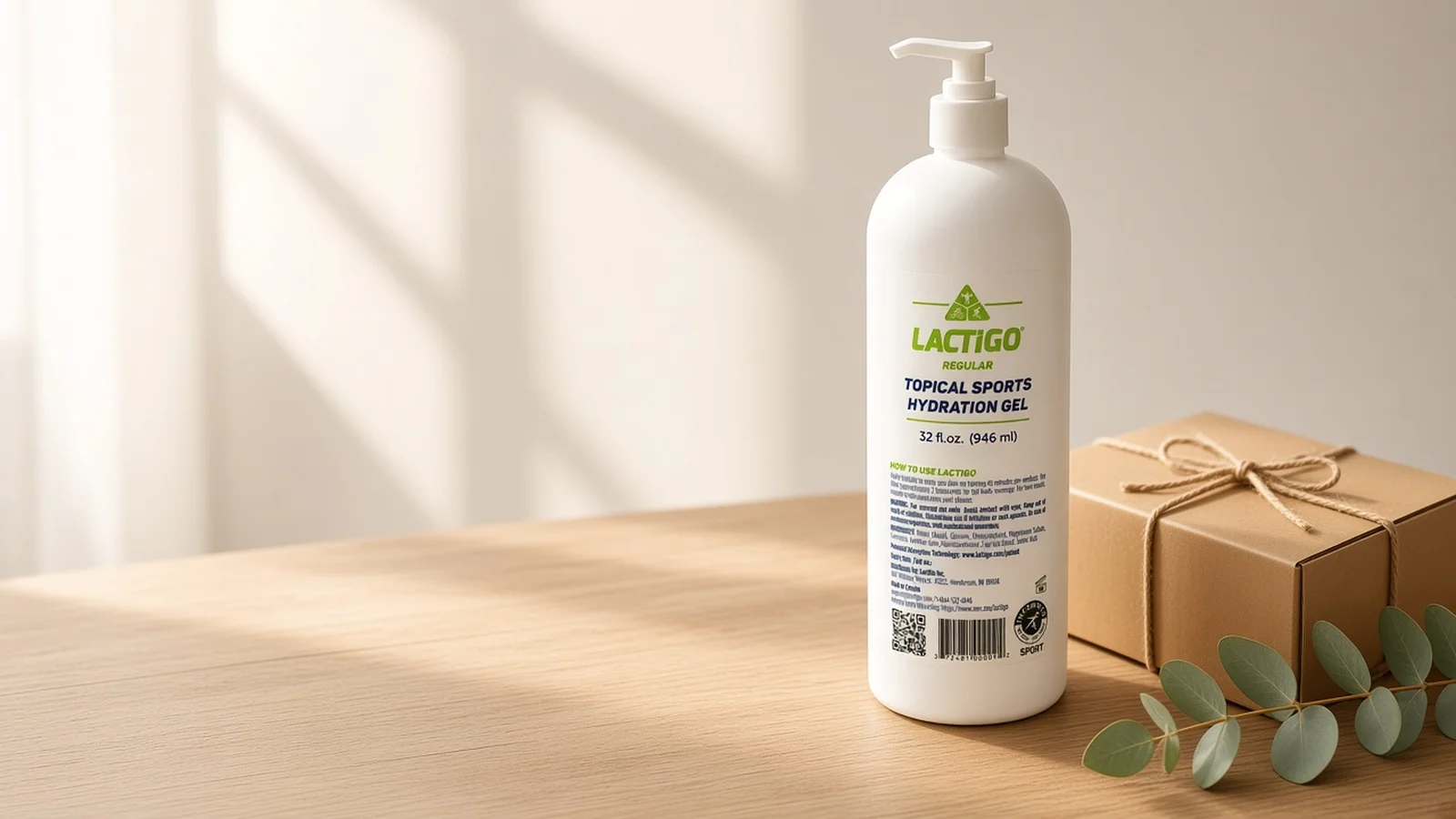
What's actually in LactiGo? And is it safe to put on your skin?
Fair questions. The answer depends on which bottle you're holding, because Regular and Menthol aren't the same product on paper. So we copied both labels word for word, then translated every ingredient into plain English.
Quick heads-up: we're an independent LactiGo affiliate. We earn a commission if you buy through our link or use code LactiGoGel. It doesn't cost you anything extra.
Two versions, two labels
Here's the part a lot of people miss. Not every LactiGo has menthol in it.
| LactiGo Regular | LactiGo with Menthol | |
|---|---|---|
| Store name | Topical Sports Hydration Gel (Regular) | Performance and Recovery Gel with Menthol |
| Type of label | Cosmetic-style label with ingredients and a warning | US OTC Drug Facts label |
| Active ingredient | None listed | Menthol 1.25% (100 mL), menthol 1.5% (946 mL pump) |
| Menthol in it? | No | Yes |
| Scent | None, per LactiGo's FAQ | Slight peppermint, per LactiGo's FAQ |
| Formats in the US store | 100 mL, 946 mL, 10 mL Go Packets | 100 mL, 946 mL |
Sources: LactiGo's product pages and FAQ, our own photo of a Regular bottle, and the two Menthol labels on DailyMed. [1,2,3,4,5]
So "LactiGo has menthol in it" is only half right. The Go Packets are the Regular formula, too. [1]
The LactiGo Regular label
Regular doesn't have a Drug Facts panel, because it has no active drug ingredient. Its back label has directions, one warning statement and an ingredient list.
The official store lists the Regular ingredients exactly like this: [1]
Aqua (Water), Glycerin, Carnosine, Magnesium Sulfate, Ethoxydiglycol, Phenoxyethanol, Xanthan Gum, Caprylyl Glycol, Sorbic Acid
Our own Regular bottle (made in Canada, distributed by LactiGo Inc. in Henderson, Nevada) prints the same nine ingredients in a slightly different order, starting with Water (Aqua), Glycerin and Ethoxydiglycol. [3]
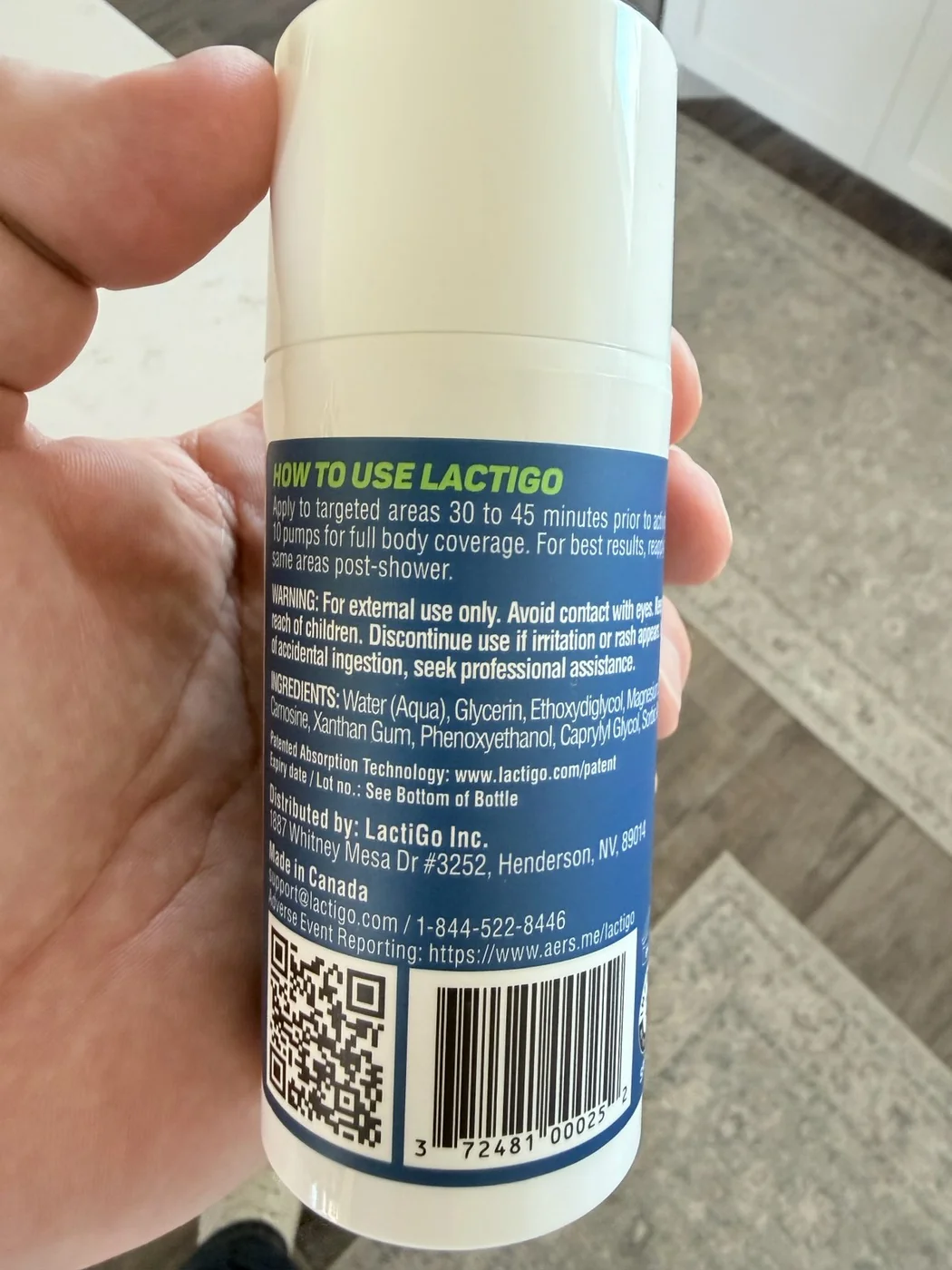
The warning on that bottle covers five things:
- For external use only.
- Avoid contact with eyes.
- Keep out of reach of children.
- Discontinue use if irritation or rash appears.
- In case of accidental ingestion, seek professional assistance.
That's it. No active ingredient, no "Uses" line and no drug claim. (LactiGo's older FAQ lists a shorter non-menthol formula without caprylyl glycol and sorbic acid, and says there may be minor differences depending on territory. Read the bottle you actually get.) [2]
The LactiGo with Menthol Drug Facts label
The Menthol version is a different story. In the US it's sold as an over-the-counter topical analgesic, so it carries the standard Drug Facts panel. Here's the 100 mL label as filed on DailyMed (NDC 72481-101): [4]
| Drug Facts section | What the 100 mL label says |
|---|---|
| Active ingredient | Menthol 1.25% |
| Purpose | Topical analgesic |
| Use | For the temporary relief of minor aches and pains of muscles and joints. |
| Warnings | For external use only. Avoid contact with eyes and mucous membranes. Stop and see a doctor if the condition worsens, or if symptoms last more than 7 days or clear up and come back within a few days. Do not apply to wounds or damaged skin. Do not bandage tightly. |
| Keep out of reach of children | To avoid accidental ingestion. If swallowed, get medical help or contact a Poison Control Center immediately. |
| Directions | Adults and children 2 years of age and older: apply to affected area not more than 3 to 4 times daily. Children under 2 years of age: consult a doctor. |
| Other information | Store at 15°C to 30°C (59°F to 86°F). |
| Inactive ingredients | Ethoxydiglycol, glycerine, L-carnosine, magnesium sulfate, phenoxyethanol, water, xanthan gum |
| Questions? | 1-844-522-8446 |
The store page lists the same formula as "Menthol 1.25%, Ethoxdiglycol, Glycerine, L-Carnosine, Magnesium Sulphate, Phenoxyethanol, Water, Xanthan Gum" (their spelling). [1]
The big 946 mL Menthol pump has its own, newer label (NDC 72481-102, March 2026). It lists menthol 1.5% and a longer set of warnings. It adds don't use with a heating pad, avoid applying into skin folds, wash your hands after each use, and ask a health professional first if you're pregnant or breast-feeding. It also says don't use on children under 2. [5] Check the strength printed on your bottle.
Notice carnosine and magnesium sulfate are listed as inactive? That's not LactiGo hiding anything. The FDA monograph this label follows covers menthol, not carnosine, so only menthol goes in the "Active" box. [4,6]
Every ingredient in plain English
Ten ingredients show up across the two versions. Here's what each one is and the usual reason it's in a gel like this.
| Ingredient | Regular | Menthol | What it is, in plain English |
|---|---|---|---|
| Menthol | No | Yes (active) | The compound that gives mint its cool feel. It switches on the skin's cold-sensing receptor (TRPM8), which is why menthol products feel cool. [7] |
| L-carnosine (carnosine) | Yes | Yes (inactive) | A small molecule made of two amino acids, beta-alanine and histidine. Your body makes it and stores most of it in muscle. LactiGo says its carnosine comes from corn-derived raw materials. [2] |
| Magnesium sulfate | Yes | Yes (inactive) | The same compound as Epsom salt. LactiGo's FAQ confirms this is the form of magnesium it uses. [2] |
| Water (aqua) | Yes | Yes | The base of the gel. |
| Glycerin (glycerine) | Yes | Yes | A humectant (it holds water). It's in a huge number of lotions and soaps. |
| Ethoxydiglycol | Yes | Yes | A solvent (chemical name diethylene glycol monoethyl ether) that keeps the other ingredients dissolved. It's common in skin products. The Cosmetic Ingredient Review panel concluded it's safe as used in cosmetics. [8] |
| Xanthan gum | Yes | Yes | A thickener made by fermenting sugar. It's what turns water into a gel. |
| Phenoxyethanol | Yes | Yes | A preservative that keeps bacteria and mold out of the bottle. The Cosmetic Ingredient Review panel found it safe at the levels used in cosmetics, generally under 1%. [9] |
| Caprylyl glycol | Yes | No | A conditioning ingredient that also helps the preservative system. |
| Sorbic acid | Yes | No | A preservative, also used in many foods. |
So is LactiGo "all natural"? We wouldn't call it that. Some ingredients occur in nature (water, carnosine, menthol). Others, like phenoxyethanol and ethoxydiglycol, are made in a lab. Preservatives are normal in any water-based gel that has to last on a shelf. Meaning... the honest description is "short ingredient list," not "all natural."
What about the carnosine?
Carnosine is the reason most people are curious about LactiGo, so here's the careful version. Raising muscle carnosine with oral beta-alanine is well studied. Whether a gel raises muscle carnosine in people hasn't been measured yet. The one absorption study we know of was in horses. [10] The small human trials of carnosine gel are split, two positive and two showing no difference from placebo. We break those down in our LactiGo reviews and in what is carnosine?.
LactiGo side effects: what the labels warn about
Neither label lists specific side effects or how often they happen. What the labels do give you is a list of warnings, and those are the closest thing to an official answer.
Both versions
- For external use only. Don't swallow it.
- Keep it out of your eyes. Menthol adds mucous membranes (inside your nose and mouth).
- Keep it out of reach of children.
- Stop if your skin reacts. Regular says to discontinue use if irritation or rash appears.
LactiGo with Menthol adds [4,5]
- Don't apply to wounds or damaged or irritated skin.
- Don't bandage tightly over it, and don't use it with a heating pad (946 mL label).
- Avoid skin folds, and wash your hands after each use (946 mL label).
- Stop and ask a doctor if the condition worsens or lasts more than 7 days, or if you get redness, excessive irritation, severe burning, swelling or blistering where you applied it (the last group is on the 946 mL label).
- Pregnant or breast-feeding? Ask a health professional first (946 mL label).
- Children under 2: ask a doctor (100 mL label) or don't use (946 mL label).
A note on menthol: on the Menthol version, a cool feeling is the menthol doing what menthol does. Burning, swelling or blistering is not. Wash it off and stop.
Had a reaction? Wash the area with soap and water. Call LactiGo support at 1-844-522-8446 (the number on both labels) to report it. Our Regular bottle also prints an adverse event reporting address, aers.me/lactigo. [3,4] If your reaction is severe, call a doctor first.
How to patch-test LactiGo
LactiGo's labels don't tell you to patch-test, and plenty of people skip it. But if you have sensitive skin, it's an easy habit. The American Academy of Dermatology suggests this for any new skin product: [11]
- Pick a quarter-sized spot where it won't get rubbed or washed off, like the inside of your forearm or the bend of your elbow.
- Apply the normal amount, twice a day, for 7 to 10 days.
- Watch for redness, itching or swelling.
- If your skin reacts, wash the product off and don't use it again. No reaction after 7 to 10 days? You're clear to use it as directed.
Sensitive to menthol, or to mint scents? Start with Regular. It has no menthol in it.
Why people ask what's in it
Is LactiGo safe?
Short answer? For most adults who follow the label, the warnings are the standard ones for a skin gel or a cooling rub. But no product is safe for everyone, and we're not going to pretend otherwise.
- The ingredients are common ones. Glycerin, xanthan gum, phenoxyethanol and ethoxydiglycol show up in lots of skin-care products, and the Cosmetic Ingredient Review panel has assessed the last two. [8,9]
- Menthol is the one real difference. It's why the Menthol labels carry the longer list of warnings. If you're sensitive to it, Regular has none.
- Check first if you're pregnant or breast-feeding, buying for a young child, or have a skin condition. LactiGo's FAQ also recommends parental guidance for anyone under 18. [2]
What about "FDA approved"? Here's the accurate version. LactiGo with Menthol is an OTC drug marketed under an FDA monograph (M017). Those products don't need product-by-product FDA approval if they follow the monograph's rules. [4,6] LactiGo Regular is sold as a cosmetic-style gel, and cosmetics (apart from color additives) don't need FDA approval before they're sold. [12] Neither one is a dietary supplement. So "FDA approved" isn't accurate for either bottle. Be wary of any seller who says it is.
Drug-tested athlete? That's a different question from skin safety. See is LactiGo banned? for how to check your batch on Informed Sport.
Regular or Menthol?
Same base, one ingredient apart. Pick by feel and by label, not by promises.
| If you... | Look at |
|---|---|
| Want no scent and no cooling feel | Regular |
| Like a cooling, minty feel | Menthol |
| Have sensitive skin or dislike menthol | Regular, and patch-test first |
| Want a product with a Drug Facts label | Menthol |
| Want single-use packets for a gym bag or travel | Regular Go Packets |
| Share a locker room and don't want to smell like mint | Regular |
Neither choice comes with a promised result. Our Regular vs Menthol guide goes deeper, and how to use LactiGo covers timing and amounts.
Where to buy LactiGo
If it were us, we'd buy from the official LactiGo store. It's the only seller LactiGo's refund policy covers, and you can trace the batch. Choose your country in the store's menu before you add anything to your cart.
Australia is ordering information only. LactiGo isn't TGA approved, so we don't make any claims about it there. Choose the Australian storefront and confirm delivery details before you pay. Is your country missing from the menu? LactiGo is coming soon there, with no date announced. Our where to buy LactiGo guide covers each storefront.
Frequently Asked Questions
What are LactiGo's ingredients?
It depends on the version. LactiGo Regular lists water, glycerin, carnosine, magnesium sulfate, ethoxydiglycol, phenoxyethanol, xanthan gum, caprylyl glycol and sorbic acid, with no active ingredient. LactiGo with Menthol lists menthol 1.25% as active, plus ethoxydiglycol, glycerine, L-carnosine, magnesium sulfate, phenoxyethanol, water and xanthan gum.
Does every LactiGo contain menthol?
No. Regular and the Go Packets have no menthol and no scent. Only LactiGo with Menthol lists it: 1.25% in the 100 mL bottle and 1.5% in the 946 mL pump.
Does LactiGo have side effects?
Neither label lists specific side effects. Both say external use only, avoid the eyes and stop if your skin reacts. The Menthol labels add stop and ask a doctor if you get redness, excessive irritation, severe burning, swelling or blistering.
Is LactiGo safe?
For most adults who follow the label, the warnings are standard for a skin gel or cooling rub. Skip broken skin and tight bandages, and patch-test if your skin is sensitive. Pregnant, breast-feeding or buying for a young child? Ask a health professional first.
Is LactiGo FDA approved?
Neither version has product-specific FDA approval. The Menthol version is an OTC drug marketed under an FDA monograph, which doesn't require one. Regular is sold as a cosmetic-style gel, and cosmetics don't need FDA approval before sale.
Why is carnosine listed as an inactive ingredient?
The FDA monograph the Menthol label follows covers menthol, not carnosine, so menthol is the only active ingredient. Carnosine and magnesium sulfate are still in the formula.
Is LactiGo all natural?
We wouldn't call it that. Water, menthol and carnosine occur in nature (LactiGo says its carnosine is made from corn-derived raw materials). Phenoxyethanol and ethoxydiglycol are lab-made.
Can I use LactiGo if I have sensitive skin?
Start with Regular, which has no menthol, and patch-test it on your inner forearm for 7 to 10 days. If you have a skin condition, ask a doctor or pharmacist first.
References
1. LactiGo. Product pages for Topical Sports Hydration Gel (Regular) 100 mL, Performance and Recovery Gel with Menthol 100 mL and Go Packets 10 mL, ingredient lists. Official store. Saved November 6, 2026. Store link appears once above.
2. LactiGo. Customer help FAQ (scent of each version, ingredient lists, "minor differences depending on territory", corn-derived L-carnosine, magnesium sulphate, parental guidance under 18). Official store FAQ page. Saved November 6, 2026.
3. Carnosine Gel. Our own photo of a LactiGo Regular 100 mL back label (directions, warning, ingredients, distributor, adverse event reporting).
4. DailyMed. LACTIGO (menthol) gel 1.25%, NDC 72481-101, label updated September 3, 2024. Accessed November 9, 2026.
5. DailyMed. LACTIGO (menthol) gel 1.5%, NDC 72481-102, label updated March 25, 2026. Accessed November 9, 2026.
6. US Food and Drug Administration. OTC Drug Review Process, OTC Drug Monographs. Accessed November 9, 2026.
7. Bautista DM, Siemens J, Glazer JM, et al. The menthol receptor TRPM8 is the principal detector of environmental cold. Nature. 2007;448:204-208.
8. Cosmetic Ingredient Review. Final report on the safety assessment of butylene glycol, hexylene glycol, ethoxydiglycol, and dipropylene glycol. J Am Coll Toxicol. 1985. Reaffirmed 2004.
9. Cosmetic Ingredient Review. Final report on the safety assessment of phenoxyethanol. J Am Coll Toxicol. 1990;9(2):259-277.
10. Dieter BP, et al. Transdermal delivery of carnosine into equine skeletal muscle. Comp Exerc Physiol. 2021;17(5):429-434. doi:10.3920/CEP200077
11. American Academy of Dermatology. How to test skin care products. Accessed November 9, 2026.
12. US Food and Drug Administration. FDA authority over cosmetics: how cosmetics are not FDA-approved, but are FDA-regulated. Accessed November 9, 2026.